Key Takeaways
- Think of a chatbot that has to check a rulebook before it’s allowed to do anything. If an answer breaks one of your policies, it never reaches your customer.
- The model does the reading. Give it a phone photo of a crumpled receipt, and it’ll still find the total. Whether that receipt gets paid is up to the rules.
- Payment apps and insurance claim tools get the most out of it, because one wrong answer there can cost money or cause legal trouble.
- There’s more work up front than with a plain chatbot. Somebody has to turn your policies into written rules, and those rules need a refresh each time the business changes.
- If you’re early stage, you can likely hold off. Launch something basic, and bring in rule checks once its mistakes start costing you money.
Neurosymbolic AI is software that lets a ChatGPT-style model and your written business rules work together. The model was trained on a huge number of examples. That’s why it can read a messy email or a scanned form, which older rule-based programs struggle with. The rules then check its answer before your product acts on it.
If you’re planning a product with a chatbot inside it, you’ve probably seen one give a confident answer that was flat wrong. In a demo, that’s a little embarrassing. In an app that moves money or stores medical records, it can cost you a customer or a regulator’s trust. Big cloud companies now sell fixes for this. Amazon is one of them. In August 2025, AWS rolled out Automated Reasoning checks on its Bedrock platform. Amazon claims it can pick out correct answers with up to 99% accuracy. A language model drafts the reply, and a logic engine then holds it up against the rules you’ve set.
Table of Contents
- What Does Neurosymbolic AI Mean in Everyday Terms?
- Why Isn’t a Chatbot on Its Own Good Enough?
- What Happens Inside a Neurosymbolic AI App?
- Is Neurosymbolic AI Better Than a Chatbot or RAG?
- Where Is Neurosymbolic AI Used Today?
- Which Startup Products Are a Good Fit for Neurosymbolic AI?
- What Are the Drawbacks of Neurosymbolic AI?
- Should Your Startup Use Neurosymbolic AI Yet?
- How Would You Add Neurosymbolic AI to an App You Already Have?
- Why Work With iTechnolabs on Your Next Product?
- Conclusion
- FAQ’s About Neurosymbolic AI
What Does Neurosymbolic AI Mean in Everyday Terms?
Two programs split the work here. One has learned from examples and handles the reading. A second program, one that sticks strictly to rules, gets the last word.
Imagine a new hire who’s quick and smart but only a few weeks into the job. Give them a messy email or a blurry receipt and they’ll read it in seconds. Because they’re new, though, they’ll sometimes guess at a missing detail and say it as if they knew for sure. So you sit them next to a manager who knows the policy binder cold. That manager couldn’t read a scribbled receipt to save their life, but they’ve never once broken a rule. Neurosymbolic software gives you both of these people inside one product.
The name is just those two halves stuck together, and some people spell it with a hyphen, as neuro-symbolic AI. “Neuro” comes from neural networks. They’re the technology behind ChatGPT and Gemini, and they learn by soaking up huge piles of examples. “Symbolic” is the older way of doing things. Someone writes a rule down in plain words, for example “Refunds over $500 need a manager’s OK.” From then on, the computer sticks to it every time.
| Neural (the part that learns) | Symbolic (the part with rules) | |
| Strong at | Making sense of messy writing and photos | Following every rule to the letter, and showing its working |
| Weak at | Makes things up now and then, and often can’t tell you why | Can’t cope with messy input, and a person has to write each rule |
| Example | Reading a phone photo of an invoice | Making sure the invoice total matches the purchase order |
Why Isn’t a Chatbot on Its Own Good Enough?
A chatbot picks the answer that sounds most likely and moves on, with nothing inside it checking the result. Old-school rule software is the reverse. It checks everything, but hand it something messy and it gives up.
Under ChatGPT sits what’s called a large language model, or LLM. It writes by guessing the next word, then the next, based on the mountain of text it read while it was being trained. Most of the time it lands on the right answer. When it doesn’t, it sounds every bit as sure of itself. That’s what people mean by a hallucination: a confident reply that happens to be wrong.
There’s only so much you can fix from inside the model. Type in the exact same question on Monday and again on Tuesday, and the replies may not match. Nobody can see exactly how it reached a given reply, so engineers call it a “black box.” And a prompt like “never approve refunds above $500” gets followed most of the time, which isn’t the same as every time.
Rule-based software has the opposite problem. This kind of software dates back to the 1950s, when experts typed out every rule themselves. It’ll never bend a rule. Real paperwork is a mess, though. A rule system expects the total in the same spot on every invoice. Show it a crumpled receipt photographed sideways and it’s lost.
What Happens Inside a Neurosymbolic AI App?
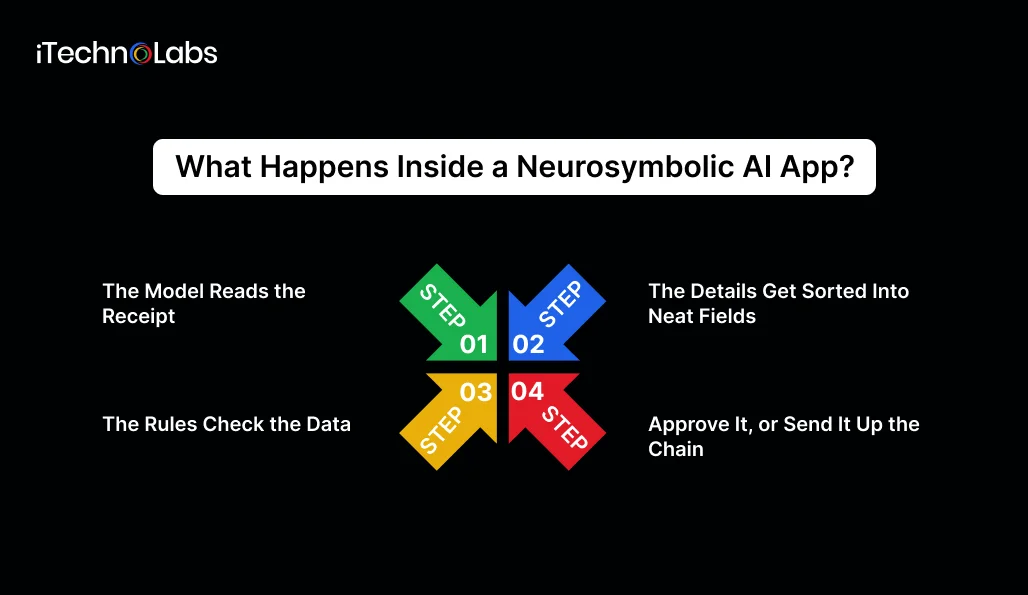
The model reads and the rules decide. Your product only acts on answers that pass.
Picture an expense app built for small businesses. An employee takes a picture of a receipt on their phone, and the app has to decide whether they get paid back.
Step 1: The Model Reads the Receipt
This one’s from a team dinner. The paper is creased, and the restaurant prints its bills in its own odd layout. The model reads it anyway and pulls out the restaurant’s name, the date, the total and the tip.
Step 2: The Details Get Sorted Into Neat Fields
The model then lists what it found in plain fields, things like merchant, date, amount and category. Messy photo in, tidy facts out. That’s the handoff, because a rule engine can’t do anything with a photo but it can work with a list.
Step 3: The Rules Check the Data
Now your policy runs against those facts. In this example, meals must be under $75 per person and receipts older than 60 days aren’t paid. Drinks with alcohol aren’t covered at all. The app marks each check as a pass or a fail and keeps a note of every result.
Step 4: Approve It, or Send It Up the Chain
If every rule passes, the claim gets approved. If one fails, it goes to a manager with the reason attached, such as “total is $112, limit is $75.” At no point can the model sign off on something your rules say no to.
Keeping those notes pays off down the line. Say an employee is annoyed that their claim got rejected, or an investor wants to know how the app decides. You can pull up the exact rule that made the call, which is more than a plain chatbot could ever show you.
Is Neurosymbolic AI Better Than a Chatbot or RAG?
Most founders adding smart features end up picking from four setups. The main thing that sets them apart is whether anything checks an answer before it reaches a customer.
| Option | What it does | Where it falls short | Works well for |
| A chatbot on its own | Answers with whatever sounds most likely | Can make things up, and nothing checks it | First drafts and support replies a person reads before sending |
| Rule-based software | Runs if-then rules someone wrote | Can’t handle messy or unusual input | Forms, calculators and fixed processes |
| RAG (retrieval-augmented generation) | Looks through your documents, then answers using what it found | May still misread or skip what it found | Help centers and “ask our docs” search |
| Neurosymbolic AI | Lets a model read and suggest, then has a rule engine check the answer before anything happens | More setup, and the rules need updating | Payments, claims, compliance, anything with strict rules |
People often confuse RAG with neurosymbolic AI. RAG passes the model the right page from your files before it answers. That cuts down on invented facts. It can still misread that page, though. And nothing compares its final answer with your rules. Plenty of neurosymbolic products use RAG for the reading step and put the rule check on top. Our team builds RAG systems and LLM features as part of our generative AI development services.
Where Is Neurosymbolic AI Used Today?
People were working on this long before ChatGPT came along. Now you’ll see it in university labs, and also in cloud services any business can pay for.
The famous one is AlphaGo. DeepMind built it to play the board game Go, and it went on to beat some of the best human players. Its neural networks sized up each board position, while a search method looked ahead at possible moves. A 2025 research survey on neurosymbolic AI holds it up as a classic case of neural networks helping a symbolic system.
AWS Automated Reasoning checks is a more down-to-earth example. You start by typing your company’s rules into a policy, such as how much paid leave staff get. Each time a language model answers a question, the tool tests that answer against the policy with formal logic. Anything that breaks a rule gets flagged. Customers have had access since August 2025.
Another route is hooking an LLM up to a knowledge graph. That’s a map of facts about your business, like which customer bought which product. The model answers using those facts, and if it says something that clashes with them, the graph catches it. Several enterprise data companies sell tools built this way.
Which Startup Products Are a Good Fit for Neurosymbolic AI?
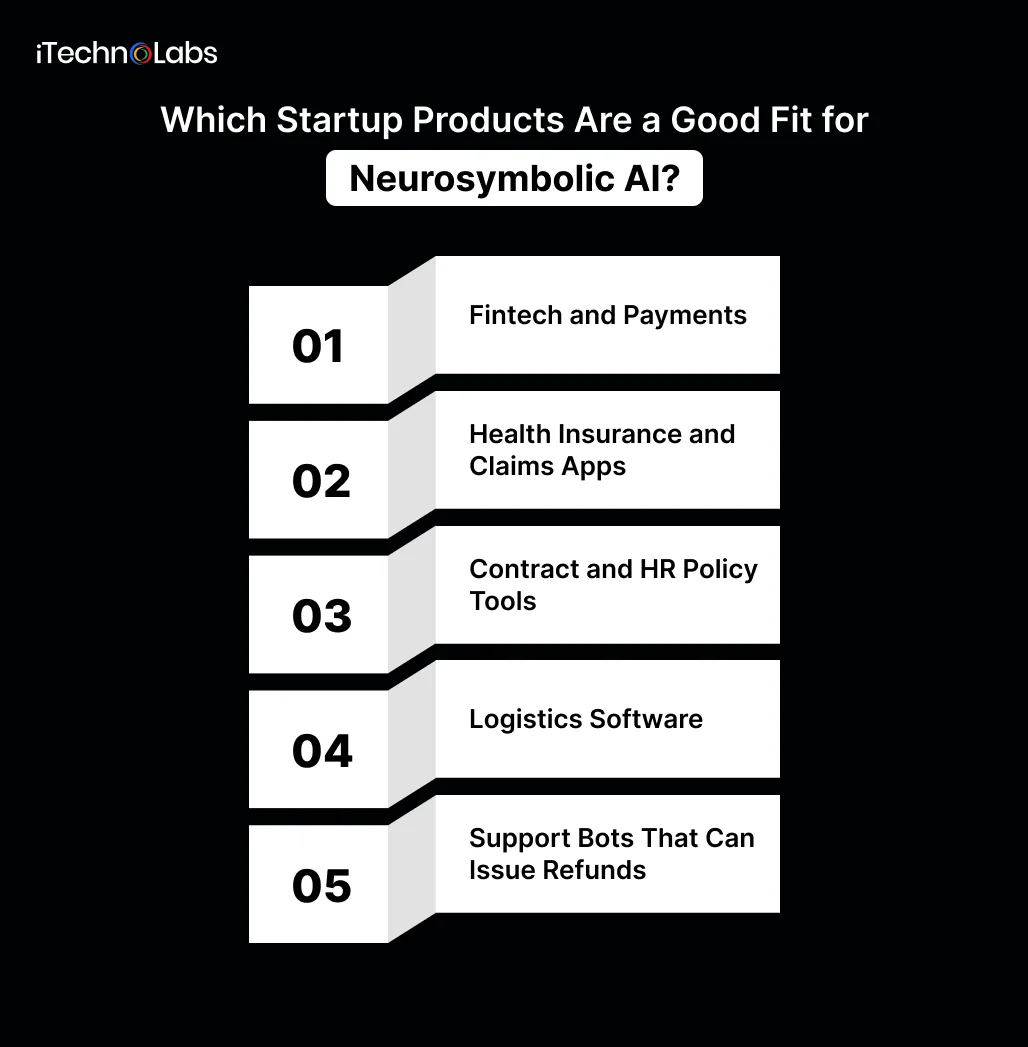
If a single bad answer could lose you money or get you into legal hot water, it’s a candidate. Some categories come up far more than others.
Fintech and Payments
Money apps already run on rules about who can borrow and when a refund is allowed. Let the model read the bank statements and ID papers. Then, before a single dollar leaves, the rules check the payout against your limits and sign-off steps. They’ll also stop the same payment from going out twice.
Health Insurance and Claims Apps
Insurance claims live or die on a policy’s fine print. Here, the model’s job is reading the doctor’s note or the claim form. Then the rules hold it up against the plan’s coverage terms, and every decision gets saved in case an auditor asks about it later.
Contract and HR Policy Tools
A contract is a set of rules buried in long paragraphs, and so is a staff handbook. The model digs out the clauses that matter. Then the rules check those clauses against what your company is willing to accept.
Logistics Software
Freight companies deal with paperwork that never looks the same twice. One carrier emails a clean PDF, the next hands over a smudged slip. The model can read both. After that, the rules match each delivery to the right order and the rate in your contract.
Support Bots That Can Issue Refunds
A help bot that only answers questions is fairly low risk. It’s a different story once the bot can hand back money or move someone’s booking. At that point, each of those actions should clear your rules before it happens.
What Are the Drawbacks of Neurosymbolic AI?
For rule-heavy work, it’s the more reliable option. You pay for that in build time and upkeep, so know what you’re signing up for.
Who writes the rules? Usually the person who knows the business best, and in a startup that’s often you. Your team carries most rules in their heads. Getting them into precise logic takes your time plus an engineer’s.
Rules don’t stay right forever, either. Your prices go up, or a new regulation comes in, and somebody has to go back and edit the rule side. If nobody does, the system will start rejecting claims it should pay and approving ones it shouldn’t.
It’ll also cost more than adding a plain chatbot. There are two systems to build and connect, and the extra check can slow responses a little.
A wrong rule is its own risk. The system follows it perfectly, so it’s wrong every single time.
And it can still be fooled. The model may misread a document before the rules ever see it. Researchers have also found that some neurosymbolic models learn to satisfy the rules for the wrong reasons, a problem they call reasoning shortcuts.
Last, fewer engineers have built these systems. So when you talk to development partners, ask them to explain their plan for the rule layer. Ask, too, what the app does when a check fails. A vague answer is a warning sign.
Should Your Startup Use Neurosymbolic AI Yet?
Plenty of early products can do without it for a while. Check where yours lands on these two lists.
You probably need it now if:
- your product moves money or makes decisions a regulator cares about
- one wrong answer could cost a customer more than a few dollars
- you have to explain each decision to auditors or investors
- your rules are clear enough to write down, like spending limits or who signs off on what
- your chatbot feature has already made confident mistakes in testing
You can probably wait if:
- you’re still testing whether anyone wants the product
- a person reviews every answer before a customer sees it
- the model mostly drafts content or summarizes notes
- you’re still changing your rules every week while you work out the business
My advice for most founders: get a simple version out during MVP development, then add rule checks only in the places it trips up.
How Would You Add Neurosymbolic AI to an App You Already Have?
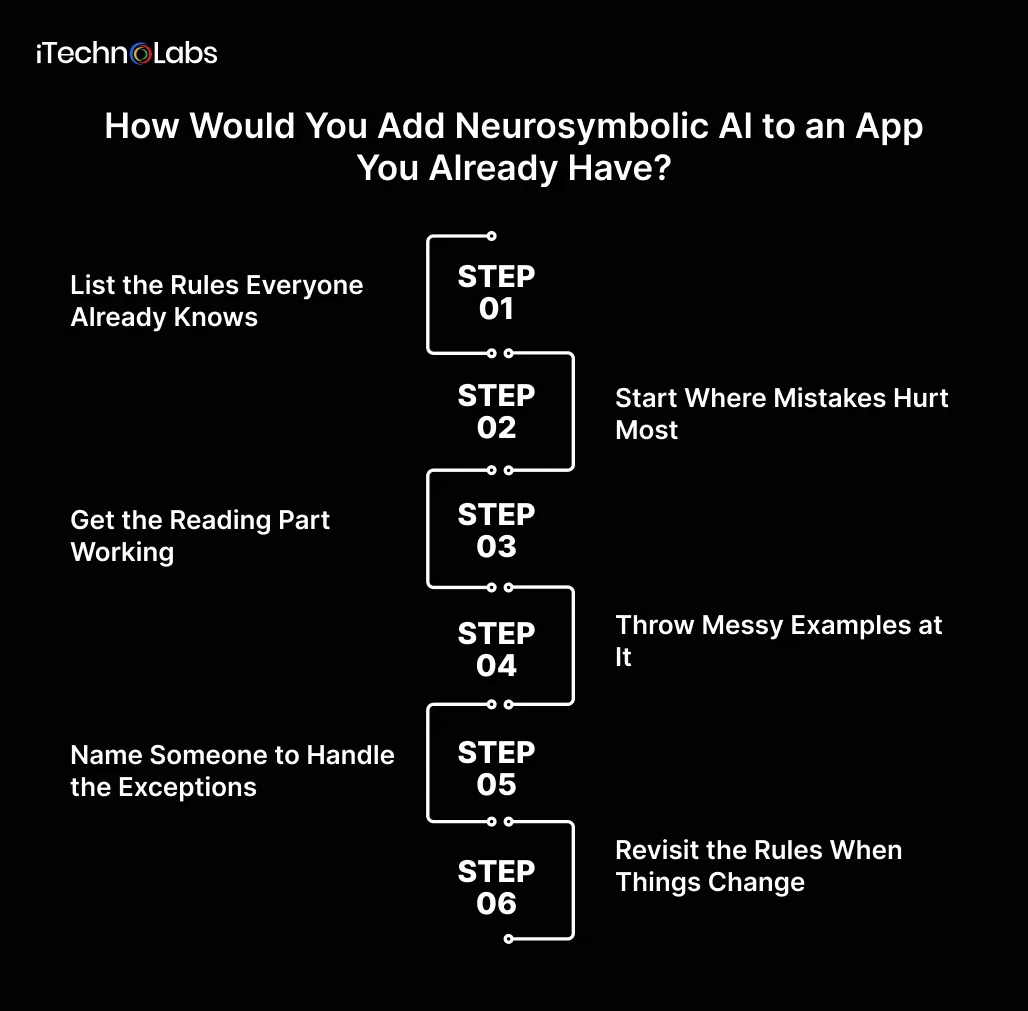
You won’t have to start over. A rule layer usually goes in bit by bit, and the decisions that would do the most damage if they went wrong get it first.
Step 1: List the Rules Everyone Already Knows
Every team has rules nobody ever wrote down, such as spending caps or who approves what. Get them into a doc. Write them the way you’d explain them to a new hire, and an engineer can convert them into logic later.
Step 2: Start Where Mistakes Hurt Most
Put anything that sends money out or has legal weight at the top. If a meeting summary comes out a little wrong, nobody gets hurt, so that can wait.
Step 3: Get the Reading Part Working
Point the model at your real documents and get that part working. After that, slot the rule check in between what the model says and what your product does.
Step 4: Throw Messy Examples at It
Use the blurry photos and half-filled forms your team already deals with, plus any weird one-offs you remember. Tidy sample data won’t show you the problems that turn up after launch.
Step 5: Name Someone to Handle the Exceptions
When a check fails, a person has to look at it. Set up one queue for flagged items and make one person responsible for it. Otherwise they pile up.
Step 6: Revisit the Rules When Things Change
New prices or a new company policy mean the rules need a look too. Put that review on the same checklist you use for any other product update.
Building this without a technical co-founder? An iTechnolabs fractional CTO can map out the setup with you before any development money gets spent.
Why Work With iTechnolabs on Your Next Product?
We build software for startups and growing businesses, and we’re certified for both security and quality.
iTechnolabs has delivered 500+ apps used by 50,000+ end users. Our 300+ developers work out of offices in Markham, Calgary, Ottawa and Sheridan, Wyoming. As an AI development company, we build LLM integrations, agents and RAG systems, the parts a rule layer sits on top of.
Two certifications back up how we work. ISO 27001:2013 covers how we keep information secure, and ISO 9001:2015 covers our quality process. Put simply, there’s a written process for how we handle your data and code. That starts to matter once your product deals with payments or personal records.
When we scope a product with you, we talk through the trade-offs in plain English. A rule check is sometimes worth the money. Other times a simpler setup does the job, and we’ll tell you when that’s the case.
Conclusion
Neurosymbolic AI gives a model that reads like a person a rule engine to check its work. Your customers can send in whatever messy input they like, and the model will make sense of it. The rules then make sure your product only acts on answers that fit your policy, and they keep a record of each decision.
Not every feature needs this. When a person already reviews the output, or very little is at stake, a plain LLM or a RAG setup usually covers it. That changes once your product starts moving money or handling regulated data. A confident wrong answer becomes a real business risk then, and a rule layer is the most direct way to rein it in.
So start small. Ship a simple version and add rule checks where it slips. Write your rules down early, even in plain sentences, since that list becomes the starting point for the rule side. When you’re ready to plan the build, our AI cost calculator will give you a first estimate to bring to an engineer.
FAQ’s About Neurosymbolic AI
Is ChatGPT Neurosymbolic AI?
No. ChatGPT runs on a large language model, a neural network trained to predict text, so it only has the learning half. There’s no built-in rule engine checking each answer against fixed logic. That’s why it can give you a right answer and a wrong one in exactly the same confident tone.
Does Neurosymbolic AI Stop Mistakes Completely?
No. It cuts down one kind of mistake, an answer that breaks your written rules, and blocks it before your product acts. It can’t catch errors your rules don’t cover. And if the model misreads a document, the rules end up checking the wrong facts. You’ll still need testing and a person on edge cases.
Is Neurosymbolic AI the Same as Hybrid AI?
Not exactly. Hybrid AI covers any mix of methods. Neurosymbolic AI is one specific mix, joining neural networks that learn from examples with symbolic systems that follow explicit rules. So all neurosymbolic AI counts as hybrid, but plenty of hybrid setups aren’t neurosymbolic at all.
What Is a Simple Example of Symbolic Reasoning?
A refund policy works well. If the order is under 30 days old and the item is unused, approve the refund. If not, send it to a person. The rule is written down and works the same way every time, so you can see exactly why each refund was approved or declined.
How Is Neurosymbolic AI Different From RAG?
RAG checks your documents before answering, while neurosymbolic AI checks the answer against your rules. RAG, short for retrieval-augmented generation, cuts down on made-up facts, but nothing stops the model from misreading what it found. Many neurosymbolic products use RAG for the reading step and a rule engine for the final decision.
Do I Need a Technical Co-Founder to Build Neurosymbolic AI?
Not necessarily. You need someone who knows your business rules, often the founder. You also need engineers who can turn those rules into logic and connect them to a model. Plenty of non-technical founders bring in a development partner or a fractional CTO to plan the system before anything gets built.
Is Neurosymbolic AI Expensive to Build?
It usually costs more than a plain chatbot feature. You’re building and connecting two systems, and someone has to write and maintain the rules. The final price depends on how many rules you have and how messy your inputs are. Starting with your riskiest decisions keeps the first version smaller.
Which Industries Benefit Most From Neurosymbolic AI?
The ones where a single mistake means lost money or legal trouble. Fintech, insurance, healthcare, legal tech and logistics all fit. Their rules are usually written down already, so the rule side has a clear place to start. Every decision also leaves a trail an auditor can follow.