
Key Takeaways
- White label app development can help established businesses launch branded digital products without funding an entirely new codebase.
- The main benefits are faster launch, lower initial development effort, predictable starting scope, and access to established features.
- Customization limits, recurring fees, vendor dependency, and data ownership can affect long-term value.
- White labeling works best when existing features fit your business model and differentiation does not depend on unique software.
- Compare total ownership costs, contractual rights, security practices, and exit options before choosing a provider.
White label app development benefits businesses by providing a prebuilt application that can be customized and launched under their own brand. For small and medium-sized businesses, this approach can reduce initial development effort, shorten the path to market, and provide established functionality without building everything from scratch. It works best when the existing product fits your needs.
For SMB owners, the decision depends on whether a white label app meets current needs, supports future growth, and provides enough control over the customer experience.
Table of Contents
What Is White Label App Development?
White label app development involves using an existing application or software platform that a provider allows another business to rebrand and offer under its own identity. Depending on the agreement, you may be able to change the logo, colors, content, workflows, and selected features.
For example, a fitness studio could use a white label booking app to manage class schedules, memberships, payments, and customer notifications without developing every component independently.
The provider supplies the underlying technology while your business manages its brand and customers. Unlike custom development, which is built around specific requirements, white label software starts with an existing product that can be rebranded within the provider’s limits.
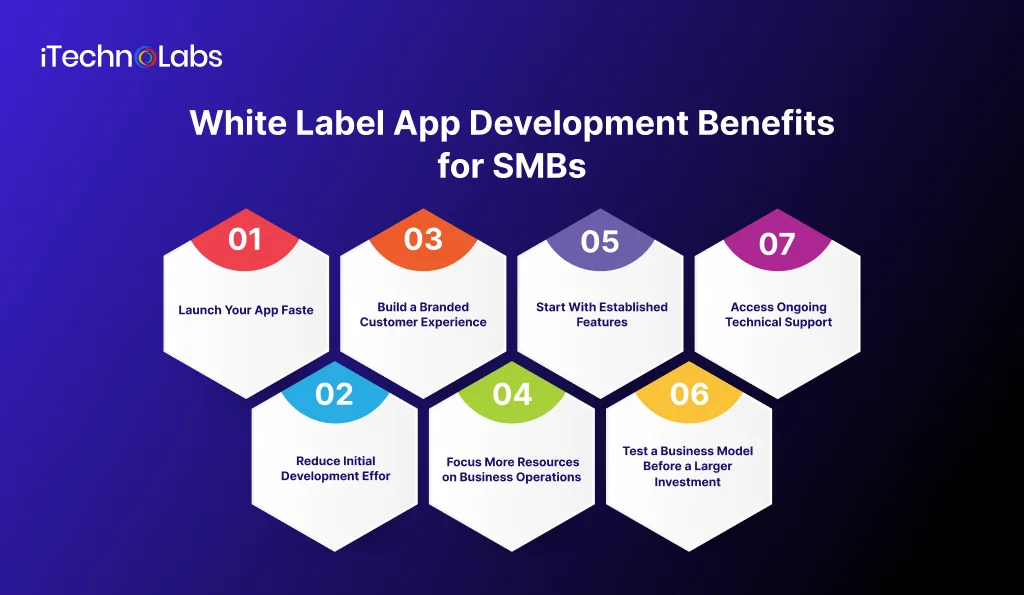
7 White Label App Development Benefits for SMB’s
- Launch Your App Faster
A prebuilt application gives your business a starting point. Common functionality such as account management, booking, notifications, payments, or reporting may already exist, reducing the amount of development required before launch.
This approach can help you test customer demand before making a larger investment. However, customization, integrations, testing, and app store preparation can still affect launch time.
- Reduce Initial Development Effort
A white label product can reduce the planning, engineering, testing, and deployment work required when its existing features match your needs. It may also reduce the need to recruit an internal development team for basic functionality.
The important distinction is between lower initial expenditure and lower lifetime cost. Licensing charges, customization fees, transaction costs, support plans, and future migrations can change the financial picture.
- Build a Branded Customer Experience
A white label app allows businesses to present digital services through their own brand rather than directing customers to an unbranded third-party product.
Depending on the provider, you may be able to customize:
- Your logo, colors, and visual identity.
- Product descriptions, content, and notifications.
- Customer registration and onboarding.
- Selected navigation elements and workflows.
- Branded communications and account screens.
This can help connect your digital channel with your existing business. Before signing, confirm which elements you can change and whether advanced branding requires additional fees.
- Focus More Resources on Business Operations
A suitable white label product can reduce the engineering work your business manages directly, freeing your team to focus on customer service, sales, marketing, and core operations while the provider handles agreed technical responsibilities.
This benefit depends on the service agreement. Establish who manages bug fixes, platform updates, support requests, integrations, and incidents before assuming those responsibilities sit entirely with the vendor.
- Start With Established Features
White label platforms often include authentication, scheduling, payments, dashboards, and notifications. Existing components can reduce development effort, but confirm that they support your preferred payment providers, accounting systems, CRM, and workflows.
Existing functionality still needs to be evaluated. Confirm that features work with your preferred payment providers, accounting systems, customer relationship management software, and operational workflows.
- Test a Business Model Before a Larger Investment
White labeling can be a practical way to test demand when the business model is understood, but customer adoption remains uncertain.
The goal is to validate the business opportunity, not to assume that a prebuilt app guarantees market success. Define what you want to learn, how you will measure adoption, and what evidence would justify a larger investment.
- Access Ongoing Technical Support
Many white label arrangements include maintenance, hosting, bug fixes, or platform updates. These services can reduce the technical burden on an SMB that lacks dedicated software staff.
Support quality and coverage vary by provider. Review response times, incident handling, maintenance windows, security updates, and the cost of support outside the standard plan.
Do not treat support as a generic feature. It should be defined in the agreement, particularly if the app supports revenue-generating or business-critical workflows.
When Does White Label App Development Make Sense?
White labeling is most useful when your business needs established functionality, a branded customer experience, and a practical route to launch without requiring complete control over the underlying software.
Your requirements are relatively standard
Your app needs familiar functions such as booking, ordering, customer accounts, payments, or service management.
You need to validate demand
You want to launch a usable product, collect customer feedback, and assess adoption before committing to a larger build.
Your team has limited engineering capacity
You prefer to buy access to established functionality rather than manage a substantial development project internally.
The app supports your core business
The software improves how customers interact with your business but is not itself the primary source of competitive differentiation.
Consider a retail business that needs a branded ordering and loyalty app. If an existing platform supports its catalogue, payment methods, promotions, and customer records, white labeling may be a sensible starting point.
The decision becomes harder when your workflows are unusual, your integrations are complex, or your software needs to create a distinct competitive advantage.
When Should You Avoid White Label App Development?
White labeling is not the right fit for every business. The lower initial effort may come with restrictions that become more expensive as requirements evolve.
Your product depends on unique features
If your competitive advantage depends on proprietary algorithms, specialized workflows, or a customer experience that existing platforms cannot reproduce, a prebuilt product may impose too many restrictions.
You could end up paying for custom modifications that undermine the original cost advantage.
You need control over the source code
Some providers license access to their platform without transferring ownership of the underlying code. Others offer different ownership or delivery arrangements.
If your business needs independent development, unrestricted modifications, or the ability to move between vendors, review those rights before committing. Never assume that branding the application means owning its source code.
Your long-term costs are difficult to predict
A low starting price may be offset by monthly licensing, per-user charges, premium features, integration work, or transaction fees.
Estimate the total cost over your intended planning period rather than comparing initial quotes alone.
Your data and compliance requirements are demanding
If the application handles sensitive customer information or operates in a regulated sector, you need clear answers about data storage, access controls, encryption, incident response, retention, and deletion.
The provider’s security claims do not remove your responsibility to evaluate whether the arrangement meets your business and legal obligations.
White Label vs. Custom App Development
The right choice depends on how much flexibility your business needs and how much responsibility it wants to retain.
| Decision factor | White label app | Custom app |
| Initial development effort | Often lower when existing features fit | Usually higher because the product is built around your requirements |
| Time to launch | Potentially shorter | Depends on scope and complexity |
| Branding | Available within provider limits | Can be designed around your brand |
| Feature flexibility | Limited by the platform and agreement | Greater control over product requirements |
| Source code ownership | Depends on the contract | Can be negotiated as part of the engagement |
| Ongoing costs | May include recurring license and usage fees | May include hosting, maintenance, and further development |
| Vendor dependency | Can be substantial | Depends on architecture, documentation, and handover |
| Best suited to | Standard workflows and faster market testing | Differentiated products and specialized requirements |
Custom development does not automatically guarantee ownership of every component, and white label software does not always prevent code access. Contractual terms matter in both models.
If your needs fall between the two, consider a hybrid approach. Start with established components and invest in custom modules for the workflows that matter most to your business.
How to Evaluate a White Label App Development Provider
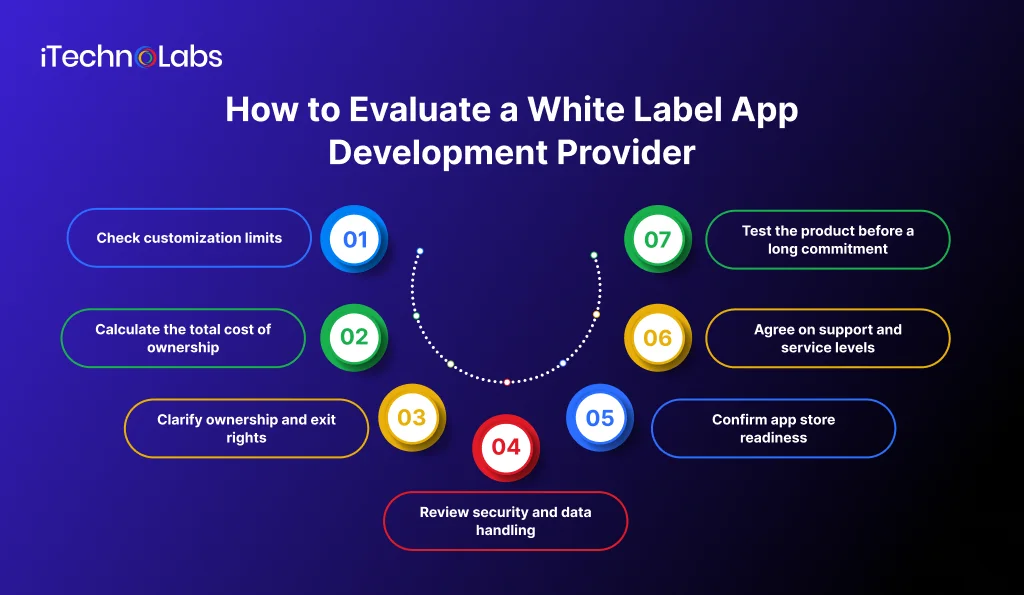
The benefits depend on the product and the agreement behind it. Before committing, evaluate the provider against your business requirements rather than relying on a demonstration or headline price.
- Check customization limits
Ask which features, workflows, integrations, and interface elements you can change. Identify any restrictions that would prevent the app from supporting your plans.
Request a demonstration of your actual use cases, not only the provider’s standard features.
- Calculate the total cost of ownership
Compare the full cost over a defined planning period. Include:
- Initial setup and branding.
- Monthly or annual licensing.
- Customization and integration fees.
- Hosting, transaction, and usage charges.
- Maintenance, support, and upgrades.
- Data export and migration if you leave.
A lower initial price is useful only if the overall cost and business value remain acceptable.
- Clarify ownership and exit rights
Ask who owns the underlying source code, custom modules, designs, and business data. Confirm whether you can export your data in a usable format and what happens if the contract ends.
Check notice periods, termination charges, migration assistance, and whether the provider can continue licensing the same product to competitors.
- Review security and data handling
Understand where customer data is stored, who can access it, how vulnerabilities are handled, and what happens after a security incident.
- Confirm app store readiness
If you plan to distribute the product through mobile app stores, verify who handles submissions, updates, policy changes, and rejections.
Apple and Google both restrict certain repetitive or low-value app experiences. Rebranding an existing product does not guarantee approval. Your app needs to provide a meaningful experience and comply with the relevant platform policies.
- Agree on support and service levels
Document support hours, response targets, escalation procedures, update responsibilities, and planned maintenance. If the application supports essential operations, determine how outages will be communicated and resolved.
- Test the product before a long commitment
Where possible, request a pilot or limited initial engagement. Test the workflows your customers and employees will use, including payment failures, account recovery, integration errors, and high usage periods.
A short evaluation can reveal practical limitations that are difficult to identify during a sales demonstration.
Final Recommendation
White label app development is worth considering when your business needs a branded digital product, its essential workflows are already supported, and speed and initial cost matter more than complete control over the technology.
Choose custom development when unique functionality, proprietary workflows, or long-term technical independence are central to your business strategy. A hybrid approach may also work when an existing platform covers standard features, but a few important functions require custom engineering.
For businesses comparing development approaches, iTechnolabs offers custom software development services and mobile app development services. The right starting point is a clear assessment of your requirements, budget, integrations, and plans.
FAQs
- What are the main white label app development benefits?
The main benefits are reduced initial development effort, faster potential launch, brand customization, access to established features, and less need to manage the underlying technology directly. The actual savings depend on how closely the existing product matches your requirements and how much customization, licensing, integration, and maintenance it requires.
- Is white label app development cheaper than custom development?
White label development can cost less initially because the underlying product already exists. However, recurring license fees, usage charges, customization, integrations, and migration expenses affect the total cost. Compare both approaches over the same planning period and include ongoing support, maintenance, and any expected changes to your requirements.
- Can I customize a white label app completely?
Not necessarily. Most arrangements allow some branding and configuration, but the extent of customization depends on the platform and contract. Ask whether you can modify core workflows, add features, change integrations, and control the user experience. If you need extensive changes, custom development may be a better fit.
- Who owns the source code of a white label app?
Source code ownership depends on the agreement. Many providers retain ownership of the underlying platform while licensing its use to customers. Some arrangements allow ownership or access to particular custom components. Confirm your rights to the code, designs, data, and modifications in writing before signing.
- Is white label app development suitable for a growing business?
It can suit a growing business if the platform supports its expected user volume, integrations, workflows, and service requirements. Check usage limits, performance, upgrade costs, and customization options. Also establish how easily you could migrate if the product eventually outgrows the platform or your business needs greater technical control.
- How do I choose a white label app development provider?
Evaluate the provider’s product fit, customization options, security practices, support commitments, pricing, ownership terms, and exit process. Request a live demonstration and test essential workflows before committing. Review the agreement carefully, especially data portability, recurring charges, service levels, and responsibility for future maintenance.