Key Takeaways
- Waterfall locks scope and sequence upfront. Agile builds in short sprints and adjusts as it goes. Neither is universally better; the fit depends on how stable your requirements actually are.
- Most software projects that stall or blow their budget do so because the methodology didn’t match the project, not because the code was bad.
- Your engagement model (in-house team, staff augmentation, or a fixed-scope contract) changes which methodology makes sense just as much as the project itself does.
- A hybrid approach, often called “Wagile,” is common for regulated or enterprise projects that need governance checkpoints without losing sprint-level flexibility.
- Five honest questions about scope stability, budget flexibility, and stakeholder availability will tell you more than any framework comparison.
Most software projects don’t fail because of bad code. They fail because someone picked the wrong way to manage the work. A fixed-scope contract run like an open-ended sprint drifts. An evolving product built under a rigid phase-gate plan gets locked into decisions made before anyone understood the real problem.
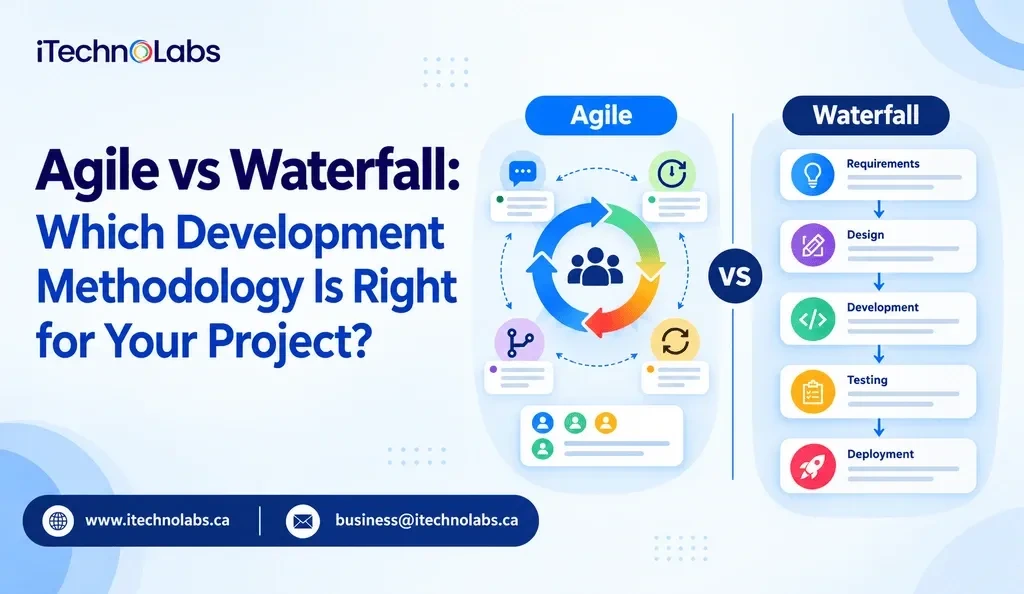
Agile and Waterfall are two common approaches to managing software projects. Agile software development is breaking a project into smaller, iterative cycles where teams build, test, review, and adjust the product based on continuous feedback.
Waterfall takes a more structured approach, moving through fixed phases in sequence, with each one completed before the next begins.
The right choice depends less on which methodology sounds more modern and more on how well-defined your requirements are, how involved you can be, and what your budget structure allows.
Table of Contents
- What Is Waterfall Software Development?
- Agile Software Development: What Is It?
- Agile vs Waterfall: Head-to-Head Comparison
- How Your Engagement Model Changes the Answer
- A Quick Self-Assessment: 5 Questions to Pick the Right Methodology
- Agile Software Development or Waterfall: Which One Should You Choose?
- iTechnolabs and Methodology Fit
- FAQs
What Is Waterfall Software Development?
Waterfall is a linear, phase-based approach: requirements, design, development, testing, deployment, maintenance. Each phase wraps up before the next starts, and there’s little built-in room to revisit earlier decisions once the team has moved on.
This structure works well when the destination is genuinely fixed. A healthcare intake system with regulatory documentation requirements, a government procurement contract with a defined statement of work, or a hardware-integrated app with a locked device specification are all cases where Waterfall’s upfront clarity pays off. You know the cost, the timeline, and the deliverable before a single line of code is written.
The tradeoff is rigidity. If a stakeholder realizes three months in that a core assumption was wrong, fixing it usually means a formal change order, a new budget line, and a delay. Waterfall punishes late discovery. It rewards projects where the requirements were genuinely knowable in advance, not just assumed to be.
Understanding the broader software development process can also help you see where methodology decisions affect planning, development, testing, and deployment.
Agile Software Development: What Is It?
Agile software development breaks a project into short cycles, usually one to two weeks, called sprints. Each sprint produces a working piece of the product that the team and stakeholders can review, test, and redirect. Instead of one large plan executed in order, the backlog gets reprioritized continuously based on what’s actually being learned.
This approach is particularly useful for projects involving mobile app development services, where user feedback and changing product requirements can influence feature priorities throughout the build. A founder building an MVP, for example, may not know which features matter most until early users begin using the product. A business automating an internal workflow may discover important edge cases only after the software is in front of the people who will use it daily. Agile treats that discovery as a normal part of development rather than a failure of the original plan.
The cost of that flexibility is predictability. A fixed budget and a fixed feature list don’t coexist comfortably with Agile, because the backlog is designed to shift. Teams that want exact deliverables at an exact price upfront will find that friction uncomfortable, even when the end product is better suited to what users actually need.
Agile vs Waterfall: Head-to-Head Comparison
| Factor | Waterfall | Agile |
| Structure | Sequential phases, completed in order | Iterative sprints, typically 1–2 weeks |
| Requirements | Defined upfront; changes are formal | Reprioritized continuously via backlog |
| Client involvement | Concentrated at milestones | Ongoing, sprint reviews and demos |
| Budget model | Fixed-price, based on defined scope | Time-and-materials, flexes with effort |
| Testing | A dedicated phase near the end | Built into every sprint |
| Best fit | Regulated, fixed-scope, hardware-dependent projects | Evolving products, MVPs, consumer-facing apps |
| Main risk | Late-stage rework when requirements shift | Scope creep if the backlog isn’t managed |
Both methodologies can overrun a budget. Waterfall does it through rework once testing exposes a flaw baked into an earlier phase. Agile software development does it through scope creep when new priorities get added faster than old ones get cut. Neither risk disappears; the question is which one you’d rather manage.
How Your Engagement Model Changes the Answer
Methodology and engagement model are more connected than most comparisons acknowledge. If you’re hiring a dedicated development team through staff augmentation, that team typically works inside your existing Agile process, attending your standups and taking direction sprint to sprint. That setup assumes ongoing availability from your side, someone reviewing demos and making priority calls regularly.
A fixed-scope contract, by contrast, tends to pair naturally with Waterfall. You define the deliverable, agree on a price, and the vendor executes against that spec with less need for your day-to-day input. This is often the right model for a well-understood tool with stable requirements, or for a business that genuinely wants a hands-off build.
Founders building an MVP usually want the Agile-and-staff-augmentation combination, because the goal is to learn fast and adjust based on real usage, not to lock a feature list in month one. SMBs replacing a legacy internal tool sometimes prefer the fixed-scope route precisely because the requirements are already well understood from years of using the old system.
A Quick Self-Assessment: 5 Questions to Pick the Right Methodology
Run through these before committing to either approach.
1. Can you describe your finished product in detail today, or will you understand it better after users touch it?
Detail now favors Waterfall. Learning-by-doing favors Agile.
2. Can someone on your side commit to reviewing progress every one to two weeks?
If not, Agile’s feedback loop won’t function as intended, regardless of what the contract says.
3. Is your budget genuinely fixed, or can it flex if the product needs more work than expected?
Fixed and inflexible points toward Waterfall’s cost certainty.
4. Does your industry or contract require upfront documentation and formal sign-offs?
Regulated and public-sector work often needs Waterfall’s paper trail, even inside an otherwise Agile team.
5. How many vendors or teams need to coordinate on this build?
A single, tightly coordinated team handles Agile well. Multiple independent vendors often work more smoothly under Waterfall’s clearer handoff points.
If your answers split across both columns, that’s not a failure of the framework. It usually means a hybrid model fits better than either pure approach.
Agile Software Development or Waterfall: Which One Should You Choose?
The simplest way to choose between Agile and Waterfall is to look at how much uncertainty your project has. If you already know exactly what needs to be built, how it should work, and what the final deliverable looks like, Waterfall can provide a clearer structure for planning, budgeting, and delivery.
Choose Agile software development when your requirements are likely to change as you learn more about your users, business processes, or technical requirements. This is often the better fit for MVPs, new digital products, and software projects where regular stakeholder feedback can improve the final result.
Waterfall makes more sense when scope, documentation, and approval requirements need to be defined upfront. Government projects, compliance-sensitive systems, and hardware-dependent applications often benefit from this level of structure.
If your project needs upfront planning and governance but also requires flexibility during development, a hybrid approach may be the better option. The goal is not to choose the methodology that sounds better. It is to choose the one that matches how much you already know about the project and how much is likely to change once development begins.
iTechnolabs and Methodology Fit
Choosing between Agile software development and Waterfall isn’t a one-time decision made in a kickoff meeting. It’s a fit assessment that should hold up against your actual requirements stability, budget structure, and how much time your team can realistically give to reviews and demos.
iTechnolabs works across both models depending on what a project actually needs, not what’s easiest to sell.
- Agile software development sprint delivery for MVPs, evolving products, and staff-augmented teams working inside your existing process.
- Fixed-scope, Waterfall-structured engagements for well-defined builds with stable requirements.
- Hybrid delivery for enterprise and compliance-sensitive projects that need phase-gate governance alongside sprint-level execution.
- Structured development processes designed to support consistent planning, delivery, and quality throughout the project.
If you’re still weighing which approach fits your project, our custom software development services team can walk through your specific scope and constraints during a scoping conversation.
FAQs
1. What is the main difference between Agile and Waterfall?
Waterfall completes a project in fixed, sequential phases where each one finishes before the next begins. Agile software development breaks the work into short, repeating sprints that each produce a working piece of the product. The core distinction is when you see working software: at the very end with Waterfall, or every one to two weeks with Agile. That timing difference is what drives most of the other tradeoffs between the two.
2. Is Agile always faster than Waterfall?
Not necessarily. Agile gets you working software sooner because each sprint delivers something usable, but the total project timeline depends on scope, team size, and how disciplined the backlog management is. Waterfall can actually finish faster for small, well-understood projects where there’s no back-and-forth needed on requirements. Agile’s speed advantage shows up most clearly on projects where requirements would otherwise need mid-project rework.
3. Which methodology is cheaper?
It depends on what goes wrong. Waterfall offers more budget certainty upfront through fixed-price contracts, but rework from late-discovered issues can add unplanned cost. Agile’s time-and-materials model flexes with actual effort, which can reduce waste from building the wrong thing, but it makes the final number harder to predict at the outset. Neither is inherently cheaper across all projects.
4. Can a small business use Agile without an internal technical team?
Yes, this is common with staff augmentation or a dedicated development team. The business doesn’t need in-house engineers running the sprints; it needs someone who can commit to reviewing demos and making priority decisions on a regular cadence. Without that involvement, an Agile engagement tends to drift toward Waterfall in practice, just without the upfront planning that makes Waterfall work.
5. When should a startup choose Waterfall instead of Agile?
Rarely, but it happens. A startup with a hardware-integrated product, a regulatory filing tied to a fixed spec, or a very narrow, well-understood MVP with no ambiguity left to resolve might reasonably use Waterfall. For most startups building a product that will change based on user feedback, Agile’s iteration is a better match for the actual uncertainty involved.
6. What is a hybrid Agile-Waterfall approach called?
It’s often referred to as “Wagile” or a phase-gate Agile model. Discovery, budgeting, and major milestone approvals follow a Waterfall-style structure, while the actual design, development, and testing work happens in Agile sprints within that framework. It’s common in enterprise and government-adjacent projects that need documented governance without losing sprint-level adaptability.