
- React Native app development in Canada can range from CAD 30,000 to CAD 300,000+, depending on scope and technical complexity.
- A focused MVP generally requires a smaller budget than a business or enterprise application with complex integrations and backend requirements.
- React Native can reduce duplicated development work when one product needs to support both iOS and Android.
- Backend architecture, integrations, security, business logic, and testing often have a greater impact on cost than the number of screens.
- A reliable estimate should be based on defined features, user roles, platforms, integrations, and first release requirements.
Building a React Native app in Canada can cost anywhere from CAD 30,000 to CAD 300,000 or more, depending on what you are building and how much engineering the product requires. A focused MVP may need a relatively modest budget, while applications with complex backend systems, integrations, security requirements, and real-time features can require a significantly larger investment.
For businesses planning a React Native project, the key question is not simply how much developers charge per hour. The total budget is shaped by app complexity, feature scope, UI and UX requirements, backend development, integrations, testing, platform-specific functionality, and the development team you choose.
This guide breaks down the React Native app development cost in Canada, typical project budgets and timelines, the factors that affect pricing, and what to look for when comparing development proposals.
Table of Contents
- How Much Does React Native App Development Cost in Canada?
- React Native App Development Cost Breakdown
- What Affects React Native App Development Cost in Canada?
- React Native vs Native App Development Cost in Canada
- How Much Does It Cost to Hire a React Native Developer in Canada?
- React Native App Development Cost by Project Type
- How to Reduce React Native Development Costs
- How to Evaluate a React Native Development Quote
- Why Choose iTechnolabs for React Native Development?
- Final Thoughts
- FAQs
How Much Does React Native App Development Cost in Canada?
The React Native app development cost in Canada typically falls between CAD 30,000 and CAD 300,000+. A focused MVP can sit near the lower end, while feature-rich and enterprise applications can require substantially larger budgets.
For context, current Canadian mobile app development estimates place basic applications around CAD 25,000 to CAD 60,000, standard business applications around CAD 60,000 to CAD 150,000, and advanced applications from CAD 150,000 upward.
For React Native projects, a practical planning range looks like this:
| React Native app scope | Estimated cost in CAD | Typical timeline |
| Focused MVP | CAD 30,000 to CAD 60,000 | 8 to 14 weeks |
| Standard business app | CAD 60,000 to CAD 150,000 | 14 to 28 weeks |
| Feature-rich application | CAD 150,000 to CAD 300,000+ | 28 to 48 weeks |
| Enterprise application | CAD 300,000+ | 40+ weeks |
These figures are planning ranges, not fixed quotes. The actual budget depends on what the application needs to do, how much backend work is required, which integrations are involved, and how much testing the product requires.

React Native App Development Cost Breakdown
A React Native budget usually covers several workstreams rather than mobile development alone.
| Development area | What it includes |
| Discovery and planning | Requirements, user journeys, architecture |
| UI and UX | Wireframes, interface design, prototypes |
| React Native development | iOS and Android application development |
| Backend development | APIs, databases, authentication, business logic |
| Integrations | Payments, maps, CRM, ERP, analytics and other services |
| QA and testing | Functional, compatibility, performance and security testing |
| Deployment | App Store and Google Play release |
| Support | Bug fixes, updates and future improvements |
This matters when comparing proposals. A CAD 50,000 quote that excludes backend development and QA may ultimately cost more than a CAD 65,000 quote that includes the complete delivery scope.
What Affects React Native App Development Cost in Canada?
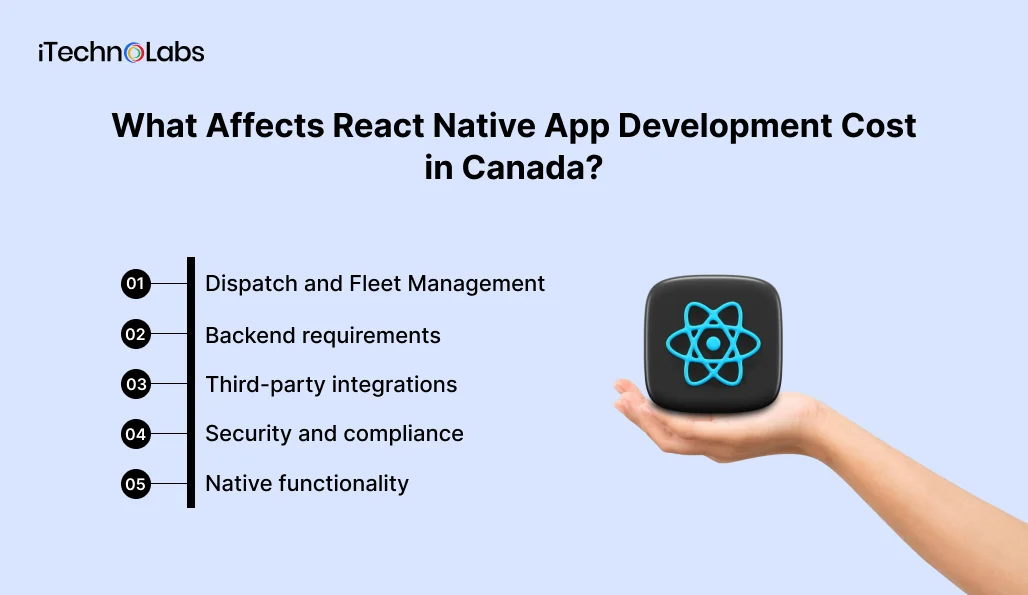
- App complexity
A basic application with authentication, profiles, and simple API calls requires less work than a platform with multiple user roles, real-time functionality, payments, advanced search, and complex business rules.
The underlying logic matters more than the number of screens.
- Backend requirements
React Native handles the mobile application layer, but most production applications still need backend services.
A simple product may use existing APIs or managed cloud services. A larger application may require custom APIs, databases, authentication, administration tools, background processing, and real-time infrastructure.
- Third-party integrations
Payments, maps, CRM systems, ERP platforms, analytics tools, communication services, and identity providers can all increase development effort.
The complexity of the integration matters. A basic API connection is very different from a two-way data synchronization system with webhooks, authentication, and error handling.
- Security and compliance
Applications handling financial information, healthcare data, personal information, or sensitive business records may require additional security controls.
Authentication, authorization, encryption, audit logging, secure data handling, and compliance requirements can increase both development and testing effort.
- Native functionality
React Native supports cross-platform development, but some applications still need native iOS or Android code.
Bluetooth, advanced camera functionality, background processing, specialized hardware, and platform-specific APIs can introduce additional development work.
React Native vs Native App Development Cost in Canada
React Native can be financially attractive when a business needs both iOS and Android applications.
The reason is straightforward. A significant portion of the application code can be shared instead of maintaining two completely separate native codebases. iTechnolabs also notes that React Native and Flutter can reduce duplicated development work compared with separate native applications.
However, React Native does not automatically make every project cheaper.
| Approach | Cost consideration | Best suited to |
| Native iOS | Separate iOS development | Deep Apple platform requirements |
| Native Android | Separate Android development | Android-specific functionality |
| React Native | Shared development across platforms | Products with substantial cross-platform functionality |
If your application relies heavily on specialized device capabilities, native development may still be the better technical choice.
How Much Does It Cost to Hire a React Native Developer in Canada?
Current 2026 market data places a mid-level freelance React Native developer in Canada at approximately CAD 147 to CAD 225 per hour, with junior rates around CAD 116 to CAD 173 per hour and senior rates around CAD 191 to CAD 286 per hour.
These rates are useful for understanding the talent market, but they should not be confused with the total cost of building an application.
A complete development project may also require:
- Product management
- UI and UX design
- Backend engineering
- QA
- DevOps
- Technical architecture
- Deployment
- Post-launch support
That is why comparing vendors purely by hourly rate can produce misleading results.
The better question is how much effort is required to deliver the complete product.
React Native App Development Cost by Project Type
React Native MVP
- CAD 30,000 to CAD 60,000
- A focused MVP may include authentication, profiles, core workflows, basic backend functionality, notifications, and a limited administration interface.
- The goal is to validate the core product before investing in a larger feature set.
Standard Business Application
- CAD 60,000 to CAD 150,000
- This range can cover multiple user roles, custom UI, payments, notifications, third-party APIs, backend systems, and more involved workflows.
Feature-Rich Application
- CAD 150,000 to CAD 300,000+
- Real-time functionality, advanced payments, location features, extensive integrations, sophisticated backend infrastructure, and complex business logic can move a project into this range.
Enterprise Application
- CAD 300,000+
- Enterprise projects can involve legacy integrations, advanced security, compliance requirements, complex permissions, high availability, multiple environments, and extensive testing.
At this level, a generic cost range becomes less useful. A detailed discovery phase is needed to produce a meaningful estimate.
How to Reduce React Native Development Costs
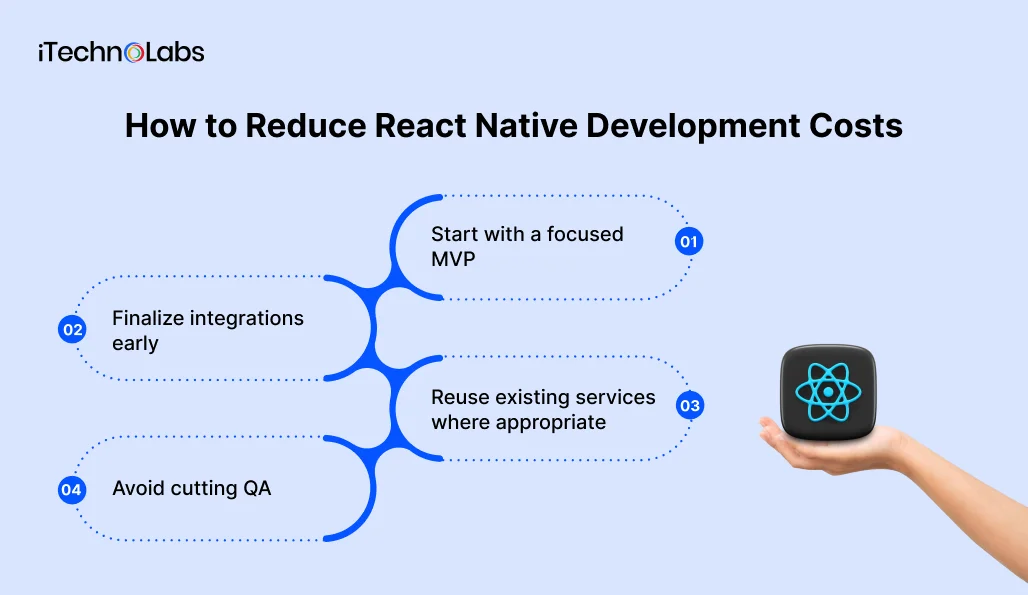
The goal should not be to remove important functionality. It should be to control unnecessary development effort.
Start with a focused MVP: Separate essential functionality from features that can be introduced later. A smaller first release gives the team a clearer scope and lets the business validate the product before expanding it.
Finalize integrations early: Identify payment providers, CRM systems, ERP platforms, maps, analytics, AI services, and other dependencies before development begins.
Reuse existing services where appropriate: Existing authentication, payment, and cloud services can reduce custom development when they meet the product requirements.
Avoid cutting QA: Reducing testing may lower the initial quote, but production bugs can create additional development and support costs later.
How to Evaluate a React Native Development Quote
Before selecting a development partner, check whether the proposal clearly defines:
- Features included in the first release
- iOS and Android scope
- Backend development
- Third-party integrations
- UI and UX
- QA and device testing
- Native functionality
- Deployment
- Source code ownership
- Post-launch support
- Treatment of scope changes
A useful proposal should connect the price to a defined scope.
If one vendor quotes CAD 50,000 and another quotes CAD 80,000, the cheaper proposal is not necessarily better. The difference may simply reflect missing backend work, testing, project management, or support.
Why Choose iTechnolabs for React Native Development?
iTechnolabs helps businesses plan, design, develop, test, and deploy React Native applications for iOS and Android.
The company has delivered 500+ applications and holds ISO 27001:2013 and ISO 9001:2015 certifications. Its mobile development services cover architecture, UI and UX, development, QA, deployment, and post-launch support.
The team can also evaluate whether React Native is the right choice for your product instead of treating it as the default technology.

Final Thoughts
The React Native app development cost in Canada depends on the product you are actually building.
React Native can reduce duplicated development work when one application needs to support both iOS and Android. But the framework itself is only one part of the budget.
The most reliable estimate comes from defining the core user journeys, features, backend requirements, integrations, security needs, platform requirements, and post-launch expectations before development begins.
For a business comparing Canadian React Native development partners, that scope-based approach provides a much better basis for comparing proposals than an hourly rate or a generic app development cost range.
FAQs
How much does React Native app development cost in Canada?
React Native app development in Canada generally starts around CAD 30,000 for a focused MVP and can exceed CAD 300,000 for complex enterprise applications. The final cost depends on features, backend requirements, integrations, security, testing, and platform-specific functionality.
Is React Native cheaper than native app development in Canada?
React Native can reduce duplicated development work when the same application needs to support iOS and Android. The actual savings depend on how much functionality can be shared and whether the product requires specialized native capabilities.
How long does it take to build a React Native app in Canada?
A focused MVP can take around 8 to 14 weeks, while a standard business application may require 14 to 28 weeks. Complex applications can take 28 to 48 weeks or longer depending on scope, integrations, backend work, and testing.
What increases React Native development costs?
Backend complexity, third-party integrations, real-time functionality, payments, security requirements, multiple user roles, custom native functionality, and complex business workflows can significantly increase development effort.
Can React Native support both iOS and Android?
Yes. React Native is designed for cross-platform mobile development and allows businesses to share substantial application code between iOS and Android. Native code may still be required for specialized platform functionality.
How can I get an accurate React Native development estimate?
Define the target users, first release features, platforms, integrations, backend requirements, security expectations, and timeline. A development team can then estimate architecture, effort, resources, and project cost based on the actual scope.











