Key Takeaways
Managing a remote development team requires a clear operating system, not constant supervision.
- Define outcomes, ownership, and acceptance criteria before development begins.
- Use asynchronous communication for routine updates and live meetings for decisions that need discussion.
- Track delivery, code quality, and blockers rather than measuring productivity by online presence.
- Establish security, documentation, code review, and testing standards from the start.
- Choose your development model based on your runway, internal engineering capacity, and need for long-term ownership.
To understand how to manage a remote development team, start with clear goals, defined responsibilities, written communication, and a consistent delivery process. Give developers the context and authority to make progress independently while tracking milestones, code reviews, testing, and feedback. The goal is predictable software delivery without unnecessary supervision.
Table of Contents
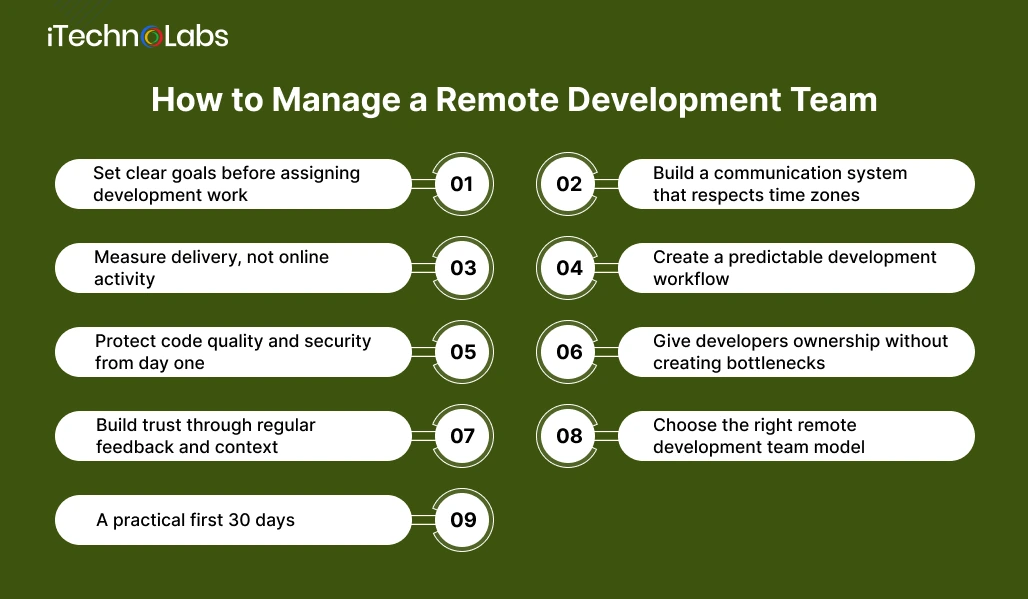
How to Manage a Remote Development Team
For startup founders, managing a distributed engineering team is a business decision as much as a technical one. Delayed releases can affect product priorities, customer acquisition, and runway. A practical management system helps developers work independently while keeping founders informed about progress, risks, and decisions that need attention.
1. Set clear goals before assigning development work
Begin every development cycle by connecting engineering tasks to a product outcome. Developers should understand why a feature matters, who will use it, and how the team will determine whether it is complete.
Instead of assigning a vague task such as improve onboarding, define a specific deliverable.
For example, a startup building a subscription application might define the work as follows.
- Objective: Enable new users to complete account registration.
- Owner: One developer responsible for implementation and coordination.
- Acceptance criteria: Required fields validate correctly, account creation handles errors, and the flow works on supported devices.
- Dependencies: Approved interface designs, authentication requirements, and access to the test environment.
- Definition of done: Code review completed, automated tests passed, documentation updated where necessary, and the feature accepted by the product owner.
Clear acceptance criteria reduce the chance of a developer completing a task that technically works but does not meet the product requirement.
Maintain a prioritised backlog and review it before each development cycle. Keep urgent fixes separate from planned feature work, and make tradeoffs explicit when new requests threaten existing commitments.
2. Build a communication system that respects time zones
GitLab documents an asynchronous-first approach to distributed work, using written discussions, shared documentation, issues, and merge requests to preserve context across time zones. It also recognises that some decisions are better handled through live discussion.
Give every communication channel a clear purpose instead of allowing project decisions to become scattered across chat messages, email, meetings, and private conversations.
| Channel | Best use |
| Project management board | Tasks, owners, deadlines, blockers |
| Issue tracker | Requirements, technical questions, acceptance criteria |
| Code repository | Code changes, reviews, technical discussions |
| Team chat | Quick coordination and urgent blockers |
| Video calls | Complex decisions, planning, feedback, relationship building |
| Shared documentation | Architecture, processes, decisions, onboarding |
Establish a simple written update format that each developer can complete without attending a meeting.
- What did I complete?
- What am I working on next?
- What is blocked?
- What decision or input do I need?
The goal is not to eliminate meetings. It is to make routine progress visible without requiring everyone to be online simultaneously.
Agree on overlapping working hours for urgent collaboration, response expectations for different channels, and a process for escalating blockers. Do not assume that a person working in another time zone should remain available outside agreed working hours.
3. Measure delivery, not online activity
A green status indicator, frequent messages, or a full calendar does not establish whether a software project is progressing. Founders need measures that connect engineering activity to delivery and product quality.
Start with a small set of metrics that answer practical questions about the work.
| Metric | What it helps you understand |
| Milestone completion | Whether agreed deliverables are progressing |
| Cycle time | How long work takes from starting to completion |
| Blocked work | Where dependencies or decisions are delaying progress |
| Escaped defects | Which problems reach users after release |
| Rework | Whether unclear requirements or implementation issues are creating avoidable work |
| Release readiness | Whether testing, review, and deployment requirements are satisfied |
Interpret these measures together. A shorter cycle time is not valuable if defects increase. A high number of completed tasks may reflect small tasks rather than meaningful product progress.
Avoid using individual lines of code, commits, or hours online as standalone productivity scores. These measures can reward activity without demonstrating customer value.
A startup without an established engineering dashboard can begin with a weekly review of milestone progress, blocked tasks, defects, and upcoming release risks. Adjust the measures as the product and team mature.
4. Create a predictable development workflow
A remote engineering team needs an agreed path from an idea to a production release. Without one, developers may interpret requirements differently, skip reviews under deadline pressure, or discover integration problems late.
A practical workflow looks like this:
- Define: Requirements, priority, owner, acceptance criteria
- Build: Small tasks, version control, documented decisions
- Review and test: Peer review, automated checks, acceptance testing
- Release: Deployment, monitoring, rollback plan
- Learn: Review feedback, defects, and process improvements
Use pull requests or merge requests for peer review, automated tests for repeatable checks, and a documented release process. Establish who can approve changes, who can deploy, and how the team responds when a release causes problems.
Process should make good engineering easier, not create paperwork for its own sake. Document decisions that affect architecture, security, product behaviour, or future maintenance. Avoid requiring lengthy documentation for trivial changes.

5. Protect code quality and security from day one
Startups often feel pressure to ship quickly. The risk is that shortcuts taken without a clear boundary become expensive maintenance work later, especially when developers work independently and the founder cannot review every technical decision.
Establish a minimum engineering standard before the first release.
- Version control: Store application code in an approved repository with controlled access.
- Code review: Require another authorised developer to review changes before merging.
- Automated testing: Test critical business logic and important user journeys.
- Environment separation: Keep development, staging, and production environments distinct where appropriate.
- Secrets management: Never store production passwords, private keys, or API secrets in source code.
- Access control: Give team members only the permissions required for their roles.
- Documentation: Record important architectural choices, deployment procedures, and recovery steps.
- Release management: Define how changes are tested, approved, deployed, and rolled back.
Assign responsibility for security reviews and production access explicitly. If your startup handles personal, financial, or other sensitive data, determine which legal, contractual, and regulatory requirements apply before selecting tools or granting access.
6. Give developers ownership without creating bottlenecks
Remote teams can struggle when every small decision requires founder approval. They can also drift when no one knows who has authority to make a decision.
Define ownership at three levels.
- Product ownership: The founder or product manager sets priorities, clarifies customer needs, and decides which features matter most.
- Technical ownership: A designated engineering lead makes or coordinates architecture, implementation standards, technical reviews, and engineering trade-offs.
- Task ownership: Individual developers own their assigned work, communicate risks, and raise decisions that exceed their authority.
Document the boundaries. A developer might choose how to implement a component independently but need approval before changing a public API, introducing a major dependency, or modifying a security-sensitive workflow.
When a decision is blocked, establish who must respond and what happens if they are unavailable. This prevents a single person from becoming the bottleneck for the entire team.
Ownership also requires accountability. Ask team members to raise concerns early, explain trade-offs, and propose solutions rather than merely reporting that a task is delayed.
7. Build trust through regular feedback and context
GitLab’s remote work guidance emphasises transparent communication, documented decisions, and choosing between asynchronous and synchronous communication according to the situation.
Establish a lightweight management rhythm that creates space for both delivery discussions and individual feedback.
| Cadence | Purpose |
| Weekly | Review progress, blockers, priorities, and release risks |
| Every development cycle | Review completed work and adjust the backlog |
| Regular one-to-one meetings | Discuss feedback, motivation, workload, and professional growth |
| Periodically | Review technical debt, architecture, security, and process improvements |
Use live meetings when a disagreement needs resolution, a technical issue requires shared investigation, or a sensitive conversation deserves a personal discussion. Record relevant decisions afterward so the rest of the team has the same context.
Trust is not the absence of oversight. It comes from clear expectations, reliable follow-through, honest reporting, and fair treatment. If a deadline slips, investigate the cause before assuming the problem is individual performance.
8. Choose the right remote development team model
Not every startup should manage its engineering capacity in the same way. The right model depends on the product stage, available budget, technical leadership, and how much control the founder needs over day-to-day development.
| Model | Best suited to | Main consideration |
| In-house team | Long-term product ownership and core engineering capability | Hiring, retention, and management overhead |
| Freelancers | Defined tasks or specialist work | Coordination and continuity across contributors |
| Dedicated external team | Ongoing product development when internal capacity is limited | Clear governance, communication, and ownership agreements |
| Staff augmentation | Adding specific skills to an existing engineering organisation | Requires internal direction and integration with existing processes |
| Fixed scope engagement | A well-defined deliverable with agreed acceptance criteria | Changes in scope need explicit handling |
Before choosing an external team, clarify who owns the source code, how intellectual property is handled, which environments and repositories the team can access, how work is accepted, and how knowledge will be transferred at the end of the engagement.

9. A practical first 30 days
If your remote team is already working but delivery feels unpredictable, avoid changing every tool and process at once. Start with the problems creating the most friction.
Week 1: Clarify ownership and priorities
Identify the product owner, technical lead, task owners, current priorities, and unresolved dependencies. Write acceptance criteria for the highest priority work.
Week 2: Standardise communication
Choose the primary channels for tasks, decisions, code review, and urgent blockers. Agree on response expectations and working hour overlap.
Week 3: Review delivery and engineering quality
Examine milestone progress, blocked work, code review practices, testing, release controls, and access permissions. Fix the most consequential gaps first.
Week 4: Evaluate and improve
Compare planned and completed work, identify recurring delays, gather developer feedback, and agree on the next set of improvements.
Treat the first month as an initial operating review, not a promise that every delivery problem will be solved in 30 days. The purpose is to establish visibility, identify root causes, and create a process the team can improve over time.
Conclusion
Managing a remote development team successfully comes down to clarity, accountability, and trust. When developers understand product goals, know who owns each decision, and follow a consistent development workflow, founders can maintain visibility without micromanaging daily activities.
Start with clear requirements, establish communication expectations, measure meaningful delivery outcomes, and make code quality and security part of the development process from day one. Review what is slowing the team down and improve the process based on evidence rather than assumptions.
Your management approach should also evolve as your startup grows. Whether you work with an internal team, freelancers, or a dedicated external development team, the goal remains the same: build the right product, maintain engineering quality, and make progress toward business objectives.
Build Your Product Faster With the Right Development Team
iTechnolabs provides software development and dedicated developer services for businesses that need engineering capacity to build, modernize, or expand digital products.
For startup founders, finding the right development partner can help address gaps in technical expertise and development capacity. The key is choosing a team that understands your product goals, communicates clearly, and works within an agreed delivery process.
If you are planning an MVP, expanding an existing application, or looking for additional engineering support, iTechnolabs can be a starting point for discussing your requirements and evaluating an appropriate engagement model.
Dedicated development teams
Explore options for adding development capacity to your project.
Custom software development
Discuss your product requirements, technical priorities, and development roadmap.
Explore Dedicated Development Teams
iTechnolabs identifies dedicated development teams and custom software development among its services. Any additional performance, cost, or delivery claims should be supported by verified project evidence before publication.

FAQs
1. How do you manage a remote development team effectively?
Set clear product goals, assign ownership, document requirements, and establish a predictable development workflow. Use written updates for routine progress, regular reviews for delivery risks, and measurable quality standards. Give developers autonomy over implementation while maintaining clear accountability for deadlines, technical decisions, security, and release readiness.
2. What tools do you need to manage remote software developers?
Most remote development teams need a project management system, a code repository, a communication platform, shared documentation, and automated testing and deployment tools. Choose tools that fit your workflow and integrate where practical. Define which tool holds the authoritative record for tasks, technical discussions, and decisions.
3. How often should remote development teams have meetings?
Schedule meetings according to the decisions the team needs to make, rather than following a rigid daily meeting schedule. Use asynchronous updates for routine progress, and hold live sessions for planning, complex technical discussions, and feedback. Review meeting usefulness periodically and document decisions for colleagues who cannot attend.
4. How do you measure remote developer productivity?
Evaluate delivery against agreed milestones, cycle time, blocked work, defect rates, and release quality. Interpret these measures together rather than treating any single metric as a complete picture of performance. Consider task complexity and dependencies before concluding an individual’s contribution or the team’s overall effectiveness.
5. What are the biggest challenges of managing remote development teams?
Common challenges include unclear requirements, delayed decisions, time zone differences, fragmented documentation, weak ownership, and inconsistent engineering practices. Address them by defining responsibilities, agreeing on communication norms, documenting important decisions, and reviewing blockers regularly. Investigate recurring delivery problems before assuming that developers are the cause.
6. Should a startup hire an external remote development team?
An external team may suit a startup that needs engineering capacity but cannot justify building a full internal department immediately. Evaluate technical expertise, communication practices, security controls, engagement terms, intellectual property ownership, and knowledge transfer. Choose a model that supports your product roadmap and preserves the level of control your business requires.