- HIPAA compliance involves administrative, physical, and technical safeguards for protected health information, not just application security.
- Healthcare software teams must assess risks, control access, protect data, maintain audit records, and prepare for security incidents.
- Compliance requirements depend on the organization’s role, the data it handles, and how the software is deployed and operated.
- Evaluate a development partner’s security practices, documentation, access controls, and incident response process before committing to a project.
- Treat compliance as a lifecycle responsibility spanning design, development, deployment, and maintenance.
HIPAA-compliant software development is the process of designing, building, testing, and maintaining software in a way that supports compliance with applicable requirements of the US Health Insurance Portability and Accountability Act (HIPAA). It involves protecting electronic protected health information (ePHI) through appropriate risk management, access controls, safeguards, documentation, and operational procedures. A secure application alone does not establish that an organization is HIPAA compliant.
For enterprise technology leaders, the practical question is not simply whether a product uses encryption. It is whether the software, its hosting environment, the people who access it, and the processes supporting it work together to protect patient information.
Table of Contents
- What Does HIPAA-Compliant Software Development Involve?
- The Three Safeguard Categories Development Teams Must Address
- Essential features of HIPAA-focused software architecture
- Business Associate Agreements And Third-Party Vendors
- A Practical Development Process for HIPAA-Focused Software
- Develop Healthcare Software with iTechnolabs
- Final Words
- FAQs
What Does HIPAA-Compliant Software Development Involve?
HIPAA establishes requirements for protecting certain identifiable health information. Its Security Rule focuses on electronic protected health information and requires appropriate administrative, physical, and technical safeguards. The Privacy Rule governs permitted uses and disclosures of protected health information, while the Breach Notification Rule addresses notification obligations following certain breaches.
For a CTO, these rules affect more than application code. They influence system architecture, vendor selection, cloud infrastructure, identity management, logging, employee access, data retention, and incident response.
A healthcare application may need to support several functions:
- Patient portals for viewing medical records and managing appointments.
- Electronic health record integrations and clinical workflows.
- Telehealth platforms with patient communication features.
- Healthcare analytics and reporting systems.
- Billing platforms and claims processing.
- AI-powered applications that process patient information.
Whether HIPAA applies depends on the entities involved, the services provided, and how protected health information is handled. A software vendor does not automatically become a business associate simply by selling software to a healthcare provider. However, a vendor that accesses or maintains protected information while providing its services may have business associate obligations.
The Three Safeguard Categories Development Teams Must Address
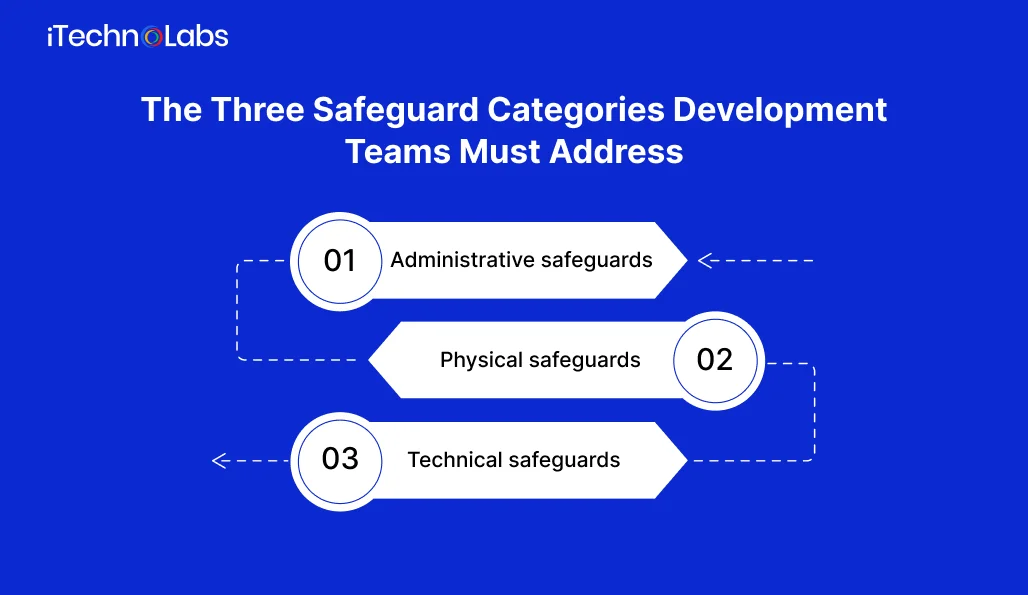
The HIPAA Security Rule organizes its safeguards into three categories. Each addresses a different part of protecting electronic health information.
- Administrative safeguards
Administrative safeguards include risk management, security responsibility, workforce security, information access management, and related policies and procedures.
Before development begins, establish who owns security decisions, how risks will be assessed, who can access sensitive data, and how incidents will be escalated. Document these responsibilities in project governance and operational procedures.
- Physical safeguards
Physical safeguards address the protection of electronic information systems and related facilities, equipment, and devices against unauthorized access and environmental hazards.
Review the physical security controls used by your hosting provider, the devices used by staff, access to development environments, and procedures for handling storage media. Cloud-hosted systems still require an assessment of the relevant physical safeguards.
- Technical safeguards
Technical safeguards cover measures that protect electronic information through technology, including access controls, audit controls, integrity protections, authentication, and transmission security.
Build these controls into the architecture rather than treating them as a final testing task. A useful baseline includes role-based permissions, strong authentication, appropriate encryption, centralized logging, secure API access, and monitoring for suspicious activity.
Essential features of HIPAA-focused software architecture
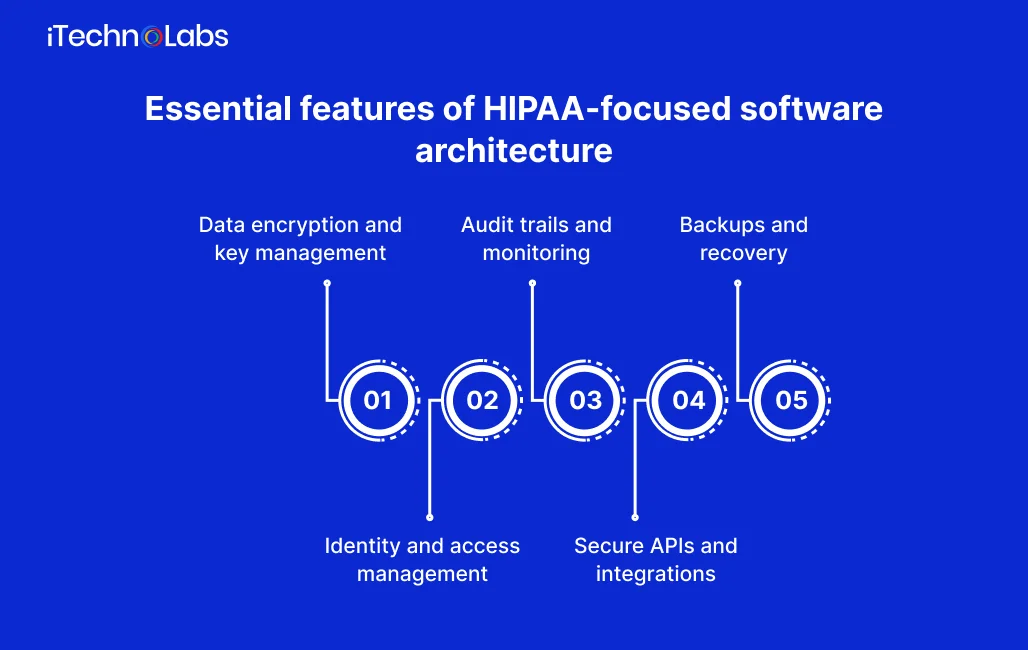
Security requirements become easier to manage when they are translated into concrete architecture and engineering decisions. The appropriate implementation depends on the application’s risks, workflows, and deployment model.
Data encryption and key management
Use appropriate encryption for sensitive information in transit and at rest. Define how cryptographic keys are stored, accessed, rotated, and revoked. Separate key management responsibilities from routine application access where practical.
HIPAA’s Security Rule does not prescribe one universal technology stack. Organizations must select reasonable and appropriate safeguards for their circumstances. Encryption is an important protection, but encryption alone does not establish compliance.
Identity and access management
Give each user only the access required for their responsibilities. A clinician, billing specialist, support engineer, and system administrator should not automatically receive identical permissions.
Use role-based access control or an equivalent authorization model. Add multifactor authentication where appropriate, review privileged accounts regularly, and revoke access when employees change roles or leave the organization.
Audit trails and monitoring
Record security-relevant events, including authentication attempts, access to sensitive records, permission changes, administrative actions, and relevant data exports.
Protect audit records against unauthorized modification and restrict who can review them. Define retention and monitoring policies based on applicable requirements and organizational risk.
Secure APIs and integrations
Integrations often create security boundaries that are easy to overlook. An application can have strong internal access controls yet expose sensitive data through an inadequately protected API or third-party integration.
Require authenticated API requests, enforce authorization at the resource level, validate inputs, protect credentials, and monitor data transfers. Review every integration that receives, stores, or processes protected health information, including analytics and AI services.
Backups and recovery
Establish encrypted backups, recovery procedures, and tested restoration plans. Define recovery objectives based on business and clinical requirements. Test whether critical systems can be restored without compromising access controls or exposing patient information.
Availability matters alongside confidentiality. A system that protects patient information but cannot recover from an outage may still create operational and patient care risks.
Business Associate Agreements And Third-Party Vendors
A business associate agreement, commonly called a BAA, is a written arrangement that defines permitted uses and disclosures of protected health information and establishes applicable safeguards and responsibilities. HIPAA requirements also extend to qualifying subcontractors that handle protected health information on behalf of business associates.
For enterprise technology teams, vendor due diligence should cover the entire data flow, not just the primary software provider.
Before signing a development contract, clarify:
- Whether the developer will access protected health information.
- Whether a BAA is required and can be executed before relevant access begins.
- Which cloud, monitoring, messaging, analytics, and AI providers will process the data.
- Which subcontractors may have access and how their obligations are managed.
- How incidents, vulnerabilities, access requests, and contract termination will be handled.
- How data will be returned or securely disposed of when the engagement ends.
HHS guidance identifies healthcare application developers, cloud service providers, and IT contractors as examples of parties that may qualify as business associates when their services involve protected health information. A cloud provider may qualify even when it stores encrypted information without possessing the decryption key.
A signed BAA is not a substitute for technical controls, risk analysis, or ongoing oversight. Both contractual responsibilities and actual operating practices matter.
A Practical Development Process for HIPAA-Focused Software
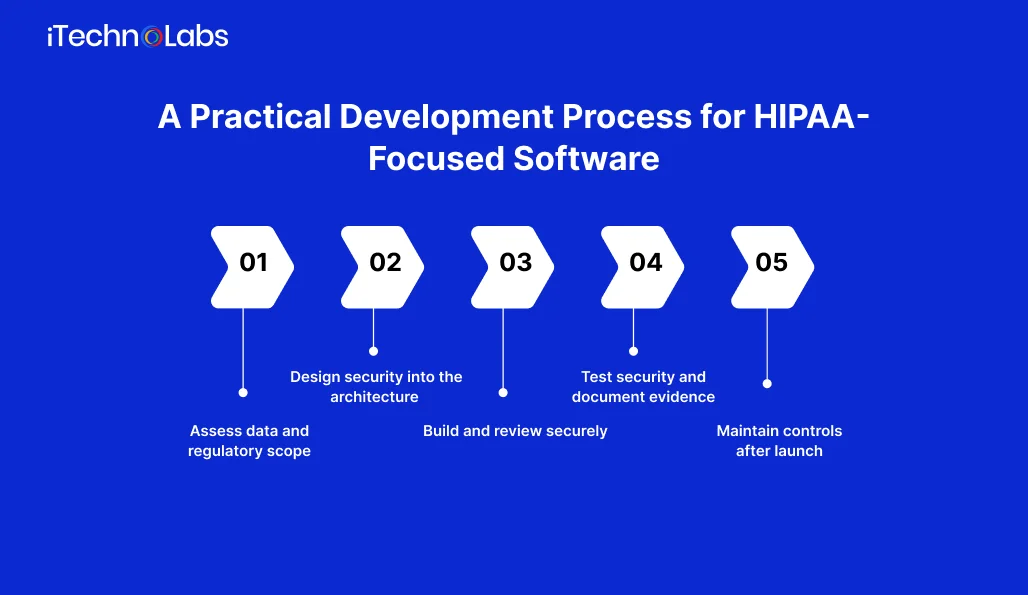
Use the following sequence to make compliance considerations part of the development lifecycle.
- Assess data and regulatory scope
Map the information the product collects, generates, stores, and shares. Identify the relevant entities, data flows, third parties, and applicable HIPAA obligations before choosing an architecture.
- Design security into the architecture
Define access boundaries, encryption, audit logging, integration controls, backup requirements, and environment separation. Document the decisions and the risks they address.
- Build and review securely
Use controlled code repositories, peer reviews, dependency scanning, secrets management, and automated security checks. Keep sensitive production data out of development and test environments unless its use is properly justified and protected.
- Test security and document evidence
Test authorization boundaries, session handling, input validation, logging, backup recovery, and relevant security scenarios. Record findings, remediation decisions, and verification results.
- Maintain controls after launch
Monitor security events, patch dependencies, review permissions, test recovery procedures, reassess risks, and update policies as the application and its vendors change.
HHS identifies risk analysis as a foundational requirement for determining which safeguards are appropriate to protect electronic protected health information. Its guidance emphasizes assessing the organization’s environment rather than following a universal technical blueprint.
Develop Healthcare Software with iTechnolabs
Building healthcare software requires careful planning around patient data protection, system integrations, security controls, and regulatory requirements. iTechnolabs helps businesses design and develop custom software and mobile applications aligned with their technical and operational needs.
From application architecture and API integrations to secure development practices and ongoing maintenance, the development process should account for security from the beginning. iTechnolabs also brings experience in custom software development, mobile applications, and AI integration, helping organizations evaluate the right technical approach for their products.
Final Words
HIPAA-compliant software development requires more than secure code or encrypted data. It involves risk assessment, appropriate administrative, physical, and technical safeguards, controlled access to protected health information, vendor oversight, and ongoing security monitoring.
For enterprise CTOs and IT directors, the key is to address compliance requirements early in the software development lifecycle. Clear security responsibilities, well-planned architecture, documented controls, and regular testing can help reduce risk while supporting long-term product reliability.
Before starting your next healthcare software project, evaluate your regulatory obligations, data flows, third-party integrations, and development partner’s security practices. A structured approach helps your team make informed technology decisions without treating compliance as a last-minute requirement.
FAQs
- What is HIPAA-compliant software development?
HIPAA-compliant software development means building and maintaining software that supports applicable HIPAA requirements for protecting health information. It involves appropriate safeguards, risk management, access controls, documentation, and operational procedures. Compliance depends on the organization’s role and the way protected health information is handled, not simply on which programming language or framework is used.
- Does HIPAA require encryption for all patient data?
The HIPAA Security Rule includes encryption and decryption as an addressable implementation specification for access to electronic protected health information. Addressable does not mean optional without analysis. Organizations must assess whether the specification is reasonable and appropriate, implement it when appropriate, or document an equivalent alternative when applicable.
- Does a software development company need a BAA?
A software development company may need a business associate agreement when its services involve creating, receiving, maintaining, or transmitting protected health information on behalf of a covered entity or another business associate. Merely supplying software does not automatically create this relationship. Determine the actual service scope and data access before work involving protected information begins.
- Can cloud-hosted healthcare software be HIPAA compliant?
Cloud hosting can support a HIPAA-compliant environment, but selecting a cloud provider does not establish compliance by itself. Organizations must assess the provider’s role, applicable contractual arrangements, access controls, configuration, monitoring, and other safeguards. Cloud services that maintain electronic protected health information may qualify as business associates, even when the information is encrypted.
- How do you test software for HIPAA compliance?
Combine technical security testing with a review of policies, risk assessments, access permissions, audit records, vendor agreements, and incident response procedures. Test authentication, authorization, data protection, integrations, backups, and recovery. Document findings and remediation. Technical testing supports compliance efforts, but a successful penetration test alone does not establish that an organization meets every applicable HIPAA requirement.
- Does ISO 27001 certification mean software is HIPAA compliant?
No. ISO 27001 concerns information security management, while HIPAA establishes specific legal requirements for covered entities and business associates. An ISO certified organization may have useful security management processes, but HIPAA applicability, required safeguards, contractual obligations, and operational practices must be assessed separately for the organization and its software environment.