Key Takeaways
- An LMS with AI mixes standard course tools with extra features. It can offer tailored suggestions, chat-style help, and activity tracking.
- The most useful features depend on your training goals, existing systems, content, and learner needs. Adding AI without a defined purpose can increase complexity without improving the learning experience.
- Prioritize a focused first release with learner management, content delivery, reporting, and one or two well-defined AI features.
- AI systems introduce considerations around privacy, accuracy, transparency, accessibility, and human oversight.
- Evaluate development cost through a defined scope, integration requirements, AI usage, security controls, and ongoing maintenance rather than relying on a generic price estimate.
AI-enabled LMS development helps businesses build learning platforms that personalize training, automate routine tasks, and make employee learning easier to manage. The cost depends on the features, integrations, AI capabilities, security requirements, and ongoing maintenance involved. Understanding these factors helps businesses choose between an existing LMS and a custom-built platform that fits their training needs and budget.
For small and medium-sized businesses, the decision goes beyond adding artificial intelligence to a learning management system. The real priority is solving practical challenges such as lengthy employee onboarding, inconsistent training, limited visibility into learning progress, and difficulty finding relevant knowledge. The right platform should address these challenges without introducing unnecessary technical complexity or operating costs.
This guide covers the essential features of an AI-powered LMS, its potential business benefits, estimated development costs, and the factors to consider before investing in a custom solution.
Table of Contents
- What Is AI-Enabled LMS Development?
- Essential Features of an AI-Powered LMS
- A Practical AI LMS Development Process
- Benefits of AI-Enabled LMS Development for SMBs
- How Much Does AI LMS Development Cost in 2026?
- Custom LMS or Existing Platform: Which Should You Choose?
- Risks to Address Before Launch
- Build an AI-Powered LMS With iTechnolabs
- Conclusion
- FAQs
What Is AI-Enabled LMS Development?
AI-enabled LMS Development is the process of building or upgrading a learning management system with artificial intelligence features that support personalized learning, content discovery, learner assistance, and training analysis. The objective is to help organizations deliver relevant learning experiences while giving administrators better tools to manage training and assess progress.
For small and medium-sized businesses, the practical question is not whether an LMS needs AI. It is whether AI can address a specific problem in employee onboarding, compliance training, skills development, or knowledge sharing.
A conventional LMS can already organize courses, enroll employees, record completions, and generate reports. An AI-enabled platform adds capabilities that can help learners find relevant material, receive explanations, and identify knowledge gaps.
The right development approach starts with a business problem, not a feature list. If employees struggle to find information, a knowledge assistant may be useful. If training managers cannot identify where learners need support, analytics and recommendations may be a better starting point.
Essential Features of an AI-Powered LMS
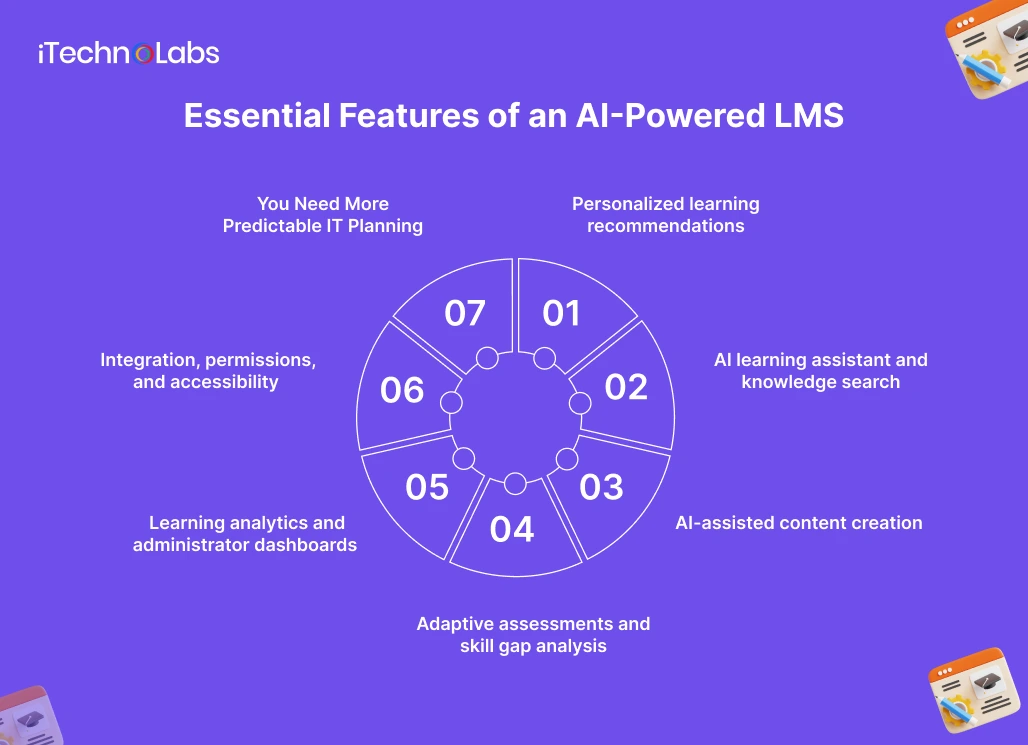
1. Personalized learning recommendations
Recommend courses based on employees’ roles, learning goals, assessment results, and skill requirements. This helps learners find relevant training while allowing managers to review recommendations.
2. AI learning assistant and knowledge search
Help employees find course materials, understand concepts, and access approved company information. Retrieval-augmented generation (RAG) can ground answers in trusted documents and reduce unsupported responses.
3. AI-assisted content creation
Generate draft course outlines, lesson summaries, quizzes, and knowledge checks. Subject matter experts should review all AI-generated content for accuracy before publication.
4. Adaptive assessments and skill gap analysis
Use assessment results to recommend revision materials and additional practice. These recommendations should support learning rather than serve as the sole basis for evaluating employee competence.
5. Learning analytics and administrator dashboards
Track course completion, assessment results, overdue training, and learner progress. These insights help training managers identify areas that may need attention.
6. Integration, permissions, and accessibility
Connect the LMS with HR systems, identity providers, and existing content repositories. Include secure authentication, role-based permissions, and accessible navigation to protect data and support different learner needs.
A Practical AI LMS Development Process
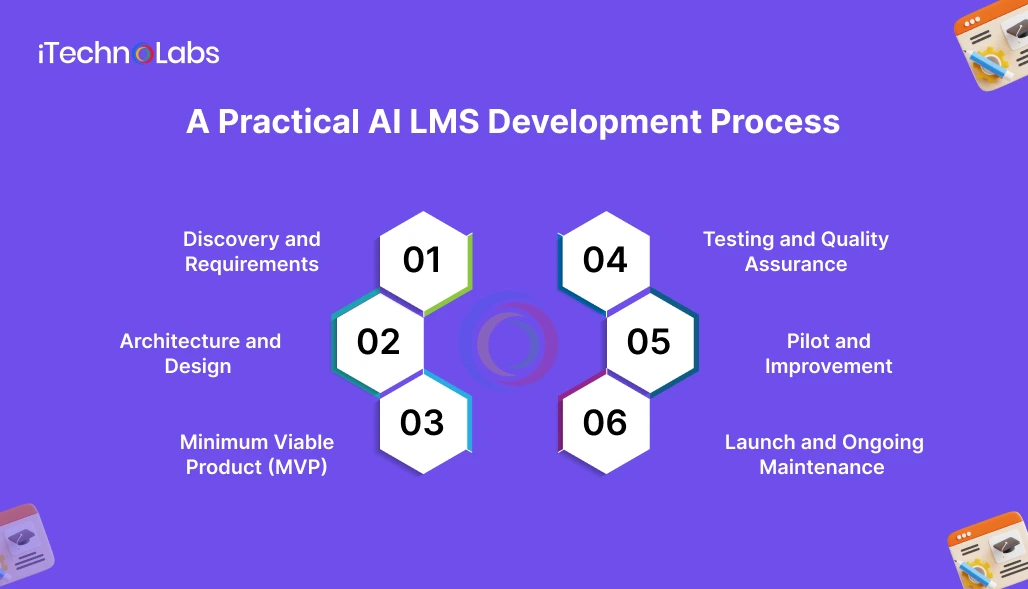
Developing an AI-powered learning management system requires a structured approach, from identifying training needs to monitoring the platform after launch. Each stage helps control costs, reduce technical risks, and ensure the system meets business objectives.
1. Discovery and Requirements
Identify your training challenges, target learners, business goals, and essential LMS features. Define measurable success criteria, such as course completion or reduced administrative workload.
2. Architecture and Design
Plan the platform’s structure, user roles, data permissions, integrations, and AI features. Design learner journeys and decide how the system will access and process training content.
3. Minimum Viable Product (MVP)
Build the essential LMS functionality first, including course management, learner accounts, and progress tracking. Add one or two priority AI features, such as an AI learning assistant or personalized course recommendations.
4. Testing and Quality Assurance
Test AI response accuracy, data security, access permissions, accessibility, and platform performance. Fix issues before making the system available to learners.
5. Pilot and Improvement
Release the platform to a small group of users. Gather feedback, identify usability problems, and compare results against the success criteria established during discovery.
6. Launch and Ongoing Maintenance
Deploy the platform, monitor usage and reliability, track AI operating costs, and update learning content. Regular maintenance helps address security issues, improve performance, and keep AI responses relevant.
Use a structured risk review during development and after launch to help maintain AI accuracy, protect learner data, and support reliable training experiences.
Benefits of AI-Enabled LMS Development for SMBs
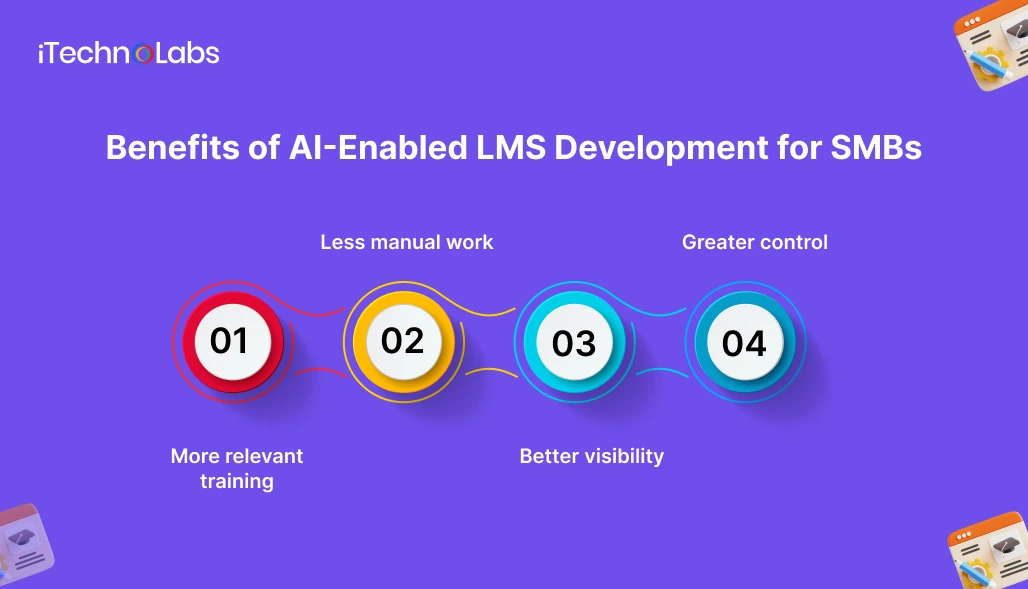
- More relevant training: Personalized recommendations can reduce the effort employees spend searching for the next useful course. The value depends on the quality of the learning content, the relevance of recommendations, and whether employees use the platform.
- Less manual work: Use automation for repetitive tasks such as course assignment, reminders, reporting, and draft content preparation. Keep human approval for policy changes, sensitive training material, and decisions that require professional judgment.
- Better visibility: A well-designed dashboard can help managers identify incomplete training, recurring assessment difficulties, and content that may need revision. These signals can inform follow-up, but they do not automatically prove that a learner lacks a skill.
- Greater control: Custom development may be worth evaluating when standard LMS products cannot accommodate specific approval processes, reporting requirements, data permissions, or integrations.
Customization creates responsibility for maintenance, testing, security, and future changes. Compare those obligations with the limitations and recurring fees of an existing platform before committing.
How Much Does AI LMS Development Cost in 2026?
Custom AI-enabled LMS development can cost approximately US$25,000 to US$60,000 for an MVP, US$60,000 to US$150,000 for a more feature-rich platform, and US$150,000 to US$300,000 or more for an enterprise system, depending on scope and technical requirements. These are indicative planning ranges synthesized from published software development provider estimates, not independently verified industry averages.
Estimated AI LMS development budget
| Platform type | Estimated development cost | Typical scope |
| AI-enabled LMS MVP | US$25,000 to US$60,000 | Course management, learner accounts, assessments, progress tracking, and one focused AI feature |
| Mid-level custom LMS | US$60,000 to US$150,000 | Personalized learning recommendations, AI-assisted content creation, dashboards, and selected third-party integrations |
| Advanced enterprise LMS | US$150,000 to US$300,000+ | Advanced AI workflows, complex integrations, single sign-on, detailed analytics, granular permissions, and enterprise security requirements |
The feature descriptions above are illustrative planning scenarios, not standardized vendor packages. A project can fall outside these ranges depending on the number of users, technical architecture, content migration, compliance requirements, and development team’s rates. Published estimates vary considerably, so compare the scope included in each quotation before setting a budget.
What Determines AI LMS Development Cost?
The cost of AI LMS development depends on platform complexity, required features, integrations, data readiness, and security requirements.
Key cost factors include:
- Core development: Course management, user accounts, assessments, and reporting.
- AI features: Personalized recommendations, knowledge assistants, and content generation.
- Integrations: HR systems, identity providers, and existing content repositories.
- Security and testing: Data protection, access controls, accessibility, and quality assurance.
- Hosting and maintenance: Cloud infrastructure, AI usage, updates, and ongoing support.
How Can You Control Development Costs?
Start with essential LMS features and one or two AI capabilities that address specific training needs. Test them with a pilot group before expanding the platform.
Request an itemized estimate covering development, delivery milestones, recurring fees, exclusions, and source code ownership.
Planning takeaway: Define your training goals, prioritize essential features, and evaluate both development and operating costs before committing to a budget.
Custom LMS or Existing Platform: Which Should You Choose?
An existing LMS is often worth evaluating first when standard course delivery, enrollment, assessments, and reporting meet your requirements. It can reduce the amount of software you need to build and maintain.
Custom LMS development deserves consideration when your workflows, integrations, permissions, reporting, or AI requirements cannot be met adequately through available products.
Before deciding, compare:
- Required features against what existing platforms already support.
- Integration effort and compatibility with your current systems.
- Control over learner data, access permissions, and AI behavior.
- Initial development cost and recurring subscription or infrastructure costs.
- Ownership, portability, maintenance responsibilities, and future flexibility.
Start with the smallest release that solves a measurable training problem. Validate its usefulness before investing in advanced personalization or complex AI workflows.
Risks to Address Before Launch
Building an AI-powered learning management system involves more than implementing features. Businesses must also ensure that learner data stays protected, AI-generated information remains reliable, and the platform behaves as expected in real training environments.
- Data Privacy and Security: Define data access permissions, retention policies, and safeguards for information shared with third-party AI providers.
- AI Accuracy: Test AI responses with realistic questions and incomplete information. Ensure the system acknowledges uncertainty instead of generating unsupported answers.
- Access Control: Prevent unauthorized users from accessing restricted employee records, assessments, and internal learning materials.
- Human Oversight: Review AI-generated lessons, quizzes, and recommendations to maintain accuracy and training quality.
- Ongoing Monitoring: Regularly evaluate system performance, security, and learner feedback to identify issues and improve the platform.
Build an AI-Powered LMS With iTechnolabs
Choosing the right AI learning management system starts with understanding your business requirements, existing technology, and employee training goals. iTechnolabs provides AI development and custom software development services to help businesses plan and build digital products around their specific operational needs.
Whether you are exploring an AI learning assistant, personalized course recommendations, automated training workflows, or integrations with existing business systems, the development approach should begin with a clear scope and defined priorities.
Our team can help you evaluate the technical requirements, identify suitable AI capabilities, plan system integrations, and assess the development effort involved in your LMS project.
Conclusion
AI-enabled LMS development can help businesses create more personalized learning experiences, simplify training administration, and improve visibility into employee learning progress. However, the value of a custom platform depends on choosing the right features, maintaining reliable learning content, and integrating AI where it addresses a genuine business need.
Development costs vary with platform complexity, integrations, AI implementation, security requirements, and ongoing operational expenses. An MVP with a focused set of features can provide a practical starting point, while organizations with complex workflows may require a more extensive development approach.
Before committing to a budget, define your training objectives, compare existing LMS products with custom development, and request an itemized estimate that covers both initial development and long-term maintenance. A clear scope makes it easier to evaluate development partners and avoid paying for features your business does not need.
The best starting point is a learning platform designed around your employees, your workflows, and the outcomes your business wants to achieve.
FAQs
1. What is AI-enabled LMS development?
AI-enabled LMS development involves building or extending a learning management system with AI capabilities such as personalized recommendations, conversational learning assistance, content drafting, or learning analytics. The appropriate features depend on training goals, available data, integrations, and governance requirements.
2. What features should an AI-powered LMS include?
Start with course management, learner accounts, assessments, reporting, and the integrations your business needs. Then prioritize AI features that address a specific problem, such as knowledge search or learning recommendations. Include permissions, evaluation, accessibility, and human review in the requirements from the beginning.
3. How much does AI LMS development cost?
AI-powered LMS development can cost approximately US$25,000 to US$60,000 for an MVP, US$60,000 to US$150,000 for a mid-level solution, and US$150,000 to US$300,000 or more for an enterprise platform. These figures are indicative planning estimates, not independently verified market averages or a project-specific quote. The final cost depends on features, AI integrations, security requirements, data readiness, and implementation complexity.
4. How long does it take to build an AI-enabled LMS?
A reliable timeline cannot be established without knowing the number of features, integrations, content migration needs, security requirements, and testing scope. Ask a development partner to break the estimate into discovery, design, implementation, testing, pilot, and launch milestones.
5. Should a small business build or buy an LMS?
Evaluate existing LMS products first if they meet your training and integration needs. Consider custom development when specific workflows, data controls, reporting, or AI requirements justify the additional cost and maintenance responsibility. Compare total ownership costs rather than the initial purchase price alone.
6. How can an AI LMS protect employee data?
Define access permissions, data retention, encryption, logging, vendor data handling, and incident response requirements before launch. Restrict AI access to authorized information, test for unauthorized disclosure, and review the applicable privacy and regulatory obligations for your organization and locations.