Key Takeaways
- Not every business challenge requires AI, and simpler solutions can often deliver better results.
- Traditional automation works best for repetitive tasks governed by clear, predefined business rules.
- AI helps interpret unstructured information, classify content, extract details, and generate contextual responses.
- Improving inefficient processes before automation prevents businesses from reinforcing unnecessary steps and operational bottlenecks.
- Integrating existing systems can eliminate manual data transfers without requiring entirely new software solutions.
- Businesses should evaluate costs, accuracy, security, and measurable outcomes before investing in AI.
Not every business problem needs new technology. Sometimes, the biggest improvement comes from using existing tools more effectively.
When a workflow becomes slow, repetitive, or difficult to manage, investing in new software can seem like the obvious next step. AI is often part of that conversation, especially when businesses want to reduce manual effort, improve productivity, and scale their operations.
But introducing technology before understanding the problem can create unnecessary complexity.
A business might need AI to interpret unstructured information. It might need traditional automation to eliminate repetitive tasks, an integration to connect disconnected systems, or a simpler process that removes redundant steps altogether.
The right approach depends on the work itself, not the technology receiving the most attention.
Table of Contents
- Traditional Automation vs. AI: Understanding the Difference
- Where Traditional Automation Delivers the Most Value
- When AI Becomes a Worthwhile Investment
- The Overlooked Opportunity: Fixing the Process First
- AI, Automation, Integrations, or Custom Software?
- What Should Businesses Evaluate Before Investing?
- Start With One Workflow And Build From There
- Make AI Work for Your Business With iTechnolabs
- Concluding Words
Traditional Automation vs. AI: Understanding the Difference
Although AI and traditional automation can work together, they serve different purposes.
Traditional automation follows predefined instructions. When a particular condition is met, the system performs an assigned action. It is particularly effective when tasks are predictable, rules are consistent, and the expected outcome is clearly defined.
AI can work with information that varies in structure, wording, or context. It can classify content, extract relevant details, identify patterns, and generate responses based on the information it receives.
Consider a customer support workflow.
Traditional automation can assign a ticket to a team based on a selected category. AI can analyse the customer’s message to identify the underlying issue, even when the customer describes it differently from the available categories.
Neither approach is universally better. The value comes from matching the method to the task.
Where Traditional Automation Delivers the Most Value
Traditional automation is often the practical choice for repetitive activities that follow clear business rules.
Common applications include:
- Lead Management: Automatically capture website enquiries, create CRM records, assign leads to sales representatives, and trigger follow-up reminders.
- Finance and Administration: Generate invoice reminders, update payment statuses, prepare recurring reports, and notify relevant employees when transactions require attention.
- Project Coordination: Create tasks when a project reaches a particular stage, notify owners about approaching deadlines, and update statuses when predefined conditions are satisfied.
- Internal Operations: Route approval requests, send onboarding instructions, synchronise records, and alert teams when specific events occur.
These workflows rarely require a system to interpret complex information. They need consistent execution, dependable integrations, and clear rules.
Traditional automation can also be easier to test and maintain because its behaviour is generally more predictable.
When AI Becomes a Worthwhile Investment
AI is useful when a workflow requires more than following fixed conditions.
Many business processes involve information that arrives through emails, PDFs, conversations, support tickets, reports, and other formats that do not follow a single structure.
Handling this variation manually can consume significant time.
AI can help address these challenges in several ways.
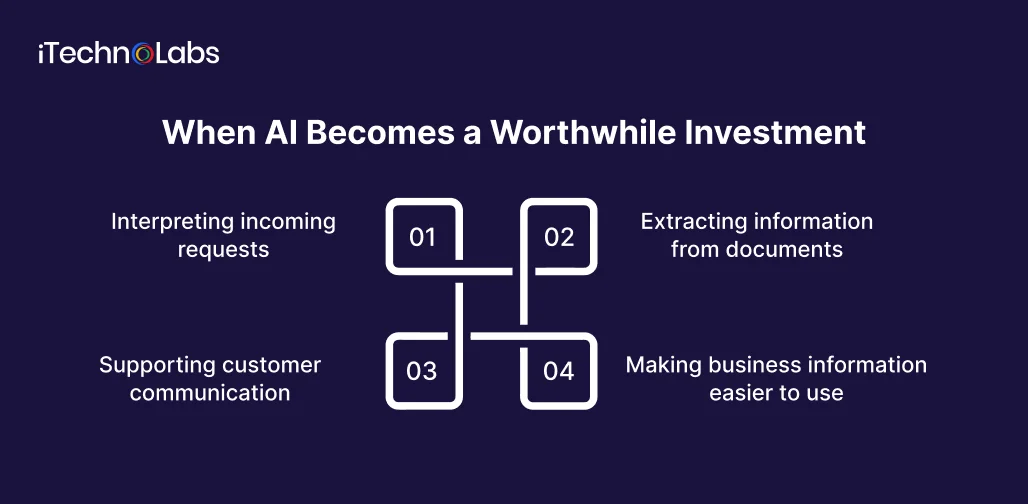
- Interpreting incoming requests
Rather than relying only on keywords, AI can analyse the content of an enquiry, identify its purpose, and suggest the appropriate department or next action.
- Extracting information from documents
AI can identify relevant fields in invoices, contracts, applications, and other documents, even when their layouts differ. Additional validation can then check whether the extracted information is complete and accurate.
- Supporting customer communication
AI can summarise previous conversations, draft contextual responses, identify recurring concerns, and help support teams handle enquiries more efficiently.
- Making business information easier to use
AI can summarise lengthy reports, identify themes across customer feedback, and help employees retrieve relevant information from internal knowledge sources.
However, these capabilities come with considerations. AI outputs can be inaccurate, inconsistent, or influenced by incomplete information. Businesses should account for data privacy, access controls, validation requirements, and human oversight when designing these workflows.
The objective is not to remove people from every decision. It is to reduce the effort required to reach a reliable outcome.
The Overlooked Opportunity: Fixing the Process First
Technology cannot compensate for every operational problem.
Imagine a team that maintains separate spreadsheets for customer information because different departments follow different procedures. Connecting every spreadsheet through automation may save some manual effort, but it can also preserve conflicting records and inconsistent practices.
A better approach might be to establish a single source of truth before introducing integrations.
The same principle applies when approval chains contain unnecessary steps, employees repeatedly request information that already exists, or responsibilities remain unclear between departments.
Before introducing another tool, examine the workflow itself.
Ask a few practical questions:
- Which steps contribute directly to the intended outcome?
- Where does information get duplicated, lost, or delayed?
- Are employees spending time on activities that no longer serve a purpose?
- Can existing software already handle part of the process?
- What exceptions require human judgement?
- How will we measure whether the proposed change has worked?
A process review can reveal opportunities that would otherwise remain hidden behind the demand for new technology.
AI, Automation, Integrations, or Custom Software?
Different operational challenges call for different solutions. The following framework can help businesses make a more informed decision.
- Improve the process when unnecessary approvals, unclear responsibilities, or redundant activities create friction.
- Integrate existing systems when business tools work adequately on their own but require employees to transfer information between them manually.
- Introduce traditional automation when repetitive tasks can be completed through predefined rules and triggers.
- Apply AI when the workflow requires interpreting variable information, classifying content, extracting details, or generating contextual responses.
- Develop custom software when existing products cannot accommodate essential business requirements, specialised workflows, or necessary system interactions.
These options are not mutually exclusive. In many cases, the strongest solution combines several of them.
For example, a document processing workflow could use AI to extract information from an invoice, traditional automation to verify required fields and apply business rules, and an integration to transfer validated data into accounting software. Exceptions could be routed to an employee for review.
Each component has a defined responsibility. AI handles interpretation, automation manages predictable actions, and existing systems retain their role in the business process.
This approach avoids forcing one technology to solve every part of the problem.
What Should Businesses Evaluate Before Investing?
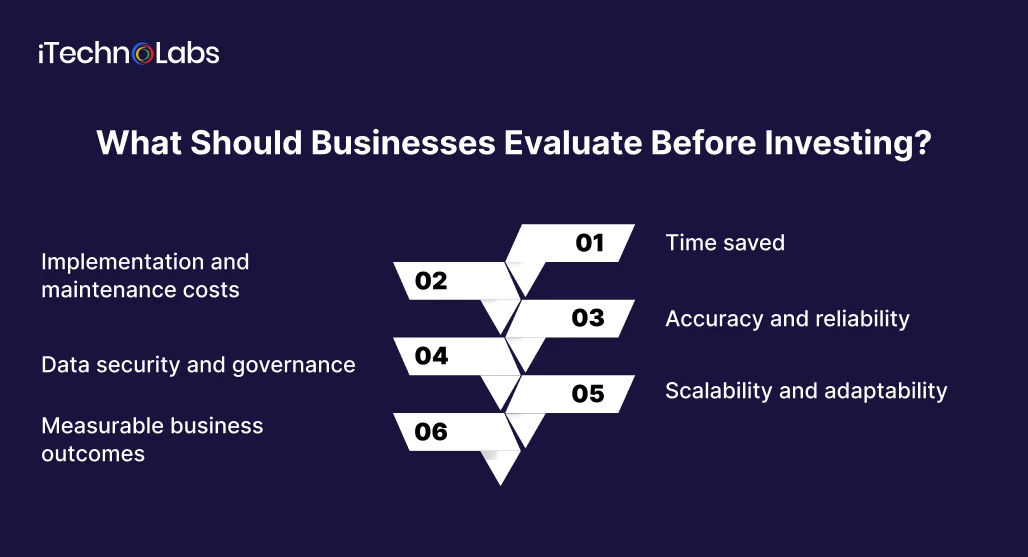
Choosing an approach requires more than comparing software features. It also means understanding the operational and financial implications.
- Time saved: Estimate how much employee time the current workflow consumes and which activities can realistically be reduced or eliminated.
- Implementation and maintenance costs: Consider development, software subscriptions, integration work, monitoring, employee training, and ongoing support.
- Accuracy and reliability: Determine how often the workflow encounters exceptions, how costly mistakes could be, and what validation is necessary.
- Data security and governance: Identify the information involved, who should access it, where it will be processed, and what safeguards are required.
- Scalability and adaptability: Consider whether the proposed solution can handle increasing workloads and changing business requirements without introducing excessive complexity.
- Measurable business outcomes: Define success before implementation. Relevant indicators might include processing time, error rates, response times, manual interventions, cost per transaction, or customer satisfaction.
A solution that saves a few minutes but introduces significant maintenance overhead may not be worthwhile. Equally, a carefully designed automation that removes hundreds of repetitive tasks can deliver substantial value without requiring AI.
The decision should be based on measurable improvements rather than technological novelty.
Start With One Workflow And Build From There
Transforming business operations does not require replacing every system or automating every department at once.
Start with a process that creates a visible operational burden. Document its steps, identify the people and tools involved, measure the existing performance, and locate the points where unnecessary effort accumulates.
Then choose the smallest practical intervention that addresses the underlying issue.
Test the change against clear success criteria. Review its reliability, gather feedback from the people using it, and refine the workflow before expanding the approach to other areas.
This incremental method helps businesses validate the value of an investment before committing to a broader implementation.
Make AI Work for Your Business With iTechnolabs
AI delivers the greatest value when it addresses a clear business need. At iTechnolabs, we help businesses identify the right opportunities, choose practical technologies, and implement solutions that improve efficiency without adding unnecessary complexity.
Our AI specialists work with your team to understand existing workflows, identify operational bottlenecks, and determine where AI, traditional automation, or system integration can deliver measurable results.
How We Help Your Business
- Identify the Right AI Opportunities: Assess existing processes, uncover repetitive tasks, and identify where AI can reduce manual effort and improve productivity.
- Develop Intelligent Automation Solutions: Combine AI capabilities with rule-based automation to streamline workflows, process information, and reduce repetitive administrative work.
- Integrate Your Existing Business Systems: Connect your CRM, ERP, accounting software, and other business applications to improve information flow and minimise manual data entry.
- Build Custom AI-Powered Applications: Develop tailored AI solutions that address specific business requirements, from intelligent document processing and information extraction to AI-assisted decision-making.
- Improve Accuracy and Control: Implement appropriate validation, human oversight, and governance measures to help maintain reliable outputs and responsible AI adoption.
- Measure Performance and Improvements: Evaluate results against business goals, track operational improvements, and refine solutions as your requirements evolve.

Concluding Words
AI, traditional automation, integrations, and custom software all have a place in modern business operations. Their effectiveness depends on how well they address a specific need.
The goal is not to introduce more technology. It is to create workflows that require less unnecessary effort, connect information more effectively, and help people focus on work that demands their expertise.
We help businesses assess their existing systems, identify operational bottlenecks, and determine where process improvements, integrations, automation, or AI can deliver meaningful results.
Whether the answer is a simpler workflow or a purpose-built solution, the starting point remains the same: understand the problem before deciding how to solve it.