Key Takeaways
- Most expensive app mistakes happen before or outside the coding itself, especially around validation, scope, architecture, testing, and partner selection.
- A smaller, clearly defined MVP can reduce unnecessary development work while giving founders something real to test with users.
- Technical decisions should follow product requirements, integrations, security needs, and future growth rather than developer preference alone.
- Testing, privacy, and security need to be part of development from the beginning rather than treated as final launch tasks.
- The right development partner should help identify technical and product risks before they become expensive rework.
The most common app development mistakes to avoid are unclear product scope, building before validation, choosing technology too early, underestimating integrations, cutting testing, and treating security as a final step. For startups, these mistakes can consume runway through rework, delayed launches, technical debt, and features users never needed.
For a funded startup, the problem is rarely just the development bill. A poor decision can also delay validation, push back revenue opportunities, create expensive rework, or leave the team maintaining a product that does not match what users actually need.
Research on large IT projects shows why execution discipline matters. McKinsey and the University of Oxford found that large IT projects in their study ran an average of 45 percent over budget and 7 percent over time while delivering 56 percent less value than predicted. These figures apply to large IT projects, not specifically startup mobile apps, but they illustrate the financial impact of weak project execution.
Here are the mistakes founders should address before development turns into expensive rework.
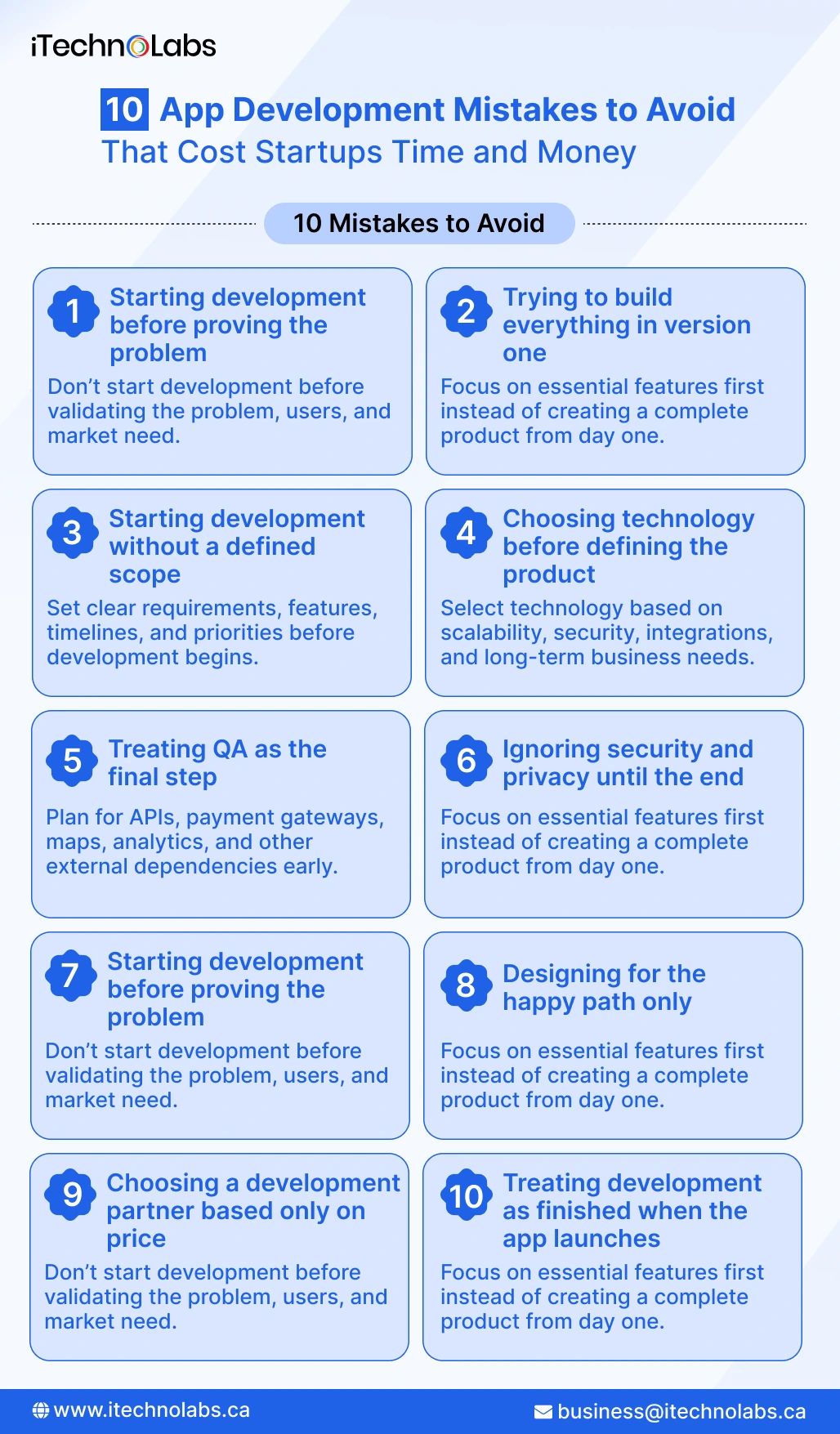
Table of Contents
- 1. Building Before Validating the Problem
- 2. Defining the Product Too Loosely
- 3. Underestimating What Sits Behind the App
- 4. Cutting Quality to Protect the Launch Date
- 5. Choosing the Wrong Development Approach
- How to Avoid These App Development Mistakes
- Why Choosing iTechnolabs is the Smart Move?
- Conclusion
- FAQs
1. Building Before Validating the Problem
Mistake 1. Starting development before proving the problem
An app idea can sound compelling internally and still fail to solve a problem users care enough about.
The mistake is moving directly from an idea to wireframes, development estimates, and engineering without first testing the underlying assumption. Founders may define dozens of features before confirming who the core user is, what problem matters most, how the existing problem is handled, and what would make someone change their current behavior.
The solution is not to spend months researching before writing code. It is to validate the highest risk assumptions first.
That can include customer interviews, competitor research, workflow analysis, clickable prototypes, landing page tests, or a narrowly scoped MVP. The exact approach depends on the product and its target users.
The goal is simple. Before investing heavily in development, establish what the first version actually needs to prove.
Mistake 2. Trying to build everything in version one
Startups often treat the first release as if it needs to represent the finished company.
That leads to large feature lists, multiple user roles, complex dashboards, advanced integrations, elaborate notification systems, and secondary features that have not yet been validated.
The result is more development effort before the startup has meaningful product feedback.
A better approach is to define the smallest version that can test the core business proposition. That does not mean building a poor-quality product. It means limiting the product to the workflows that matter most for the first validation cycle.
A clear MVP also makes technical planning easier. Developers can make deliberate architecture decisions around the initial requirements instead of building infrastructure for hypothetical features.
2. Defining the Product Too Loosely
Mistake 3. Starting development without a defined scope
A sentence such as build an app like this one is not a development specification.
Developers need to understand user roles, workflows, business rules, integrations, data requirements, permissions, edge cases, platforms, and expected behavior. When those details remain unclear, different people make different assumptions.
That creates scope changes during development.
Scope changes are not always avoidable. Startups learn as they build, and some requirements will change. The problem is uncontrolled change without understanding its effect on time, architecture, testing, and budget.
Before development begins, the team should document the core user journeys, feature priorities, technical requirements, integration dependencies, and acceptance criteria as part of a defined mobile app development process. A change can then be evaluated against the original product objective instead of being added simply because someone requested it.
This is also where a development partner should challenge unclear requirements rather than immediately estimate them.
Mistake 4. Choosing technology before defining the product
React Native, Flutter, native iOS, native Android, Node.js, cloud platforms, databases, and AI services all have legitimate use cases.
The mistake is selecting a technology because it is popular or because the development team prefers it before the product requirements are understood.
Technology selection should follow the product.
The decision should consider target platforms, device requirements, performance expectations, integrations, security, available development skills, maintenance requirements, and the product roadmap.
For example, a startup that needs rapid cross-platform validation may have different requirements from a product that depends heavily on platform-specific capabilities or complex device functionality.
The right question is not which technology is best in general. It is which architecture fits the product you are actually building.
3. Underestimating What Sits Behind the App
Mistake 5. Treating integrations as a small development task
The mobile interface is only one part of many modern applications.
A product may need payment processing, maps, authentication, CRM systems, ERP software, analytics, messaging, cloud storage, third-party APIs, identity providers, or internal business systems.
Each integration introduces requirements around authentication, data mapping, error handling, rate limits, permissions, testing, monitoring, and failure recovery.
An integration that looks simple from the user interface can become a significant technical dependency.
That is why integration requirements should be identified during discovery rather than added after the main application has already been designed.
The same applies to backend architecture. Decisions around APIs, databases, authentication, data models, background processing, and hosting can affect how easily the product evolves later.
Mistake 6. Ignoring security and privacy until the end
Security is not a final testing activity.
OWASP’s Mobile Application Security Verification Standard covers areas including secure data storage, cryptography, authentication and authorization, network communication, platform interaction, code quality, resilience, and privacy. These areas need to be considered throughout development.
For startups handling personal, financial, healthcare, location, or other sensitive information, the consequences of weak security can extend well beyond fixing a technical defect.
Privacy requirements also affect product design. Apple requires developers to provide information about app privacy practices in App Store Connect, including relevant data collection practices from third-party code integrated into the app.
The practical approach is to identify sensitive data, define who can access it, determine where it is stored, establish authentication and authorization rules, and review third-party services before implementation.
Security decisions made early are usually easier to manage than security problems discovered after launch.
4. Cutting Quality to Protect the Launch Date
Mistake 7. Treating QA as the final step
When a launch date becomes important, testing is often the first area pressured to shrink.
That creates a false tradeoff. The team may appear to save time by reducing testing, but defects discovered after release can consume engineering capacity while affecting users and slowing product development.
Testing should cover more than whether each screen works in isolation.
A serious test plan should examine critical user journeys, API behavior, authentication, payments where relevant, device compatibility, network interruptions, permissions, error states, performance, and regression risks.
Google’s current Android quality guidance specifically recommends testing performance, stability, platform compatibility, third-party SDK maintenance, and representative devices. It also recommends using tools such as the Google Play pre-launch report and Android Vitals to identify stability issues.
Apple similarly advises developers to test for crashes and bugs on devices running the latest software before submission. Apple reports that more than 40 percent of unresolved App Review issues are related to its App Completeness guideline, which includes crashes, placeholder content, and incomplete information.
Mistake 8. Designing for the happy path only
A product can work perfectly when everything goes right and still fail users when something changes.
- What happens when the network disappears during checkout?
- What happens when an API returns an error?
- What happens when a user denies location access?
- What happens when a payment succeeds but the confirmation request fails?
- What happens when a user switches apps during a critical workflow?
These cases need to be designed and tested before release.
Android’s current quality guidance includes testing interruptions, device states, major user flows, performance, stability, and representative hardware and software combinations.
For startups, this matters because the first users are also providing the first serious test of the product. A weak launch experience can make it harder to distinguish a product problem from a quality problem.
5. Choosing the Wrong Development Approach
Mistake 9. Choosing a development partner based only on price
The lowest development estimate does not necessarily represent the lowest project cost.
Two proposals can look similar while making very different assumptions about discovery, design, architecture, testing, project management, integrations, documentation, and post-launch support.
A lower initial quote can become more expensive if important requirements were excluded or if the project requires significant rework later.
Startups should compare proposals based on what is actually included and use a clear set of questions to ask an app development company before signing.
Look at how the team handles discovery, scope changes, technical decisions, QA, communication, code ownership, documentation, security, deployment, and ongoing maintenance.
The right partner should be able to explain what the estimate includes and identify uncertainties instead of hiding them.
Mistake 10. Treating development as finished when the app launches
Launch is not the end of product development.
Once users interact with the product, the startup gains information that was impossible to obtain during development. Some features will perform better than expected. Others may rarely be used. New technical issues may appear under real traffic. User behavior may expose friction in important workflows.
That means the development plan should include analytics, monitoring, feedback collection, maintenance, and a process for prioritizing improvements.
Product analytics can help teams measure meaningful events rather than relying only on downloads or registrations. Firebase, for example, supports predefined and custom events that can be used to measure important actions inside an application.
The objective is not to build everything after launch. It is to use real product evidence to decide what deserves the next investment.
How to Avoid These App Development Mistakes
Avoiding expensive mistakes starts before the first sprint.
Begin with a clear product definition. Identify the target user, core problem, primary workflow, MVP scope, technical requirements, integrations, security considerations, and success criteria.
Then validate the highest-risk assumptions before committing to a large build.
Once the scope is clear, select the architecture and technology based on the actual requirements. Establish development standards, testing expectations, security controls, analytics requirements, and release criteria before implementation begins.
The development partner should also have a process for handling change. Startups need flexibility, but flexibility without scope control quickly becomes uncontrolled development.
A practical development process therefore looks like this.
Validate the problem → Define the MVP → Document requirements → Plan architecture → Build incrementally → Test continuously → Launch with analytics → Prioritize based on evidence.
This approach does not eliminate uncertainty. It makes uncertainty visible early enough to manage.
Why Choosing iTechnolabs is the Smart Move?
Avoiding costly development mistakes starts with making the right decisions early. iTechnolabs helps startups define product scope, plan architecture, choose the right technology, manage integrations, and build mobile apps for iOS, Android, React Native, and Flutter.
With 500+ apps delivered, 300+ developers, and ISO 27001:2013 and ISO 9001:2015 certifications, iTechnolabs brings structured development practices to startup projects.
Have an app idea? Start by reviewing what needs to be built, what should be validated, and where development risks could add unnecessary cost.
Conclusion
App development mistakes rarely begin with a coding error. They usually start with decisions made before development begins, such as building without validation, expanding the MVP too far, leaving requirements unclear, choosing technology too early, or overlooking integrations and security.
The same applies during delivery. Cutting QA, ignoring edge cases, selecting a partner based only on price, or launching without a plan for product feedback can create problems that are harder and more expensive to fix later.
The better approach is to control uncertainty early. Validate the problem, define the MVP, document the requirements, plan the architecture, identify integrations, build with security and testing in mind, and use real user feedback to guide what comes next.
For startups working within limited runway, disciplined development is not about building less for the sake of saving money. It is about investing development effort where it can actually move the product forward.

FAQs
1. What are the most common app development mistakes to avoid?
The most common mistakes include building before validating the problem, overloading the MVP with features, starting with unclear requirements, choosing technology too early, underestimating integrations, delaying security, reducing QA, ignoring edge cases, selecting a partner based only on price, and treating launch as the end of development. Each can create avoidable rework or product risk.
2. How can startups reduce app development costs?
Startups can reduce unnecessary development costs by validating the product early, defining a focused MVP, documenting requirements, identifying integrations before development, and prioritizing features based on user and business value. Cost control is not simply about reducing developer hours. It is about avoiding work that later has to be redesigned, rebuilt, or removed.
3. Should a startup build an MVP before developing the full app?
An MVP can be useful when the startup needs to validate a product assumption before making a larger investment. The MVP should contain the minimum functionality required to test the core proposition rather than a collection of unfinished features. The appropriate scope depends on the product, target users, technical requirements, and validation goals.
4. How early should security be considered in app development?
Security should be considered during product planning and architecture rather than added immediately before launch. Requirements around authentication, authorization, data storage, network communication, sensitive information, third-party services, and privacy can affect both the architecture and user experience. OWASP’s MASVS provides a structured baseline for evaluating mobile application security.
5. How much testing does a mobile app need before launch?
Testing should cover the app’s critical workflows, integrations, supported devices and operating systems, performance, stability, permissions, network conditions, and important error states. The required depth depends on the product and its risk profile. Android and Apple both provide platform-specific quality and review guidance that should be incorporated into the release process.
6. What should startups look for in an app development partner?
Startups should evaluate how a development partner handles discovery, requirements, architecture, scope changes, testing, security, communication, code ownership, deployment, and post-launch support. The comparison should focus on what each proposal includes rather than only the headline price. A development partner should also identify project risks and assumptions before implementation begins.