Key Takeaways
- A dedicated team fits a product whose scope will keep changing for months. For a fixed, well-defined build, a fixed-price contract is easier to manage.
- Define roles, success metrics, and decision rights before you speak to any vendor.
- Score vendors on a weighted checklist. Security evidence, team stability, and reference calls should outweigh hourly rate.
- Pay for a pilot sprint before you sign a long-term contract.
- Write IP ownership, replacement, and exit terms into the contract on day one.
To hire a dedicated development team, define your roles and success metrics, shortlist vendors against a scored checklist, run a paid pilot sprint, then sign a contract covering IP ownership, security, and replacement terms. Treat it as a vendor evaluation, not a recruitment drive: you are choosing a delivery partner.
If your roadmap is ahead of your headcount, or leadership has handed you an AI mandate without an AI team, adding external development capacity can help you move forward without waiting for a full internal hiring cycle. A dedicated team puts engineers on your backlog sooner, but it moves the risk from recruiting to vendor selection. This playbook covers the five decisions that determine whether the engagement holds up: model fit, team design, vendor evaluation, pilot and contract, and onboarding.
Table of Contents
Confirm a Dedicated Team Is the Right Model
A dedicated development team works best when you need a group of engineers focused on one product over an extended period and expect the roadmap to change as the product develops. You set the priorities, control the backlog, and provide product direction, while the vendor typically handles recruitment, payroll, equipment, and team administration.
The important question is not whether a dedicated team is available. It is whether the engagement model matches the way your product will be built and managed. Compare it with the other common options before making a decision.
| Model | Best when | You control | Main risk |
| Dedicated team | Scope will evolve; product is long-lived | Priorities, backlog, team direction | Needs an internal product owner |
| Staff augmentation | You lack one or two specific skills | Daily tasks of each individual | Your managers carry the coordination load |
| Fixed-price project | Scope and deadline are firm | Scope, at signing only | Every change request reprices the work |
| Freelancers | Short, bounded tasks | Task by task | Continuity and availability |
A dedicated team is usually worth considering when three conditions are present. First, the product roadmap is expected to change over several months rather than ending with one defined release. Second, the product will require continued development after the initial launch. Third, someone on your side can make product decisions and prioritize the backlog regularly.
If all three conditions apply, a dedicated team gives you more control over priorities while allowing the vendor to manage the development capacity. If you only need a specific skill for a limited period, staff augmentation may be more appropriate. If the requirements and deadline are already fixed, a fixed-price engagement may require less ongoing coordination.
The internal product owner is particularly important. A dedicated team can build what you ask for, but someone on your side still needs to decide what should be built next, clarify competing requirements, review priorities, and accept completed work. Without that role, the team can spend time waiting for decisions or working on lower-priority tasks.
Once the model is confirmed, you can hire dedicated developers with a clear brief instead of an open-ended search.
Define the Team and Budget Frame Before Contacting Vendors

Do not let the vendor decide your team structure before you have defined your own requirements. Start with the product roadmap and identify the skills, responsibilities, and level of involvement you need. Vendors can then recommend adjustments based on their delivery experience rather than building the team around the people they currently have available.
Define the Team Structure
Start with the roles required to deliver the next stage of your product. The exact mix will depend on your technology stack, roadmap, and existing internal team.
- Product owner: Owns priorities, manages the backlog, and makes product decisions.
- Tech lead or architect: Guides technical decisions, architecture, and engineering standards.
- Developers: Build and maintain the product based on the required technology stack.
- QA engineers: Define and execute testing processes and help maintain release quality.
- Delivery manager: Coordinates delivery, dependencies, communication, and progress.
- Specialists when required: Add DevOps, design, data, or other specialists when the roadmap requires those capabilities.
Do not build the team around every role a vendor offers. Start with the work that needs to be delivered, then determine which roles are necessary to support it. You can expand or rebalance the team after the pilot as the roadmap becomes clearer.
Define Success Metrics
Agree on how you will determine whether the team is delivering effectively. Keep the initial set focused on three or four measures that can be reviewed consistently.
- Release frequency: How regularly completed work reaches production.
- Cycle time: How long work takes from being started to reaching production.
- Production defects: How many issues escape into the live product.
- Roadmap outcome: One measurable product or business result connected to the work being delivered.
These metrics give both sides a shared basis for reviewing performance. They also make it easier to identify whether a problem comes from team capacity, unclear requirements, technical constraints, or changing priorities.
Establish Decision Rights
Define who has authority to make different types of decisions before development begins. This prevents the team from waiting for approvals or receiving conflicting instructions.
- Architecture: Who approves significant technical or architectural changes?
- Product priorities: Who decides what enters or leaves the backlog?
- Acceptance: Who confirms that completed work meets the requirements?
- Team changes: Who can request additional roles or changes to the team?
- Escalation: Who handles issues that the development team cannot resolve?
A dedicated team still needs clear direction from the client side. Without defined decision rights, even a capable team can lose time waiting for clarification or responding to competing priorities.
Establish the Budget Frame
Do not compare vendors using hourly rates alone. First define what you actually need to pay for, then compare the total monthly cost of the proposed team.
The cost will depend on factors such as:
- Team size: More roles and developers increase the monthly cost.
- Seniority: Senior engineers and specialist roles generally cost more than junior positions.
- Technology requirements: Less common or highly specialized skills can affect rates.
- Delivery location: Vendor location and delivery model influence pricing.
- Included services: Determine whether QA, DevOps, design, delivery management, or other services are included.
- Team composition: A team with several senior specialists will have a different cost structure from a team with a broader mix of experience levels.
Ask every shortlisted vendor for an itemized monthly proposal showing the team composition, role, seniority, rate, and included services. This makes the proposals easier to compare and helps you understand what you are actually paying for rather than selecting a vendor based on the lowest hourly rate.
Evaluate Vendors With a Weighted Scorecard
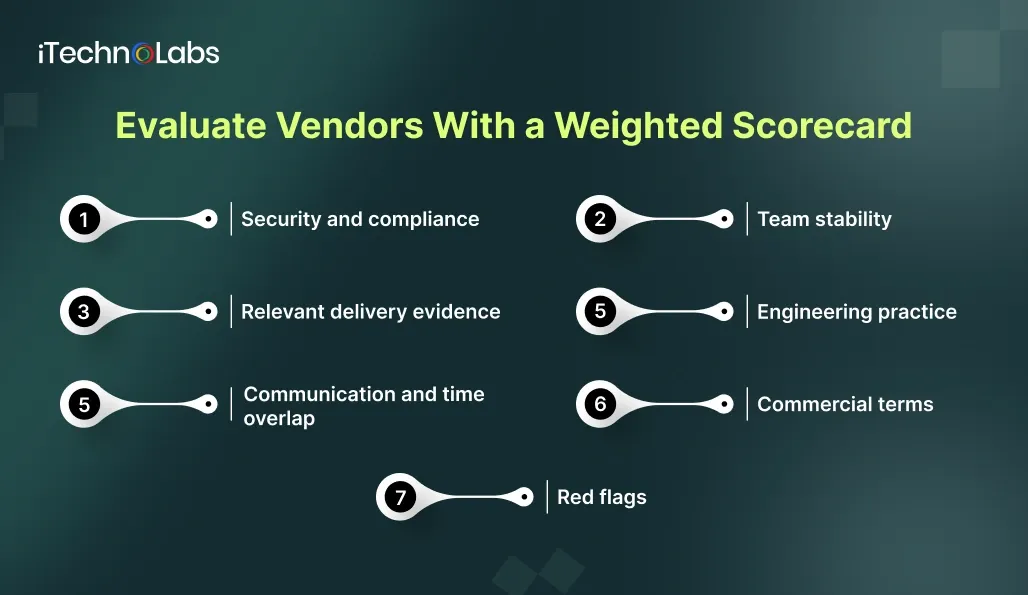
Do not let hourly rate become the main factor when choosing a dedicated development partner. A lower rate does not necessarily mean a lower overall cost if the team creates rework, requires more supervision, or changes frequently. Before speaking with vendors, agree on the evaluation criteria and their relative importance. If you are still defining your broader hiring requirements, start with this guide on how to hire a developer for a project.
Use the scorecard below to compare vendors consistently. Have at least two people from your organization score each vendor independently, then discuss the differences before making a decision. The suggested weights are a starting point. If your project involves regulated or sensitive data, security and compliance should carry more weight.
| Criterion | Suggested weight | What to ask for |
| Security and compliance | 25% | Certificates, scope statements, access-control and incident processes |
| Team stability | 20% | Attrition, replacement policy, named team members |
| Relevant delivery evidence | 20% | Two reference calls with similar products |
| Engineering practice | 15% | Code review process, CI/CD pipeline, documentation samples |
| Communication and time overlap | 10% | Working-hour overlap, reporting cadence |
| Commercial terms | 10% | Itemized quote, notice period, exit terms |
1. Security and compliance: Ask the vendor to provide its ISO/IEC 27001 certificate, issuing body, and certificate scope rather than simply accepting a claim of being certified. Review how the vendor manages access, security incidents, and sensitive project information. The certificate scope is important because it shows which parts of the organization and which locations are actually covered.
2. Team stability: Find out who will work on your account and how the vendor handles employee departures. Ask about the replacement process, knowledge transfer, and how quickly a replacement can become productive. Before signing, speak with the proposed tech lead and developers rather than evaluating the engagement only through a sales representative.
3. Relevant delivery evidence: Look for experience that resembles your product, technology stack, complexity, or industry requirements. Ask for client references and speak directly with those clients where possible. Instead of asking only whether the vendor delivered successfully, ask how they handled missed expectations, changing requirements, technical problems, or team changes.
4. Engineering practice: Ask how the team handles code reviews, testing, CI/CD, documentation, technical debt, and production issues. Request examples of their development process or documentation where appropriate. The goal is to understand how engineering quality is maintained after the initial development work is complete.
5. Communication and time overlap: Clarify working hours, meeting schedules, escalation paths, reporting practices, and response expectations before the engagement starts. A technically capable team can still create friction if communication responsibilities and availability are unclear.
6. Commercial terms: Request an itemized proposal showing the roles involved, team composition, rates, included services, and any management or QA costs. Review notice periods, replacement terms, and exit conditions alongside the monthly price. This gives you a clearer basis for comparing the total engagement rather than comparing hourly rates alone.
7. Red flags: Be cautious when a vendor agrees to every feature and deadline without asking questions about scope, dependencies, or technical constraints. Other warning signs include being unable to name the proposed team, refusing reasonable reference checks, avoiding questions about replacement procedures, or providing pricing that cannot be explained by role or service.

Run a Paid Pilot, Then Lock the Contract Terms
Before committing to a long-term engagement, test the team on real work. A paid pilot of one or two sprints gives you an opportunity to evaluate how the developers communicate, estimate work, review code, document decisions, and respond to changing requirements before you expand the relationship.
Use real backlog items rather than a separate test project. This shows how the team performs in the environment they will actually work in and gives both sides a clearer understanding of expectations. During the pilot, pay attention to four areas: the quality of code reviews, whether developers ask useful questions before starting work, how closely estimates match actual delivery, and whether documentation is maintained as part of the development process.
The goal is not to prove that the team can complete a sprint. It is to determine whether they can work effectively within your product, processes, and expectations. If the pilot exposes gaps, you can address them before making a longer commitment.
Once the pilot meets your expectations, move to the long-term agreement. Work with your legal counsel to clearly define the terms that protect both sides:
- IP assignment: Specify that intellectual property created for the project belongs to you and keep repositories under your own accounts from the beginning.
- Confidentiality and data handling: Define confidentiality obligations, data processing requirements, and how production data can be accessed or used.
- Security obligations: Establish access requirements such as your identity provider, multi-factor authentication, and least-privilege permissions.
- Replacement terms: Define how quickly a departing team member must be replaced and how knowledge transfer will be handled.
- Notice and exit: Establish the notice period and require the handover of source code, documentation, credentials, and other project assets when the engagement ends.
The contract should make the working relationship clear before problems arise. Well-defined IP, security, replacement, and exit terms give both parties a clear process for handling changes throughout the engagement.
Onboard for the First 90 Days
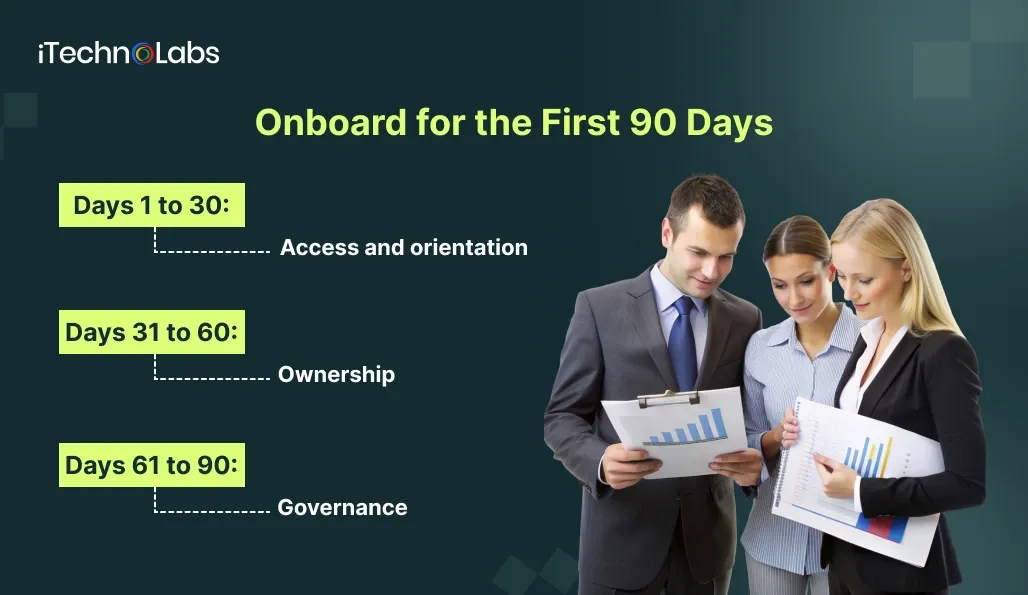
A dedicated team becomes an extension of your organization only through deliberate integration. Plan it in three stages.
Days 1 to 30: access and orientation.
- Provision accounts, environments, and repositories. Walk the team through the architecture and the reasoning behind past decisions.
- Set shared tooling, documentation standards, and meeting rhythm. Assign small first deliveries so review habits form early.
- For guidance on how team roles and ceremonies fit together, find how to hire an agile software development team.
Days 31 to 60: ownership.
- Once the team understands the product and development process, move from guided tasks to defined ownership.
- Give the team responsibility for a specific module, service, or product area and make its responsibilities clear.
- Review progress against the success metrics you established during vendor selection.
- Use retrospectives to identify communication gaps, unclear requirements, technical issues, or role changes that need to be addressed before the team takes on more responsibility.
Days 61 to 90: governance.
- By this stage, the focus should shift from initial onboarding to a repeatable working model.
- Review delivery performance, quality, team composition, and progress against your agreed metrics.
- Decide whether the team needs to grow, remain at its current size, or change its role mix as the roadmap evolves.
- Establish a regular operating rhythm, such as weekly backlog reviews, monthly performance or steering meetings, and quarterly roadmap planning.
- This gives both sides a clear structure for managing priorities and making changes as the product develops.
Final Words
Hiring a dedicated development team is not simply about finding developers with the right technical skills. The stronger approach is to define the work, team structure, success metrics, decision rights, security requirements, and commercial terms before selecting a vendor.
Evaluate potential partners on relevant delivery experience, team stability, engineering practices, communication, and security rather than hourly rate alone. A paid pilot can then help validate how the team works before a long-term commitment.
Once selected, give the team clear ownership, proper product context, measurable expectations, and a defined governance process. When the engagement is structured around these factors, a dedicated development team can become a practical extension of your engineering organization while giving you the flexibility to adjust capacity as your roadmap changes.

FAQs
1. How long does it take to hire a dedicated development team?
Timing depends mostly on how quickly you finalize scope and complete vendor diligence. The main stages are preparing roles and metrics, shortlisting, interviews, and a pilot sprint. Budget time for the pilot, because it gives real performance evidence. Treat any vendor promising a fully staffed team within days with caution.
2. What is the difference between a dedicated development team and staff augmentation?
A dedicated team is a group the vendor assembles and typically helps manage, working exclusively on your product. Staff augmentation adds individual specialists to your existing team, and your managers direct them. For a broader comparison of these engagement models, see staff augmentation vs dedicated team. Choose a dedicated team for a long-lived product, and augmentation to fill specific skill gaps.
3. What should a dedicated development team contract include?
Include IP assignment to you, confidentiality and data-handling terms, security obligations, a replacement process for departing engineers, and a notice period. Add an exit clause covering handover of code, documentation, and credentials. Have your legal counsel review the agreement before signing, especially if you handle regulated data.
4. How much does it cost to hire a dedicated development team?
A dedicated development team typically costs $12,000 to $40,000 per month for a small offshore team of three to five engineers in 2026. The actual cost depends on team size, seniority, technology stack, location, and whether roles such as QA, DevOps, design, and delivery management are included.
5. Who owns the code when you hire a dedicated team?
You should. The contract must assign intellectual property to you as work is created, and repositories should live in your own accounts from day one. Confirm that the vendor’s engineers sign matching agreements, and that no third-party code enters the codebase without disclosure.
6. What are the warning signs of a weak dedicated team vendor?
Watch for a vendor that agrees to every request without questions, cannot name the people on your team, refuses reference calls, or cannot itemize pricing by role. Also be wary of offering CVs instead of interviews with the engineers who will actually work on your product.