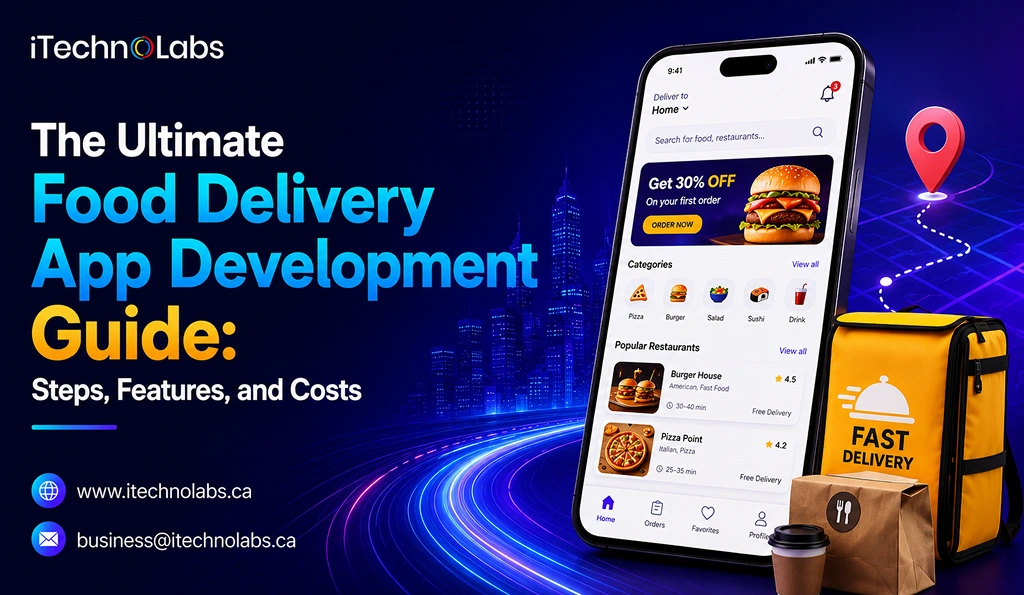
The food delivery sector has witnessed an outstanding increase recently, mainly because of the evolution in consumer choices, widespread smartphone usage, and the desire for convenience. Industry analysts forecast the worldwide online food delivery business to exceed $1.80 trillion by 2035 as more and more people choose to order food via mobile applications instead of eating out or making a phone order.
With growing competition from eateries, startups, cloud kitchens, and food chains, they are focusing on launching food delivery applications through food delivery app development to offer a smooth ordering process, retain customers better, and open up new sources of revenue. The current food delivery applications provide functionalities like tracking the order live, making payments safer, giving product suggestions based on user preference, and managing delivery in a quicker way, thereby becoming a vital component of the food service area these days.
In case you want to start a brand new food delivery service or take the restaurant business you already have to the digital world, grasping the development process is really important. This article shows you the key stages, features that you cannot do without, total cost of development, and the hottest trends in food delivery application development that will enable you to construct a viable and scalable product.
TL;DR
- Food delivery apps help businesses expand customer reach quickly.
- Essential features improve ordering, payments, tracking, and engagement.
- Development costs vary based on complexity and functionality requirements.
- AI and automation are shaping future food delivery experiences.
- Scalable architecture ensures long-term growth and operational efficiency.
Key Points
- A food delivery application provides a simplified and enhanced platform for restaurants and startup owners to manage their businesses and grow their income streams.
- A user-friendly interface, secured payment options, real-time tracking, and effective order management are crucial components of a food delivery application.
- The cost of development varies depending on complexity, required features, development platforms, tech stack, and third-party integration.
- Technologies like AI, ML, and predictive analysis can drastically help in personalizing service and improving delivery time.
- Constant maintenance, optimization, and updates are necessary to retain user interest.
Table of Contents
- What is Food Delivery App Development?
- Why Invest in Food Delivery App Development?
- Key Steps in Food Delivery App Development
- Essential Features of a Food Delivery App
- Advanced Features for Competitive Advantage
- Food Delivery App Development Cost
- Best Practices for Food Delivery App Development
- Future Trends in Food Delivery App Development
- Why Choose iTechnolabs for Food Delivery App Development?
- Conclusion
- FAQs
What is Food Delivery App Development?
Developing a food delivery app involves creating digital tools that let users place orders from various eateries and food outlets through mobile devices or computers. These apps connect users with food providers and delivery personnel, while also offering a platform for business management, resulting in a smooth and well-organized ordering process.
New-age food delivery applications enhance each step of the customer’s experience. Firstly, they help users locate restaurants near them easily. Then, they allow customers to check the menus without any hassle. Secure and quick payment options are also available, while users can even monitor their food being delivered live. Such systems not only make the food ordering process comfortable for the users but also, at the same time, enable businesses to better serve customers, raise their sales, and manage deliveries more effectively.
Given the rapid growth of consumer habits favoring online and on-demand ordering, embarking on food delivery app development is a way for businesses to double down on their online presence, reach a broader audience, and maintain their competitiveness in the swiftly changing food service market. Leading food delivery apps usually mix features like tailored suggestions, instant order visibility, diverse payment methods, customer feedback, reward schemes, and powerful data analysis for an excellent user experience.
Why Invest in Food Delivery App Development?
The increasing popularity of ordering food online has changed what customers expect. Convenience, fast service, and 24/7 availability are now the main features of the eating experience. Since more and more people are ordering their food via mobile apps, food delivery app development has really become a clever investment move for restaurants, cloud kitchens, and food businesses who want to stay ahead in the competition and achieve profitable growth.
Creating a separate food delivery app is an excellent means for businesses to establish a direct connection with their customers, cut down the dependence on third-party platforms, and customize the customer experiences to boost the number of orders. Also, it helps a great deal in consolidating business operations, improving the efficiency of the delivery, and providing a basis for business intelligence with data-driven insights.
Key benefits of investing in food delivery app development include:
- Expanding market reach and attracting a larger customer base
- Increasing order volume, sales, and overall revenue potential
- Delivering a convenient and seamless ordering experience
- Strengthening customer loyalty through personalized offers and rewards
- Improving operational efficiency with automated order management
- Gaining actionable insights through customer behavior and analytics
- Enhancing brand visibility and digital presence
- Supporting business scalability and long-term growth
As the food delivery sector is constantly changing, stores that put their money into creative and easy-to-use delivery apps are in a stronger position to fulfill customers’ expectations, increase profits, and hold on to the competitive edge in the market.
Key Steps in Food Delivery App Development
Developing a successful food delivery app entails thorough planning, smart decision-making, and a customer-focused mindset. Choosing a perfect business model, producing the app, and its maintenance after release, these are the crucial steps that decide the success of the platform. By having a well-organized development procedure, businesses are able to come up with solutions that are not only scalable, secure, and user-friendly but also keep pace with the changing tastes of customers.
1. Define Your Business Model
One of the first things you need to consider when creating a food delivery app that will have a successful business behind it is the business model of the application. Your choice of business model will affect functionality, user flow, monetization methods, and the required development.
Common food delivery business models include:
- Single Restaurant App – Designed for individual restaurants managing their own orders and deliveries.
- Multi-Restaurant Marketplace – Connects customers with multiple restaurants through a single platform.
- Cloud Kitchen Platform – Supports delivery-only food businesses without physical dining locations.
- Subscription-Based Service – Offers exclusive benefits, discounts, or unlimited deliveries through recurring subscriptions.
A well-defined business model helps align development efforts with long-term business goals.
2. Conduct Market Research
It is important to gain a clear view of your target audience, competitors, and the market trends before development. In-depth market research can enable you to understand your customers’ pain points and find a gap or trend for your product to address and establish a clear, unique value proposition in order to stand out from the crowd.
Research should focus on:
- Customer preferences and ordering behavior
- Competitor strengths and weaknesses
- Emerging food delivery trends
- Regional market demands
- Pricing and delivery expectations
3. Identify Core Features
The usefulness of a food delivery app significantly contributes to its overall functionality. Identifying core functionalities early on streamlines operations.
Feature planning should cover:
- Customer-facing functionalities
- Restaurant management tools
- Delivery partner capabilities
- Administrative controls and analytics
Prioritizing features based on business objectives helps optimize development costs and timelines.
4. Design an Exceptional User Experience
Among the various elements that affect customer loyalty and satisfaction, user experience (UX) is arguably the most significant. A well-designed and attractive interface enables users to explore restaurant options, order meals, and make payments with ease.
Key UX considerations include:
- Simple navigation
- Fast checkout process
- Responsive design
- Clear menu presentation
- Easy order tracking
- Accessibility across devices
A seamless experience encourages repeat orders and strengthens customer loyalty.
5. Choose the Right Technology Stack
Choosing the correct technologies to implement on the platform is extremely important in order to provide a dependable and scalable food delivery platform. The technologies selected must be able to keep up with the platform’s performance needs, security, future scalability, and integrability requirements.
Technology decisions may include:
- Native or cross-platform development
- Frontend and backend frameworks
- Database management systems
- Cloud infrastructure
- Security protocols
- API integrations
Choosing the right stack ensures long-term scalability and efficient app performance.
6. Develop the Application
After the planning and design stage is complete, development commences. The aim of this stage is to construct the basic building blocks of the application, implement the features that have been defined, connect the required services to the application, and ensure good communication between all stakeholders (customers, restaurants, drivers, and admins).
Core components typically include:
- Customer mobile application
- Restaurant management panel
- Delivery partner application
- Administrative dashboard
The development process should follow best practices for code quality, security, and performance optimization.
7. Integrate Essential Third-Party Services
Today, the operations of food delivery applications rely on many third-party integrators to ease and facilitate functionality and user-friendliness and to offer services, like payment processing, navigation, notifications, analytics, and customer service, for their apps.
Common integrations include:
- Payment gateways for secure transactions
- GPS and map services for navigation
- Push notification systems
- Analytics and reporting tools
- Customer support solutions
- SMS and email communication services
These integrations streamline operations and provide additional value to users.
8. Perform Comprehensive Testing
By thoroughly testing a food delivery app before launch, developers will be able to identify and fix all potential problems. As a result, this project not only becomes well-secured but also stable with high performance and good user experience, irrespective of what device or platform the user is using. Besides, these efforts also help greatly in minimizing the risks that may arise after the software is launched.
Testing should cover:
- Functional testing
- Security testing
- Performance testing
- Compatibility testing
- Usability testing
- Load and stress testing
A well-tested application minimizes downtime, improves user satisfaction, and protects business reputation.
9. Launch, Monitor, and Maintain
Deploying the app is only the first part. Continuously monitoring, maintaining, and updating the app is essential to optimize its performance, improve its security, resolve problems, add new functionalities, and satisfy changing customer demands and business goals.
Post-launch activities include:
- Monitoring performance metrics
- Collecting user feedback
- Fixing bugs and issues
- Releasing feature updates
- Enhancing security measures
- Optimizing app performance
Regular improvements help businesses remain competitive and ensure long-term success in the evolving food delivery market.
Essential Features of a Food Delivery App
One of the crucial factors in the success of a food delivery application is the features provided by the platform for the customers, restaurants, delivery partners, and administrators. The system should offer effortless ordering, streamlined operation management, and a clear communication channel between all users. The application features can help achieve customer satisfaction, efficiency in delivery, and management of daily operations.
Customer Features
These customer-facing functionalities are a cornerstone in making the food ordering experience efficient, convenient, and engaging. It allows users to search for a restaurant, order their food, make the payment, and track delivery, and also allows interaction with the application fluidly.
- User registration and secure login
- Restaurant search and advanced filtering
- Menu browsing and item customization
- Shopping cart management
- Multiple secure payment options
- Real-time order tracking
- Ratings and reviews
- Order history and reorder functionality
- Push notifications and order updates
Restaurant Features
Restaurant management functionality allows food companies to have a streamlined handling of the daily operations of their food business, such as modifying menu items, receiving orders, checking on stock and inventory, analyzing sales, and communicating with customers.
- Restaurant profile management
- Menu creation and updates
- Order acceptance and processing
- Inventory and stock management
- Sales analytics and reporting
- Customer communication tools
Delivery Partner Features
The delivery partner functionalities provide mechanisms for the drivers to efficiently handle assigned orders, optimize their routes, and make their deliveries using the correct navigation system. This also gives them real-time updates of their deliveries. These functionalities lead to speed, efficiency of delivery, and timeliness of customer order fulfillment.
- Order assignment and acceptance
- Route optimization
- GPS navigation and location tracking
- Delivery status updates
- Earnings and performance tracking
Admin Panel Features
The Admin Dashboard is the central platform for managing your entire food delivery platform, providing admins with access to users, restaurants, delivery partners, orders, promotions, and overall business data.
- User and customer management
- Restaurant onboarding and management
- Delivery partner management
- Analytics and performance reporting
- Promotional campaign management
- Commission and revenue management
Together, these features create a robust food delivery platform that delivers exceptional customer experiences while supporting efficient business operations and long-term scalability.
Advanced Features for Competitive Advantage
In the fierce competition within the food delivery industry, businesses have to provide a lot more than just simple services in order to exceed customers’ expectations and differentiate themselves from other brands. With the application of advanced features, customer experiences can be improved, and customer retention and loyalty, as well as operational efficiency, can be boosted, which also provides more business opportunities to be discovered. Through utilizing smart technologies and customizable features.
AI-Powered Recommendations
Use artificial intelligence to process customer preferences, order history, and browsing behavior, and then make personalized food and restaurant recommendations to customers.
Voice Search Functionality
Allow searching for restaurants, dishes, or cuisines by voice to speed up and ease the ordering process.
Loyalty and Rewards Programs
Encourage repeat purchases by offering reward points, exclusive discounts, cashback offers, and membership benefits to loyal customers.
Contactless Delivery Options
Provide customers with safe and convenient delivery experiences through contactless drop-offs and digital confirmation systems.
Multi-Language Support
Expand your reach and improve accessibility by offering the app in multiple languages to serve diverse customer groups.
In-App Chat Support
Facilitate seamless communication between customers, restaurants, delivery partners, and support teams through integrated messaging features.
Scheduled Deliveries
Allow users to place orders in advance and schedule deliveries at their preferred date and time for added convenience.
Subscription Plans
Offer premium membership programs with benefits such as free delivery, exclusive deals, priority support, and special promotions.
Predictive Analytics
Utilize data analytics and machine learning to forecast demand, optimize delivery operations, manage inventory, and support strategic decision-making.
By incorporating these advanced features, businesses can deliver highly personalized experiences, improve customer satisfaction, increase retention rates, and build a scalable food delivery platform capable of adapting to future market demands.
Food Delivery App Development Cost
Such things as the complexity of the features, design, and technology platform, and where the team usually contributes to significant fluctuations in the development of the food delivery app. A very basic food delivery app can be around $10,000-$25,000; a medium-featured food delivery app from $25,000 to $60,000; and for a huge, multi-featured food delivery marketplace having advanced features such as AI-based suggestions, real-time statistics, multi-vendor and subscription options, and many other features, it might cross over $150,000. Whether you are planning to launch a basic food ordering application or a feature-packed food delivery marketplace, these cost influencing aspects would surely let you manage the budget effectively.
| App Type | Estimated Cost |
| Basic Food Delivery App | $10,000 – $25,000 |
| Medium-Complexity App | $25,000 – $60,000 |
| Advanced Food Delivery Platform | $60,000 – $150,000+ |
Factors Affecting Food Delivery App Development Costs
Several factors influence the overall cost of developing a food delivery application:
1. Number of Features
The more features you add, the higher the time and development cost. For instance, features like recommendations via AI, real-time tracking, loyalty programs, or subscription models obviously demand more resources and skills.
2. Platform Selection
Running different applications for iOS, Android, and web is more costly than it seems. It’s often possible to lower costs and still reach a large segment of the market through cross-platform development.
3. UI/UX Design Complexity
Custom designs, user interfaces with interaction and animation, and user-personalized experiences may have increased design and development input.
4. Third-Party Integrations
There can be significant impacts to the cost due to integration with external services such as payment gateways, GPS services, push notifications, analytical tools, customer support services, etc.
5. Security Requirements
The inclusion of strong security features, such as data encryption, authentication security, payment security, and regulatory compliance, increases the cost of the project.
6. Maintenance and Support
Regular maintenance, bug fixes, performance improvements, security updates, and new features are ongoing costs that need to be included for sustained success.
After reviewing the points above and tying them to your own business needs, you can develop a feasible budget for your business and a food delivery app that can scale as needed and that benefits both your business and your customers.
Suggested Article: How to Build a Food Delivery App With AI Innovation?
Best Practices for Food Delivery App Development
Implementing key features is merely one part of the equation. If a company wants to build a successful food delivery app, then it should also think about performance, security, scalability, and user satisfaction so that such a platform that is created delivers value over time. Aligning oneself with leading industry practices can go a long way in improving how customers are served, making operations efficient, and ensuring by other means, that the company continues to grow in the face of fierce competition.
1. Prioritize User Experience
The design of a simple, logical, and easy-to-use interface for easy navigation through restaurants, order taking, and payment.
2. Ensure Fast App Performance
Increase application responsiveness and load time speeds; lessen the time the user waits and has to think of what to do next, and increase customer loyalty.
3. Implement Robust Security Measures
Secure your users’ data and payment information via encryption, strong authentication mechanisms, and adherence to industry security standards.
4. Optimize for Scalability
A flexible architecture that can easily accommodate increasing numbers of users, restaurants, orders, and functionality as the business expands.
5. Offer Multiple Payment Options
Offer a wide variety of payment methods such as credit/debit cards, digital wallets, UPI, or the local preferred modes.
6. Use Data Analytics for Decision-Making
Leverage analytics to gain insights into customer behavior, order trends, operational performance, and business opportunities.
7. Continuously Gather Customer Feedback
Analyze the reviews, scores, and ideas of customers in order to detect any weaknesses and to improve user experience.
8. Regularly Update and Improve the Application
Release ongoing updates for bug fixing, performance enhancement, security reinforcement, and new feature introduction that maintain the platform at the forefront of the industry.
By adhering to these guidelines, companies will develop a dependable, scalable, and customer-oriented food delivery application serving as a catalyst for engagement, streamlining operations, and enabling sustained success in the burgeoning food delivery industry.
Future Trends in Food Delivery App Development
Rapid technological advancements and rising customer expectations will be two pivotal factors shaping the future of food delivery app development. As customers increasingly demand speed, personalization, and convenience, companies are leveraging innovative technologies to enhance service quality, streamline operations, and gain a competitive advantage. Adapting to these emerging trends will enable food delivery businesses to remain relevant and meet the evolving expectations of modern customers.
1. Artificial Intelligence and Machine Learning
By employing intelligent recommendations, demand predictions, automated customer service, and optimizing operations, AI and machine learning are revolutionizing food delivery apps.
2. Hyper-Personalized Recommendations
Advanced algorithms analyze user preferences, browsing behavior, and order history to deliver highly personalized restaurant and menu suggestions.
3. Drone and Autonomous Vehicle Deliveries
New delivery technologies, such as self-driving vehicles and drones, are likely to make delivery times faster and cheaper and operations more efficient.
4. Voice-Enabled Ordering
Voice assistants and voice search capabilities are making food ordering more convenient by allowing users to place orders using natural language commands.
5. Sustainable Delivery Solutions
Businesses are increasingly adopting eco-friendly practices, including electric delivery vehicles, optimized delivery routes, and sustainable packaging materials.
6. Cloud Kitchen Expansion
The growth of cloud kitchens continues to reshape the food delivery industry by reducing operational costs and enabling businesses to serve larger markets without physical dining spaces.
7. Advanced Predictive Analytics
Predictive analytics helps businesses forecast customer demand, optimize inventory levels, improve delivery planning, and make data-driven decisions.
8. Augmented Reality Menu Experiences
The menu can also be made more engaging and interactive for diners through customers being able to see the menu item in augmented reality before ordering.
With both of these technologies constantly improving, those food delivery services that choose to innovate will find themselves well placed to provide customers with better service, improve their efficiency, and ensure that the company will experience continuous growth in what is a growing and competitive sector.
Why Choose iTechnolabs for Food Delivery App Development?
Selecting the right development partner has a significant impact on the performance of your food delivery application. At iTechnolabs, we understand the development requirements in the food industry well; we use our expertise along with our cutting-edge development techniques and customer-centric approach to provide high-quality, scalable, secure food delivery apps that are fully compliant with your business needs.
Our expert team works alongside you right from idea generation and UI/UX to development, testing, and maintenance of the food delivery app. We utilize up-to-date technologies to develop robust food delivery applications.
1. Experienced Development Team
With many years of combined experience, our expert developers, designers, and project managers have a solid track record of building custom food delivery applications for startups, restaurants, and enterprises.
2. Customized Solutions
We will create an order-taking platform on a design unique to your business to suit your business strategy, your customers, and your operational needs.
3. Scalable and Future-Ready Architecture
Your platform can cope with your growth, be it from larger amounts of users, a bigger chain of restaurants, or more orders, due to the scalable nature of our solutions.
4. Advanced Technology Integration
From AI-powered recommendations and real-time tracking to secure payment gateways and analytics, we integrate cutting-edge technologies that enhance functionality and performance.
5. User-Centric Design Approach
We focus on creating intuitive and engaging user experiences that simplify food ordering, improve customer satisfaction, and increase retention rates.
6. Quality Assurance and Security
Every application undergoes rigorous testing and security assessments to ensure reliability, performance, and data protection.
7. Transparent Development Process
We maintain clear communication, regular progress updates, and complete transparency throughout the project lifecycle.
8. Ongoing Support and Maintenance
We promise to continue our services even after the product launch with constant maintenance updates, performance tuning, and technical support to ensure the smooth working of your application.
With a tested development method, creative solutions, and being dedicated to client success, iTechnolabs supports businesses to turn their food delivery ideas into strong digital platforms that attract customer interaction, improve efficiency, and enable sustained business growth.
Also, read: How to Start a Food Delivery App in 2026?
Conclusion
Developing a food delivery app is no longer just a matter of choice for business owners, but a crucial investment with which they can tap into the ever-rising online food delivery market. As the appetite for convenience, rapidity, and smooth digital experiences grows among consumers, the businesses that adapt to food delivery innovations might well be the front-runners in the race. When businesses focus on the features that matter most, create user experiences that their customers can travel through with their eyes closed, set up technology infrastructure that is solid, and design scalable systems, in fact, they will be able to build platforms that not only make customers happy but also, at the same time, help them operate efficiently and increase revenues sustainably.
For instance, a startup that is getting into the food delivery business, a restaurant that wants to increase the number of its online customers, or an enterprise that wants to make its delivery operations more efficient, a food delivery app that has been developed thoughtfully can be the key to opening up their doors to new ways of growth and also help deepen the relationships with their customers. Choosing to work together with a skilled development company like iTechnolabs will give you the opportunity to turn your idea into a powerful, future-proof solution that can help you attain long-term success in the constantly changing food delivery environment.
FAQs
1. How much does food delivery app development cost?
On average, food delivery app development costs vary between $10,000 and $150,000+ based on the complexity and feature set of the application, design standards, technology utilized, and supported platform.
2. How long does it take to develop a food delivery app?
Development time is project-dependent. A simple food delivery app may take 2-4 months, while complex multi-vendor platforms with custom features can take 6-12+ months.
3. What features are essential in a food delivery app?
Key features include user registration, restaurant search, menu browsing, secure payments, real-time order tracking, ratings and reviews, delivery management, and an admin dashboard.
4. Can a food delivery app support multiple restaurants?
Yes. Multi-restaurant marketplace apps allow customers to browse and order from multiple restaurants through a single platform, making them ideal for startups and food delivery businesses.
5. Why should I choose iTechnolabs for food delivery app development?
With customized solutions, seasoned developers, scalable technologies, a secure framework, and end-to-end development support, iTechnolabs assists you in creating a high-performing food delivery app.