

Key Takeaways
- Validate the problem and target users before investing heavily in development.
- Build a minimum viable product (MVP) around the smallest feature set that tests your core business assumption.
- Your budget depends on scope, integrations, design, platform choices, security requirements, and ongoing maintenance.
- Choose native or cross-platform development based on user needs, technical constraints, and your product roadmap.
- Evaluate development partners on communication, technical ownership, security practices, delivery transparency, and post-launch support.
Startup app development is the process of planning, designing, building, testing, launching, and improving a mobile or web application to solve a specific customer problem. For startups, the goal is to validate demand, deliver useful functionality, and establish a product foundation that can evolve with real user feedback and business needs.
Table of Contents
- What Is Startup App Development?
- Why Startups Need A Clear App Development Strategy
- How To Develop An App For A Startup
- Choosing The Right Technology For Startup App Development
- How Much Does Startup App Development Cost?
- Security, Quality, And Scalability From Day One
- Launch Planning And Measuring Product Performance
- Build Your Startup App with iTechnolabs
- Conclusion
- FAQs
What Is Startup App Development?
Startup app development covers the work required to transform a business idea into a functioning digital product. Depending on the concept, that product may be an iOS app, an Android app, a cross-platform mobile application, a web application, or a combination of these.
For an early-stage company, development is also a series of business decisions. Every feature consumes time and resources. The important question is not simply whether a feature can be built, but whether it helps validate the product, serve users, or support a defined business objective.
A startup app project generally includes:
- Product discovery and market validation.
- Requirements definition and user experience design.
- Technical architecture and technology selection.
- Frontend and backend development.
- API integrations, data management, and security.
- Quality assurance and release preparation.
- Monitoring, maintenance, and product iteration.
Treat these activities as connected parts of one product lifecycle. A technically functional app is only an initial milestone. The product must also solve a real problem, offer a clear user experience, and support a viable business model.
Why Startups Need A Clear App Development Strategy
Startups operate under constraints that established companies may not face in the same way. Founders need to manage runway, demonstrate progress, respond to customer feedback, and decide when to invest in engineering capacity.
Start with three questions:
- What specific problem will the app solve?
- What is the smallest useful product that can test whether customers want the solution?
- What evidence will justify investing in the next development phase?
These questions help separate a promising business opportunity from a feature list built around untested assumptions. They also make discussions with developers more productive because the team can evaluate proposed features against a defined business objective.
How To Develop An App For A Startup
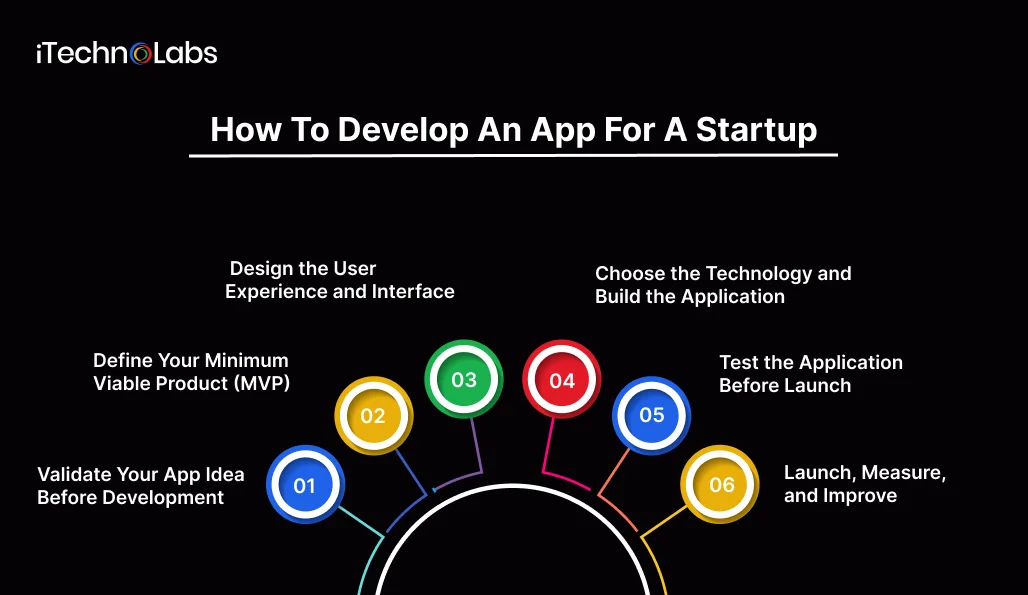
App development for startups involves more than writing code. It requires validating the business idea, identifying the right features, designing an intuitive user experience, building and testing the product, and improving it after launch. Following a structured process helps founders control development costs, reduce uncertainty, and focus on features that solve real customer problems.
1. Validate Your App Idea Before Development
Before investing in development, establish whether your idea solves a problem that people genuinely experience. Start by identifying your target users, understanding their current challenges, and investigating how they address those challenges today.
Speak with potential customers and ask about their experiences rather than simply asking whether they like your idea. Their existing behaviour, frustrations, and willingness to try an alternative can reveal whether the proposed app addresses a meaningful need.
You can also test your concept with a simple landing page, product mockup, or clickable prototype. These early experiments help you collect feedback and identify weaknesses before committing to a full development project.
The goal of validation is not to prove that every assumption is correct. It is to identify the biggest risks early, while changing direction is still relatively inexpensive.
2. Define Your Minimum Viable Product (MVP)
A minimum viable product, or MVP, is an initial version of an application that includes the essential functionality needed to deliver value and test important product assumptions.
Once you have validated the problem, define what your first release must accomplish. Identify your primary user, the main task they need to complete, and the features required to support that task.
For example, a startup building a food delivery app might initially focus on restaurant listings, menu browsing, order placement, payment, and basic order status updates. Features such as loyalty programmes, advanced recommendations, and complex promotional campaigns could be considered after the core ordering experience has been tested.
Create a prioritised feature list and separate essential requirements from future enhancements. This gives your development team a clearer scope and helps prevent unnecessary features from increasing the initial budget or delaying the launch.
A successful MVP is not defined by how many features it contains. It is defined by whether it delivers a useful experience and helps the startup learn what to build next.
3. Design the User Experience and Interface
Before development begins, map how users will navigate the application and complete its main tasks. Start with user flows that show the steps between opening the app and reaching a desired outcome.
Next, create wireframes to establish the layout, navigation, and placement of important elements. Turn these into a clickable prototype that lets potential users interact with the proposed experience before the underlying software is built.
Use feedback to identify confusing screens, unnecessary steps, unclear instructions, and accessibility issues. Refine the design before moving into detailed implementation.
Good design is not just about appearance. It helps users understand what to do, complete tasks with less friction, and recognise the value of the product.
4. Choose the Technology and Build the Application
Select a technology stack that fits your product requirements, available budget, expected usage, and long-term maintenance needs. Your options may include native iOS or Android development, cross-platform frameworks such as React Native and Flutter, or a web application when browser access better suits the product.
Once the technical approach is agreed, development typically covers the frontend, backend, database, authentication, and integrations required by the MVP. The frontend handles the user interface, while the backend manages application logic, data processing, and communication with external services.
Establish development milestones, version control, code reviews, and regular demonstrations so you can review progress throughout the project. Keep the requirements and acceptance criteria documented, and assess the impact of any requested scope changes before approving them.
The right development approach balances immediate product needs with the ability to maintain and extend the application as the business grows. Building unnecessary complexity too early can consume resources that would be better spent validating the product.
5. Test the Application Before Launch
Before releasing the app, verify that its essential features work as expected across supported devices, operating systems, and usage conditions. Testing should cover the main user journeys as well as error handling, performance, security, and access permissions.
For example, a shopping app should be tested from product discovery through checkout and order confirmation. The team should also check what happens when a payment fails, a network connection drops, or a user enters invalid information.
Combine automated tests with manual testing and user acceptance testing. Address defects that affect core functionality, data protection, or reliability before making the application available to customers.
Testing early and throughout development helps uncover problems before they affect a larger audience. It also reduces the risk of spending launch budgets on acquiring users who encounter avoidable technical issues.
6. Launch, Measure, and Improve
Once the application passes its release checks, launch it to an appropriate initial audience and monitor how people use it. Prepare app store listings where applicable, confirm analytics are working, establish error monitoring, and make sure the team can respond to problems after release.
Measure outcomes that reflect the product’s purpose. Useful metrics may include user activation, retention, task completion, conversion rates, and application reliability. For a subscription app, you might examine how many users complete onboarding and proceed to a paid plan. For a booking app, you might track successful bookings and repeat usage.
Collect feedback through user interviews, support requests, and product analytics. Use these findings to distinguish between features users genuinely need and additions that offer little practical value.
Launching the app is the beginning of a continuous learning process. The strongest next step is not always adding more functionality. Sometimes it is improving onboarding, fixing a confusing workflow, or addressing a technical issue that prevents users from receiving value.
Review product performance regularly and prioritise changes according to user needs, business objectives, and available resources. This approach allows your startup to evolve its app using evidence rather than assumptions.
Choosing The Right Technology For Startup App Development
Technology decisions influence initial development effort, ongoing maintenance, hiring options, and how easily the product can evolve. The best choice depends on the requirements rather than the popularity of a particular framework.
Native or cross-platform mobile development
Native development
Native iOS development commonly uses Swift, while Android development commonly uses Kotlin.
Native apps can provide direct access to platform capabilities and detailed control over platform-specific interactions. Building and maintaining separate iOS and Android implementations can also require more coordinated engineering effort.
Cross-platform development
React Native and Flutter are established options for building applications for multiple mobile platforms.
A shared codebase can reduce duplicated implementation work, although platform-specific features, integrations, testing, and maintenance still require attention.
Web application or progressive web app
A browser-based product may be a practical starting point when users primarily need dashboards, workflows, account management, or access across devices without installing a mobile app.
Consider a web-first approach when it tests the business hypothesis with less implementation complexity. Choose mobile first when the user experience depends on device capabilities, frequent mobile usage, or app-specific distribution.
How Much Does Startup App Development Cost?
Startup app development can cost approximately $15,000 to $250,000 or more, depending on the product’s complexity, features, platform requirements, integrations, and security needs. GoodFirms’ September 2026 cost guide estimates basic apps at 15,000–40,000, mid-level apps at 40,000–120,000, and advanced apps at 100,000–250,000 or more. These are broad industry estimates, not a quote for your specific project.
A clickable prototype that tests a user journey requires a different investment from a production app with payments, multiple user roles, real-time functionality, and complex backend systems. Comparing these projects by price alone can lead to unrealistic budgets and expectations.
Startup App Development Cost and Timeline
The following table uses published estimates from GoodFirms’ 2026 cost guide to illustrate how project scope can affect both budget and delivery time.
| App complexity | Estimated development cost (USD) | Estimated timeline |
| Basic app or focused MVP | 15,000–40,000 | 3–6 months |
| Mid-level app | 40,000–120,000 | 6–9 months |
| Advanced app | 100,000–250,000+ | 9–12 months |
| Enterprise-level application | 250,000–500,000+ | 12–18+ months |
The cost and timeline ranges overlap because complexity is not determined by feature count alone. A relatively small app with demanding security requirements or difficult third-party integrations may cost more than a larger application built around straightforward workflows.
Security, Quality, And Scalability From Day One
Startups do not need to build enterprise-level infrastructure for every early product. They do need to make deliberate decisions about protecting data, controlling access, maintaining reliability, and avoiding architectural choices that create unnecessary risk.
Include these safeguards in your initial engineering plan:
- Use appropriate authentication and authorization for protected features.
- Encrypt sensitive data in transit and protect it at rest where required.
- Keep credentials and API secrets out of source code.
- Apply least privilege to user, developer, and infrastructure access.
- Validate inputs and handle failures safely.
- Maintain dependency updates, backups, logs, and error monitoring.
- Test important user journeys and access control rules before release.
Scalability is not simply the ability to handle more users. It also involves keeping the code understandable, documenting key decisions, monitoring operating costs, and making future changes without repeatedly rebuilding the same components.
Start with an architecture suited to the product’s known requirements, then revisit it when measured usage or new features justify greater complexity. Avoid paying for infrastructure you cannot yet use, but do not postpone essential security and data integrity controls.
Launch Planning And Measuring Product Performance
A launch is the start of product learning, not proof that the business model works. Downloads and registrations alone may not show whether users receive enough value to return or pay.
Define success metrics before the first release. Select a small set of measures linked directly to the product’s intended outcome.
| Metric | What it helps you understand |
| Activation | Whether new users reach the product’s main value |
| Retention | Whether users return over a defined period |
| Conversion | Whether users complete a desired action, such as a purchase or booking |
| Task completion | Whether users complete the core workflow |
| Reliability | Whether errors or crashes prevent meaningful use |
| Acquisition cost | What you spend to attract users, where reliable cost data is available |
Establish a baseline, define the measurement period, and interpret the results in the context of your product and audience. Do not adopt arbitrary success thresholds without a reasoned basis.
If users sign up but do not complete the core action, the problem may lie in onboarding, usability, pricing, or the underlying value proposition. If they return but do not convert, investigate whether the product and commercial model match their needs.
Use this evidence to decide whether to improve the existing experience, test a new approach, expand the feature set, or reconsider the original hypothesis.
Build Your Startup App with iTechnolabs
iTechnolabs provides mobile app development, custom software development, and AI development services. According to the supplied company information, iTechnolabs has delivered 500+ apps, served 50,000+ end users, and has a team of 300+ developers. The company also holds ISO 27001:2013 and ISO 9001:2015 certifications.
If you have a product idea but lack the internal engineering capacity to build it, the right development partner can help you define requirements, evaluate technology options, prioritize MVP features, and plan the work needed to move toward launch.
Discuss your product goals, target audience, essential features, integrations, and budget with iTechnolabs. A discovery conversation can help clarify the technical requirements and identify the next steps for your project.
Conclusion
Successful startup app development begins with a validated business idea, a clearly defined MVP, and a development plan that balances product requirements with budget and timeline constraints. Choosing the right technology, prioritizing essential features, and testing the application before launch helps founders make informed decisions at every stage.
Before committing to development, identify your target users, define the problem your app will solve, and establish the features required for your first release. Compare development partners based on technical expertise, communication, code ownership, transparent estimates, and post-launch support. Use customer feedback and product performance data to guide future improvements rather than investing in features without a clear purpose.
The goal is not to build the biggest app on day one. It is to create a useful product, validate its value with real users, and establish a foundation for sustainable growth.
FAQs
1. Should a startup build an MVP before developing a complete app?
In most cases, a focused MVP is a sensible starting point when important assumptions about customer demand or product usability remain untested. It lets you evaluate a smaller set of core features before expanding the investment. A larger initial build may be justified when regulatory, technical, or operational requirements make a smaller release impractical.
2. Should a startup choose native development or cross-platform technology?
Native development offers platform-specific control, while cross-platform frameworks such as React Native and Flutter can support shared implementation across iOS and Android. The right option depends on performance requirements, device features, budget, maintenance, and team expertise. Compare the expected user experience and total ownership requirements before selecting a framework.
3. How can a startup avoid unexpected development costs?
Agree on a documented scope, milestone deliverables, acceptance criteria, and a process for approving changes. Request estimates that identify exclusions, third-party expenses, infrastructure, testing, and post-launch support. Costs become harder to manage when requirements remain unclear, or new features are added without reassessing their impact on budget and schedule.
4. How should a startup choose an app development partner?
Evaluate relevant technical experience, discovery capabilities, communication practices, delivery transparency, security, code ownership, and post-launch support. Ask for verifiable project examples and speak with references where possible. The best partner is one whose approach matches your product’s requirements and whose decisions you can understand, review, and challenge.
5. Who owns the app’s source code after development?
Ownership depends on the contractual terms, applicable law, and any third-party components used in the project. Put intellectual property ownership, licensing, repository access, documentation, credentials, and handover obligations in writing before development starts. Confirm that open source and commercial dependencies have appropriate licences for your intended use.
6. What should happen after the app launches?
Monitor errors, reliability, user behaviour, and the completion of core workflows. Collect feedback, fix important defects, and prioritize improvements against measurable product objectives. Post-launch work is part of the product lifecycle, so your original budget and delivery agreement should address maintenance, infrastructure, security updates, and future development.











