Key Takeaways
- Validate demand before committing to a full product build.
- Keep the MVP focused on one valuable workflow rather than a long feature list.
- Choose architecture and technologies based on actual product requirements, not anticipated scale alone.
- Plan for security, subscription billing, integrations, observability, and maintenance from the beginning.
- Measure activation, retention, and willingness to pay before expanding the product.
Building a micro SaaS product requires more than a promising idea. A successful launch depends on validating a specific customer problem, choosing the right technology stack, and building an MVP that delivers measurable value. This micro-SaaS development guide explains how startup founders can plan, build, secure, and monetize a focused software product without overengineering the first release.
Table of Contents
What Is Micro SaaS Development?
Unlike a broad software platform, a micro SaaS product concentrates on a narrower set of needs. Its development priorities are clear product scope, efficient operations, reliable recurring value, and a technical foundation that supports future improvements.
For a funded startup founder, the opportunity is to solve a problem well before investing in a large engineering organization. A product that automates a repetitive task for a specific professional group can be more practical to validate than a platform designed to serve several unrelated markets.
A small product team may be able to operate a narrowly scoped SaaS application with limited operational overhead, but the actual workload depends on usage, integrations, security requirements, and support expectations. A small product does not automatically mean a simple codebase or low maintenance costs.
How to Build Micro SaaS Products: Complete Process
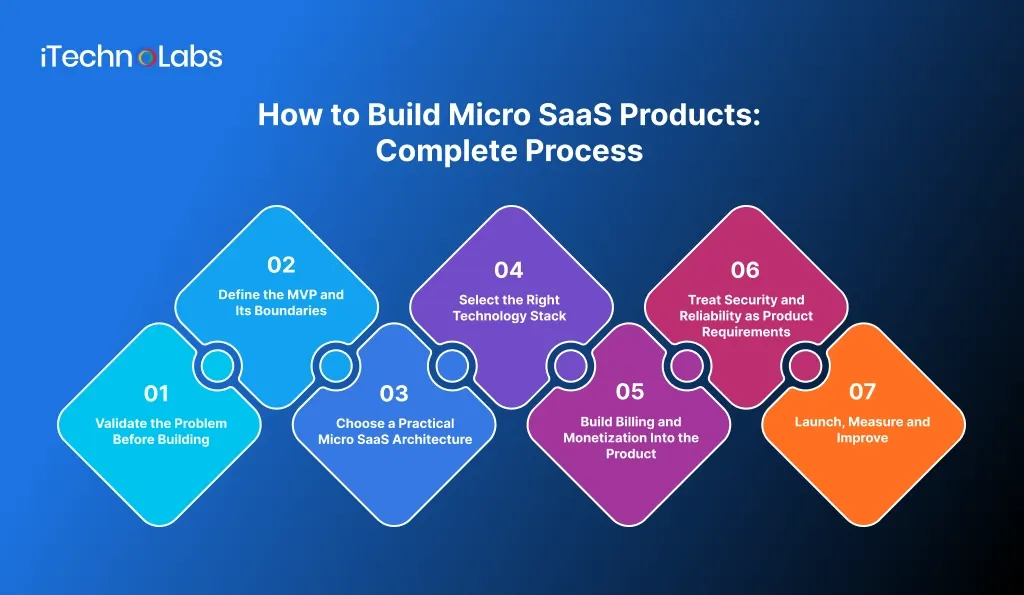
1. Validate the Problem Before Building
Begin with the customer and the workflow, not the technology stack.
Identify a specific group of users, understand how they currently solve the problem, and determine what makes their existing process costly, slow, or frustrating. Research should establish whether the problem occurs regularly and whether users have a reason to adopt a different solution.
For example, a product might help independent accounting firms collect recurring documents from clients. The initial opportunity is not to build a complete accounting platform. It is to investigate whether document collection is painful enough that firms would pay for a focused tool.
Before development, investigate:
- Who experiences the problem and how frequently?
- What tools or manual processes do they use today?
- Which part of the workflow creates the most friction?
- Who controls the purchasing decision?
- What would make customers switch or pay for an alternative?
Test the idea using customer interviews, a clickable prototype, a landing page, a demonstration, or a small pilot. Where possible, ask potential customers to make a meaningful commitment rather than relying on compliments or hypothetical purchase intentions.
Decision gate: Proceed when you have evidence of a recurring problem, a reachable audience, and a plausible reason customers would pay for the proposed outcome.
2. Define the MVP and Its Boundaries
A minimum viable product, or MVP, is a focused product version intended to test key assumptions and deliver a useful outcome. It is not permission to release software with inadequate security, unreliable data handling, or broken core workflows.
Write down the main job the product must perform. Every proposed feature should support that job, enable safe operation, or be necessary to test the business model.
Consider a micro SaaS product for recurring document collection.
| Build for the first release | Evaluate after validation |
| User registration and access control | Advanced role customization |
| Client and document records | Complex reporting dashboards |
| Document request workflow | Multiple workflow automation rules |
| Notifications and basic status tracking | Extensive third-party integrations |
| Subscription entitlement checks | Multiple enterprise billing arrangements |
The correct MVP scope depends on the product’s main promise. A document collection tool needs reliable file handling and access controls. A reporting product may need accurate data ingestion and export capabilities. Feature prioritization should reflect the core value rather than a generic MVP checklist.
Define acceptance criteria before implementation. Specify what a successful user journey looks like, which errors must be handled, and what evidence will indicate that the first release is useful.
3. Choose a Practical Micro SaaS Architecture
SaaS architecture must account for application reliability, security, performance, operational processes, and cost. AWS documents these concerns in its Well-Architected SaaS Lens, including tenant isolation, identity, onboarding, and tenant-aware operations.
For an early micro SaaS product, start with the simplest architecture that meets the requirements and can be maintained by the available team.
A typical web application may contain:
- Frontend: The interface customers use to complete the core workflow.
- Backend: Application rules, business logic, and API endpoints.
- Database: Structured records, relationships, and transaction data.
- File storage: Separate object storage where the product manages uploaded documents or media.
- Authentication and authorization: Identity verification and permission enforcement.
- Billing integration: Subscription status, payment events, and access entitlements.
- Operations layer: Logging, monitoring, backups, deployment, and recovery procedures.
A modular monolith is often a reasonable starting option when one team owns a focused application. It can keep deployment and debugging relatively straightforward while allowing business logic to remain organized into modules. Microservices may become appropriate when specific scaling, deployment, or ownership requirements justify their additional operational complexity.
Plan for tenant isolation
In a multi-tenant SaaS product, multiple customers use the same application environment or underlying platform. The design must prevent one customer from accessing another customer’s information.
Model the tenant or organization relationship explicitly. Enforce authorization on the server side for every relevant request, scope database queries to the correct tenant, and test attempts to access records belonging to another account.
Do not rely on hidden interface elements as a security control. If a user cannot access a record, the backend must reject the request even when someone calls the API directly.

4. Select the Right Technology Stack
The best SaaS technology stack is the one that supports the product’s requirements and the team’s ability to build, test, and maintain it. Popularity alone is not a sufficient selection criterion.
| Layer | Options to evaluate | Main decision |
| Frontend | React, Next.js, or another suitable web framework | Interface complexity and team familiarity |
| Backend | Node.js, Python, PHP or another suitable runtime | Business logic, integrations and ecosystem |
| Database | PostgreSQL or another appropriate database | Data relationships, transactions and query patterns |
| Hosting | Managed cloud services or a suitable application platform | Operations, reliability and deployment needs |
| Payments | Stripe or another suitable billing provider | Supported markets, plans and payment requirements |
| Monitoring | Application logs, error tracking and service metrics | Ability to detect and investigate failures |
Evaluate the stack against six practical criteria: developer familiarity, deployment complexity, integration requirements, security support, operating costs and expected maintenance effort.
A managed database or hosting platform may reduce infrastructure work, but it does not eliminate the need for backups, access controls, monitoring, or recovery planning. Likewise, using an established framework does not make an application secure by default.
Document the reason for each major technology choice. This makes future decisions easier when the team needs to change a provider, introduce a new integration, or accommodate additional customer requirements.
5. Build Billing and Monetization Into the Product
A micro SaaS business needs a pricing model that customers can understand and the product can enforce reliably. Billing should be treated as part of the product architecture, not as an isolated payment form.
Common approaches include:
- Flat rate: One recurring price for a defined set of capabilities.
- Tiered pricing: Different plans based on functionality or usage limits.
- Per seat: Charges based on the number of users.
- Usage-based pricing: Charges based on measured consumption.
Stripe’s subscription pricing documentation describes recurring pricing approaches including flat rate, per seat, tiered, and usage-based models.
Select a model that reflects how customers receive value. A collaboration product may suit per seat pricing, while a data processing product may be better suited to measured usage. These are starting hypotheses to validate, not universal rules.
The implementation should handle successful payments, failed renewals, cancellations, plan changes, refunds where applicable, and subscription state changes. Access permissions must reflect the authoritative billing state rather than a user-controlled frontend value.
Before launch, test billing edge cases and explain the renewal terms, usage limits, and cancellation process clearly. Customers should understand what they are buying and what happens when their subscription changes.
6. Treat Security and Reliability as Product Requirements
SaaS security and reliability require attention throughout the development lifecycle. The AWS Well-Architected framework addresses security, reliability, operational excellence, performance efficiency, and cost optimization as distinct design concerns.
Include these controls in the initial engineering plan:
- Use established authentication mechanisms and enforce authorization on the server.
- Apply least privilege to users, services, and infrastructure credentials.
- Protect sensitive data in transit and at rest where appropriate.
- Validate inputs and handle errors without exposing secrets or private records.
- Keep dependencies updated and review security advisories.
- Configure backups and test restoration rather than assuming backups are usable.
- Monitor application errors, resource consumption, and suspicious access patterns.
- Document incident response and recovery responsibilities.
A micro SaaS product can remain small in feature scope while still handling sensitive customer data. Security requirements should reflect the information being processed, applicable obligations, and the consequences of unauthorized access.
Define what happens when an external API becomes unavailable, a payment webhook is delivered more than once, or a background job fails. Idempotent processing, retry policies, and useful logs can prevent transient failures from creating duplicate operations or confusing account states.
7. Launch, Measure and Improve
Launch to a defined group of target users once the core workflow is tested, critical security controls are in place, and support responsibilities are clear.
Track a small set of product measures tied to customer value.
| Metric | Question it answers |
| Activation | Do new users reach the first meaningful outcome? |
| Retention | Do users return when the problem occurs again? |
| Conversion | Do eligible users become paying customers? |
| Churn | Are customers cancelling or failing to renew? |
| Support issues | Which problems prevent users from receiving value? |
| Operating cost | What does it cost to deliver the service reliably? |
Registrations alone do not prove product value. A product can attract signups but still struggle if onboarding is confusing, the workflow is incomplete, or customers do not return.
Review customer feedback alongside product behavior. If users repeatedly abandon the same step, investigate the underlying problem before adding more features. If customers rely on manual workarounds, consider whether the product’s main workflow needs redesign.
Increase infrastructure capacity or architectural complexity when observed usage, reliability requirements, or product changes justify it. Avoid both premature optimization and the opposite mistake of postponing essential security and data integrity work.
From Micro SaaS Idea to Market-Ready Product: Build with iTechnolabs
A good micro SaaS idea needs the right engineering decisions behind it. From validating the product concept to choosing an architecture, integrating subscription billing, and preparing for launch, each decision affects how efficiently you can build and maintain your software.
At iTechnolabs, we help businesses turn focused software ideas into working digital products through product planning, custom SaaS development, API integrations, workflow automation, subscription management, and cloud infrastructure.
Why Choose iTechnolabs for Micro SaaS Development?
- Build around a real customer problem
Start with product discovery and feature prioritization. Define the core user workflow, identify the essential MVP features, and create a development roadmap aligned with your business goals.
- Choose architecture that fits your product
Select the appropriate frameworks, databases, integrations, and cloud services based on your product requirements. The objective is to build a maintainable foundation without introducing unnecessary technical complexity.
- Prepare for subscriptions and recurring revenue
Implement subscription billing, plan management, payment workflows, and access controls that match your monetization model. Design the customer experience around clear pricing and predictable account management.
- Connect the tools your customers already use
Integrate relevant APIs and third-party services to reduce manual work and make your product more useful within existing customer workflows.
- Plan for security, testing, and ongoing maintenance
Address authentication, authorization, data protection, testing, deployment, monitoring, and post-launch improvements as part of the development plan.
- Work with a team that supports your product journey
When validating an MVP or developing a more feature-rich SaaS application, define the scope, delivery milestones, code ownership, and support expectations before development begins.

Conclusion
A successful micro SaaS product starts with a narrow customer problem and develops through evidence-based decisions. The engineering work matters, but so do validation, scope control, billing, security, support, and customer retention.
Validate the problem, define a focused MVP, select an appropriate architecture and technology stack, and launch with a clear plan for learning from users. Build for the requirements you understand today while preserving room to respond to evidence tomorrow.
FAQs
1. What is micro SaaS development?
Micro SaaS development is the process of designing, building, and maintaining a focused software as a service product for a specific customer group or business problem. The product typically has a narrower scope than a broad software platform, but it still requires suitable architecture, security, billing, customer support, and ongoing maintenance.
2. How do you choose a micro SaaS idea?
Start with a recurring problem experienced by a clearly defined audience. Investigate existing workarounds, speak with potential customers, and test whether they would commit time or money to a solution. Choose an idea based on evidence of customer need and a credible way to reach buyers, not enthusiasm for a particular technology.
3. Which technology stack is best for a micro SaaS product?
There is no universally best stack. React, Node.js, Python, and PostgreSQL are possible choices, but the right combination depends on product requirements, team expertise, integration needs, security, and maintenance. Choose technologies the team can operate reliably rather than adding tools solely because they are popular.
4. Should a micro SaaS MVP use a monolith or microservices?
A modular monolith is a reasonable starting point for many focused products because it can reduce deployment and operational overhead. Microservices may be justified when separate components have distinct scaling, release, or ownership requirements. Choose the architecture based on demonstrated needs, and revisit the decision when product evidence changes.
5. How should a micro SaaS product handle multiple customers?
Multi-tenant SaaS applications must enforce appropriate isolation between customer accounts and their data. Represent tenant ownership explicitly, enforce permissions on the server, scope data access correctly, and test cross-tenant access attempts. The appropriate database isolation model depends on the sensitivity of the data, compliance obligations, and operational requirements.
6. How do micro SaaS products make money?
Common subscription pricing models include flat rate, tiered, per seat, and usage-based billing. Choose a model that reflects the value customers receive and validate it with the target market. Clearly communicate plan limits, renewal terms and cancellation conditions, and test billing events before accepting live subscriptions.
7. What should be tested before a micro SaaS launch?
Test the primary user journey, authentication, authorization, data isolation, payment events, error handling, integrations, backups, and recovery procedures. Verify that monitoring can detect important failures and that support responsibilities are assigned. The testing scope should reflect the product’s risks and the consequences of service disruption.
8. When should a startup hire a micro SaaS development partner?
External development support may be useful when a startup lacks the engineering capacity or specialist expertise required to build its product. Evaluate potential partners on technical fit, communication, scope management, testing, source code ownership, and post-launch support. Agree on deliverables and acceptance criteria before development begins.