Key Takeaways
- The mobile app development process has seven stages: discovery, wireframing, UI/UX design, development, QA, launch, and post-launch support. Most founders don’t think enough about the first and last stages.
- A simple app usually takes 3 to 5 months from start to finish. A complex app with many integrations can take 8 months or more.
- Development takes up the most time. But QA and post-launch support are where vendors often cut corners.
- There are three common ways to work with a vendor: fixed price, dedicated team, and staff augmentation. Each one changes how much risk you carry on cost.
- Hidden costs like App Store fees, third-party APIs, and ongoing maintenance often add 15 to 20% on top of the build price. Most agencies don’t mention this upfront.
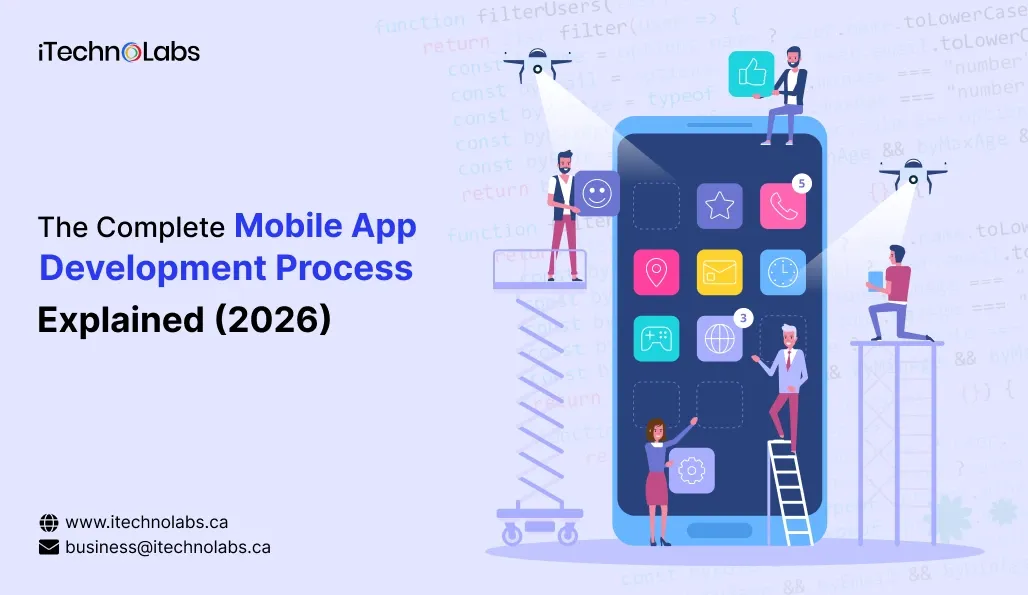
The mobile app development process is the path a team follows to turn an idea into a live app on the App Store or Google Play. It runs through seven stages: discovery, design, development, testing, launch, and ongoing support. A simple app takes about 3 months. A complex one can take 7 to 8 months or more.
If you’re evaluating vendors right now, the stage you should worry about most isn’t development. It’s whatever stage the vendor talks about least in their pitch. That’s usually QA, post-launch support, or the hidden costs buried outside the headline price. A BCG survey of C-suite executives found something telling. Nearly half saw more than 30% of their tech projects run late or over budget. Vague process breakdowns are usually the reason why. This guide covers all seven stages. You’ll see what each one costs, and where founders lose money without realizing it until the invoice shows up.
Table of Contents
What Is the Mobile App Development Process?
Think of it as seven checkpoints, each one building on the last. Discovery sets the direction. Wireframing and design shape what the app looks and feels like. Development turns that into working software. QA catches what’s broken before real users do. Launch gets it live. Post-launch support keeps it running and improving. This is the same process behind every mobile app development company engagement. It doesn’t matter if you’re building a simple MVP or a multi-platform product.
Miss a checkpoint, or rush through it, and the problem doesn’t disappear. It shows up later, usually as a bigger bill or a worse launch.
Why This Matters Before You Sign With a Vendor
Most vendors will hand you a proposal with one price and one launch date. On their own, those two numbers don’t tell you much. What matters is what’s inside each stage. How many design changes do you get? Is testing a real cycle, or a rushed afternoon? Who owns the code once the work is done?
If you’re comparing quotes right now, use the breakdown below as your checklist.
What Are the 7 Stages of Mobile App Development?
Every real app build goes through these seven stages. Skip one, and you don’t save time. You push the cost to a later stage, where it costs more to fix.
1. Discovery & Consultation. The vendor learns about your goals, your users, and what you’re working with. This is where the feature list gets locked in. A good partner will push back on ideas that won’t work, instead of just agreeing with everything.
2. Wireframing & Prototyping. Simple screen layouts show how a user will move through the app before any real design work starts. This step is easy and cheap to change. Skip it, and you’ll end up redoing costly design work later.
3. UI/UX Design. The wireframes turn into real screens, with your brand, colors, and buttons. This stage usually ends with a clickable prototype, so you can try out the flow before any code gets written.
4. Development (Frontend + Backend). This is where the app gets built. Frontend is what users see and tap. Backend is the server, database, and logic running behind the scenes. Most teams building for both iOS and Android use Flutter app development or React Native. This lets them share one codebase across both platforms, instead of building twice. This is the longest stage. It’s also where budgets often grow if the scope wasn’t locked down early.
5. QA & Testing. The app gets checked for bugs, slow performance, and problems on different phones and OS versions. Rushed testing is the number one reason apps get bad reviews right after launch.
6. Launch & Deployment. The app goes live on the Apple App Store and Google Play. Apple’s review alone can take anywhere from a day to a week. Apps get rejected over small policy issues often enough that you should plan for it.
7. Post-Launch Support. This covers bug fixes, updates for new OS versions, and new features based on how people actually use the app. Most agencies stop talking about this stage once the contract is signed. Ask about it before you sign, not after.
How Long Does Each Stage Take?
Timelines change based on how complex the app is. Here’s a realistic range for a mid-size app with a handful of core features and one or two outside integrations.
| Stage | Simple App | Complex App |
| Discovery & Consultation | 1 week | 2 weeks |
| Wireframing & Prototyping | 1–2 weeks | 2–3 weeks |
| UI/UX Design | 2–3 weeks | 4–6 weeks |
| Development | 6–8 weeks | 14–20 weeks |
| QA & Testing | 1–2 weeks | 3–4 weeks |
| Launch & Deployment | 1 week | 1–2 weeks |
| Total (pre-launch) | ~3 months | ~7–8 months |
Post-launch support runs on after that. It’s not part of the totals above.
What Does the Process Cost at Each Stage?
Cost depends less on the stage itself, and more on how you choose to work with a vendor. Get this part wrong, and you’ll either pay for flexibility you don’t need, or lose flexibility you actually needed.
- Fixed price. You agree on scope and price upfront. This works well when your plan is locked and won’t change mid-build. Any change to scope usually means a new price.
- Dedicated team. You get a full team working only on your product, billed by the month. This fits bigger projects, or ones where the plan will shift as you learn from real users. It’s the model most custom software development projects end up using once the build goes past a simple app.
- Staff augmentation. You add individual specialists to a team you already manage. This works well if you already have someone leading the product, but need more hands to build it. If you’re weighing this option, try this first. Hire developers on a short-term basis, then decide if you need a full dedicated team later.
Here’s what most quotes leave out.
- Apple Developer Program: $99 a year. You need this to publish on the App Store.
- Google Play Console: a one-time $25 fee.
- Third-party APIs: things like payment tools, maps, and push notifications. Cost depends on usage, and it’s rarely part of the base quote.
- Post-launch maintenance: industry estimates put this at around 15 to 20% of the build cost, every year. This covers bug fixes, OS updates, and small new features.
Ask any vendor to list these costs separately before you sign. If they can’t, that’s a sign the quote is too good to be true. Our app cost calculator gives you a starting range based on your feature list before you get on a call.
A Real Build: Smart EV Charging Platform
A Canada-based EV infrastructure company came to iTechnolabs with hardware already out in the field. It was placed in homes, apartment buildings, and fleets. What they didn’t have was software to make any of it work. Billing was done by hand. Drivers had no way to know if their charger was even working. And buildings with limited power had no way to manage several chargers running at once, without risking an electrical problem.
We built the platform in two phases, so the first phase’s design never had to be rebuilt for the second. Phase one covered home chargers. It included a Flutter app for iOS and Android, plus an admin panel built in Next.js. The backend ran on Node.js, using OCPP, the standard way software talks to charging hardware. We built a live status screen that tracks 12 different charger states. Drivers always know what’s happening, whether the charger is active, waiting on approval, or paused to save on power costs. Billing became fully automatic.
Phase two extended that same backend to cover fleets, multi-site admin tools, and power management across whole buildings. None of the phase one work had to be redone.
The result speaks for itself. The platform now handles more than 50,000 charging sessions a day. Uptime sits at 99.9%. It manages 2.4MW of power across sites, and responds in about 12 milliseconds on average. Smart power controls cut costs for both the operator and their customers. The backend was built to scale from day one. That meant the team never had to grow headcount just to keep up.
That two-phase approach is the same thinking behind every stage above: build it right the first time, so growth doesn’t mean starting over.
Final Take
The mobile app development process isn’t complicated, once you see all seven stages laid out. What separates a smooth build from a painful one comes down to two things. Does your vendor treat testing and post-launch support as real work, not an afterthought? And will they show you the hidden costs before you sign, not after?
Most bad app experiences don’t come from bad code. They come from a stage that got rushed or skipped, quietly, somewhere between the sales call and the launch date. A vendor who walks you through each stage, with real numbers attached, is telling you something important before the project even starts. The ones who keep it vague usually have a reason to.
Frequently Asked Questions
1. What are the 7 stages of mobile app development?
There are several different stages of the software development life-cycle, and skipping any one of them is likely to cost more time and money later on. For this reason, a service that combines multiple stages of the life cycle is to be avoided. This holds true even when the quoted price for that service looks good.
2. How long does it take to build a mobile app?
A simple app with core features usually takes about 3 months from discovery to launch. A complex app with several integrations can take 7 to 8 months or more. Development takes up the biggest share of that time. A bigger feature list is usually what stretches the timeline the most.
3. How much does mobile app development cost?
The total cost will depend on these factors: how many different features your app will have, what platforms you choose, and how you engage your vendor. Fixed price works well for a locked scope. Dedicated teams and staff augmentation suit projects that will change over time. Ask for an itemized quote that separates the build cost from hidden costs like maintenance and outside tools.
4. What’s the difference between a dedicated team and staff augmentation?
A dedicated team is a full group working only on your product. Staff augmentation adds a few specialists to a team you already run in-house. Which one fits depends on two things. Do you already have someone leading the product internally? And how much day-to-day control do you want to keep?
5. Do I own the code after the app is built?
This might depend on the specifics of your contract. Make sure you get this on paper during negotiations. Ensure you have the source code rights, not just ownership of the fully developed app. Some agreements treat these two things separately. A vendor who won’t put full code ownership in writing is a warning sign worth taking seriously.
6. What happens if my requirements change mid-development?
Under a fixed price model, a change in scope usually means a new price. Dedicated team and staff augmentation setups handle changes more easily, since you’re paying for time and people, not one fixed deliverable. This is one of the biggest reasons to pick your engagement model based on how settled your plan actually is.
7. Why does QA matter so much in the process?
Rapid testing, which is inadequate testing, is one of the biggest reasons applications, upon release, show issues like crashes, bugs, and incompatibility with some devices. This is the most straightforward stage vendors can cut to meet a deadline. This is why it’s important to know exactly how testing is scheduled before signing a contract.
8. What should I ask a vendor before signing a contract?
Ask five things. What’s the full cost, broken down? What’s the timeline for each stage? Who owns the source code? What does support look like after launch? And how are changes to scope priced? A vendor who can answer all five clearly is one worth trusting.