

Key Takeaways
- Choose Python when machine learning, data analysis, automation, or AI features are central to your product.
- Choose Node.js when your application depends on real-time communication, asynchronous APIs, or a JavaScript-focused engineering team.
- Database queries, external services, architecture, and infrastructure all affect application performance.
- Developer availability, testing, deployment, and library compatibility can matter more than the initial framework choice.
- Your backend should support the product you need to launch today without creating avoidable constraints tomorrow.
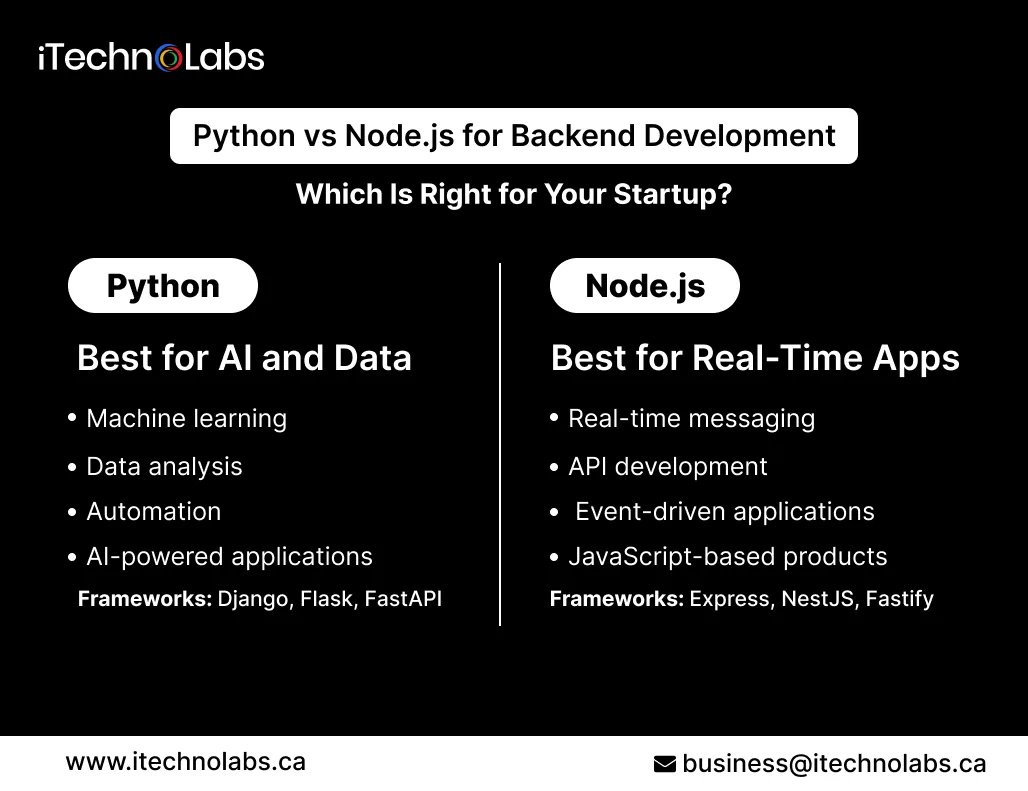
Python vs Node JS for backend development comes down to your application’s workload, AI requirements, development team’s skills, and long-term product plans. Python is a strong choice for AI-driven products, data processing, and business logic. Node.js is well suited to real-time applications, API driven products, and JavaScript-based development teams. Neither is automatically faster or cheaper for every project.
Table of Contents
What Is the Difference Between Python and Node.js?
Python is a general-purpose programming language commonly used for web development, automation, data science, and artificial intelligence. Node.js is a JavaScript runtime that allows developers to execute JavaScript outside the browser, including on backend servers.
The important distinction is that Python is a language, while Node.js is a runtime for JavaScript. A fair comparison considers the complete backend stack, including frameworks, databases, libraries, hosting, and development practices.
For a startup, the real question is which stack allows your team to build, validate, and maintain the product with the least unnecessary complexity.
Python vs Node.js: Quick Comparison
| Factor | Python | Node.js |
| Technology | General-purpose language | JavaScript runtime |
| Backend frameworks | Django, Flask, FastAPI | Express, NestJS, Fastify |
| AI and machine learning | Strong ecosystem | Possible through APIs and integrations |
| Real-time applications | Supported with suitable frameworks and architecture | Natural fit for event-driven applications |
| Asynchronous I/O | Supported through asyncio and compatible frameworks | Core strength of its event-driven runtime |
| Data processing | Strong scientific and data tooling | Suitable for many data processing tasks |
| Full stack language | Requires a separate frontend language in typical web applications | JavaScript can be used on both frontend and backend |
| Performance | Depends on implementation and workload | Depends on implementation and workload |
| Best fit | AI products, data-intensive workflows, business applications | Real-time systems, APIs, JavaScript-centred products |
Python’s official documentation describes asyncio as a foundation for asynchronous frameworks, network servers, and other I/O bound applications. Node.js uses an event loop and non-blocking I/O to handle many concurrent operations. These capabilities do not guarantee that one stack will outperform the other in every application.
1. Performance and Scalability
Node.js is designed around event-driven execution and non-blocking I/O. This makes it a natural candidate for workloads involving many concurrent network connections, such as messaging, notifications, collaborative applications, and API gateways.
However, CPU-intensive work can block the Node.js event loop if it is not handled appropriately. The official Node.js guidance recommends avoiding long-running operations on the event loop and offloading expensive computation when necessary.
Python also supports asynchronous programming through asyncio and asynchronous web frameworks. Python applications can handle concurrent I/O effectively when the framework, libraries, and database drivers support the chosen execution model.
For CPU-intensive tasks, Python teams may need multiprocessing, background workers, native libraries, or separate compute services, depending on the workload.
Consider an MVP with user accounts, payments, and a dashboard. The speed of database queries, payment provider responses, caching, and network requests may have a greater impact on perceived performance than the choice between Python and Node.js.
Which should you choose?
Consider Node.js for a connection-heavy, event-driven product. Consider Python when computation is closely tied to data processing or AI. Benchmark the actual application before making performance claims or committing to a major architectural decision.
2. AI and Machine Learning Integration
Python has an established ecosystem for machine learning, data manipulation, statistical computing, and model development. Libraries such as PyTorch, TensorFlow, and pandas support common tasks across these areas.
If your product depends on document processing, predictive models, recommendation systems, or custom machine learning pipelines, Python can reduce the need to bridge multiple languages within the AI workflow.
Node.js can also power AI applications. It can call hosted model APIs, manage authentication, expose inference endpoints, coordinate agent workflows, and connect AI services to web applications.
The distinction is that using an AI API is not the same as training or operating a model with a specialised machine learning stack.
Which should you choose?
Lean toward Python if model development, experimentation, or data science is central to the product. Node.js remains a practical option if AI is an integrated feature within a predominantly JavaScript application. A separate Python AI service can also work when the existing backend is already built with Node.js.
3. Development Speed and Team Productivity
Python and JavaScript have different syntax, runtime environments, frameworks, and development conventions. Both support established approaches to building APIs and web applications.
Python frameworks offer different trade-offs. Django includes many features for building full web applications, while Flask offers a smaller framework and FastAPI supports API development with type hints and asynchronous capabilities.
Node.js teams can choose Express for a minimal web framework, NestJS for a more structured application architecture, or Fastify for an alternative focused on efficient server development.
Development speed depends on how closely the framework fits your requirements. A framework with built-in authentication and administration features may reduce implementation work for one product, while a smaller framework may offer more flexibility for another.
For a startup, productivity also depends on the engineering team’s experience. Choosing a language that the team already understands may reduce onboarding, debugging, and hiring friction.
Which should you choose?
Select the stack your team can build and maintain confidently. Evaluate a small, representative feature in each candidate stack if the decision is uncertain. Compare implementation effort, testing requirements, integration complexity, and maintainability rather than counting lines of code.

4. Cost of Development and Maintenance
Neither Python nor Node.js has a universal development cost advantage. Project costs depend on scope, team composition, developer rates, architecture, integrations, infrastructure, and ongoing support.
A language that is familiar to your team may reduce training and hiring friction. Conversely, a specialist requirement, such as maintaining a complex machine learning pipeline, may influence the cost of staffing and operating the system.
An MVP’s initial development cost is only part of the financial decision. Maintenance, monitoring, security updates, database optimisation, cloud resources, and future feature development also affect total cost of ownership.
For example, selecting Node.js because the frontend already uses JavaScript could simplify language sharing across the application. Selecting Python for a data-intensive product could simplify the model development workflow. Neither benefit is automatic, and both should be evaluated against the team’s actual skills.
Which should you choose?
Estimate costs across three stages: MVP delivery, the first major product expansion, and ongoing maintenance. Compare the same feature scope and service expectations for both stacks. Avoid choosing solely on a quoted hourly rate or an unverified claim about language performance.
5. Security, Reliability, and Long-Term Maintenance
Security is an engineering practice, not an inherent guarantee provided by a programming language. Both ecosystems require dependency management, authentication controls, input validation, secure configuration, logging, monitoring, and regular updates.
Python and Node.js projects can both be designed for reliable deployment and long-term maintenance. The framework, dependency choices, testing strategy, code review process, and operational setup influence the result.
A startup should consider who will own the code after launch. A highly customised backend that only its original developer understands can become difficult to maintain, regardless of its language.
Which should you choose?
Prioritise a clear architecture, documented APIs, automated tests, dependency scanning, and an explicit maintenance plan. Review framework maturity and the compatibility of critical libraries before committing to either stack.
Python vs Node.js: Which Is Better for Your Startup?
The best choice becomes clearer when the product’s primary workload is identified.
| Your product requirement | Recommended starting point |
| AI-powered SaaS or machine learning product | Python |
| Data analysis or predictive modelling | Python |
| Real-time messaging or collaborative features | Node.js |
| JavaScript-focused full-stack team | Node.js |
| Traditional business application with complex workflows | Either, based on team and framework fit |
| API driven product with many external integrations | Either, based on workload and developer experience |
| AI product with a JavaScript frontend and specialised models | Python AI service with Node.js where appropriate |
These are starting recommendations for common product patterns, not benchmark results or universal rules. A well-designed system can use either stack for many of these requirements.
Can You Use Python and Node.js Together?
Yes. Separate services can communicate over HTTP APIs, message queues, or other agreed interfaces, even when they use different programming languages.
A startup might use Node.js for user-facing APIs and real-time features while using Python for model inference or data processing. This architecture allows each service to use a suitable tool, but it also introduces additional deployment, monitoring, networking, and operational responsibilities.
A multi-language architecture is most useful when the benefits of separating workloads outweigh the cost of operating multiple services.
Start with one backend stack when it satisfies the requirements. Introduce a second runtime only when a clear technical or product need justifies the added complexity.
How to Make the Final Decision
Before choosing a backend, answer five questions:
- What is the product’s main workload? Distinguish ordinary database-driven requests from real-time connections, data processing, and model inference.
- What must the MVP deliver? Select the framework that supports the required features without unnecessary infrastructure.
- What skills does your team have? Account for current expertise, hiring needs, and ongoing code ownership.
- What will the next stage require? Identify likely integrations, traffic patterns, data growth, and AI features.
- How will success be measured? Test representative endpoints and workflows, measuring latency, throughput, error rates, resource use, and development effort.
Do not select a stack based on popularity alone. Define the workload, test the critical paths, and choose the architecture that meets the product’s requirements with manageable operational complexity.
Turn Your Software Idea into a Scalable Product with iTechnolabs
Choosing a backend technology is only the first step in building a successful digital product. Your architecture must also support your business logic, third-party integrations, security requirements, and future product roadmap.
At iTechnolabs, we provide custom software development and AI development services to help businesses turn product ideas into working applications. Whether you’re planning an MVP, building an AI-powered platform, or modernising an existing application, our team can help you evaluate the right technology stack for your requirements.
Our approach focuses on understanding your product goals, selecting suitable technologies, and planning an architecture that supports ongoing development and maintenance.
Conclusion
Choosing between Python and Node.js for backend development depends on your product requirements, team expertise, and long-term goals. Python is a strong choice for AI-driven applications, machine learning, and data-intensive workflows. Node.js is well suited to real-time applications, API driven platforms, and products built around a JavaScript-focused technology stack.
For startups, the priority should be selecting a backend that supports a faster MVP launch without creating unnecessary complexity as the product grows. Consider your core features, integration requirements, development budget, and maintenance needs before making the final decision. When both technologies appear suitable, test a representative feature and compare performance, implementation effort, and operational requirements.
The right backend is the one that fits your product, supports your roadmap, and gives your team a practical foundation for future development.

FAQs
1. Is Python or Node.js better for backend development?
Neither is universally better. Python is often a practical starting point for AI, machine learning, and data-intensive products. Node.js is often suitable for event-driven APIs, real-time features, and JavaScript-centred teams. The right decision depends on workload, developer experience, framework requirements, and long-term maintenance.
2. Is Node.js faster than Python?
There is no universal performance winner across all applications. Node.js is designed for non-blocking I/O and concurrent network operations. Python can also support asynchronous workloads, and its performance varies by framework, implementation, and workload. Benchmark representative requests on comparable infrastructure before deciding which stack meets your latency and throughput requirements.
3. Should startups use Python for AI applications?
Python is a strong starting point when a product requires model training, experimentation, data analysis, or specialised machine learning libraries. A product that only calls hosted AI APIs may also work well with Node.js. Choose based on whether AI is a core computational workload or a feature integrated into the wider application.
4. Is Node.js suitable for large-scale applications?
Node.js can support large applications when its architecture, infrastructure, and implementation match the workload. Teams need to manage event loop blocking, database access, caching, failure handling, and background jobs. Scalability depends on the complete system, not the runtime alone. Load testing and operational monitoring help identify bottlenecks before they affect users.
5. Can Python and Node.js be used in the same application?
Yes. They can operate as separate services that communicate through APIs or messaging systems. For example, Node.js can manage application requests while Python handles machine learning inference. This approach adds deployment and monitoring complexity, so it is best used when service separation provides a clear technical benefit.
6. Which backend should I choose for an MVP?
Choose the stack that covers your MVP requirements, matches your team’s skills, and supports the next likely product milestone. Python may suit a data- or AI-centred MVP, while Node.js may fit a JavaScript-focused product with real-time features. Validate the decision with a small technical prototype before committing to a larger build.











