

Key Takeaways
- Request a current SOC 2 report and confirm that its scope covers the services and systems relevant to your engagement.
- Assess security controls in everyday development work, including code reviews, privileged access, secrets management, and deployment approvals.
- Understand the difference between a SOC 2 Type 1 report and a Type 2 report before evaluating the evidence.
- Review subcontractor access, incident notification obligations, data handling, and contract termination procedures.
- Evaluate the development partner’s actual evidence and operating practices instead of relying on a compliance badge or general security statement.
Choosing a software development partner is also a third-party risk decision. A development team may access source code, cloud infrastructure, production environments, customer information, and sensitive business processes.
A SOC 2 compliant development company should be able to explain how its security controls protect your systems, data, and development workflows, and provide appropriate evidence to support its claims. Enterprise buyers should review the scope of any SOC 2 report, examine access and change management practices, and verify how the partner handles subcontractors, incidents, and contractual security obligations.
Table of Contents
- Why SOC 2 matters when choosing a development partner
- What Should a SOC 2 Compliant Development Company Provide?
- SOC 2 Type 1 vs. Type 2: What should enterprise buyers check?
- A Practical Checklist For Evaluating A Development Partner
- How To Compare Security Evidence Across Development Partners
- What This Means When Evaluating iTechnolabs
- Conclusion
- FAQs
Why SOC 2 matters when choosing a development partner
The American Institute of Certified Public Accountants (AICPA) establishes the Trust Services Criteria used in SOC 2 examinations. These criteria cover security, availability, processing integrity, confidentiality, and privacy, depending on the scope of the examination. A SOC 2 report describes a service organization’s systems and controls to help customers assess outsourcing risks.
AICPA guidance explains that organizations request SOC 2 reports to understand the design and effectiveness of controls at service organizations.
For an enterprise CTO, the practical concern is how much access an external engineering team receives and what happens when something goes wrong. Developers may work with private repositories, deployment credentials, customer data, internal APIs, and cloud environments. A weakness in these workflows can create risk for the organization buying the service.
Treat SOC 2 as one source of assurance within a broader vendor assessment. The report should support your evaluation of the partner’s controls, not replace technical due diligence, contractual safeguards, or your own security responsibilities.
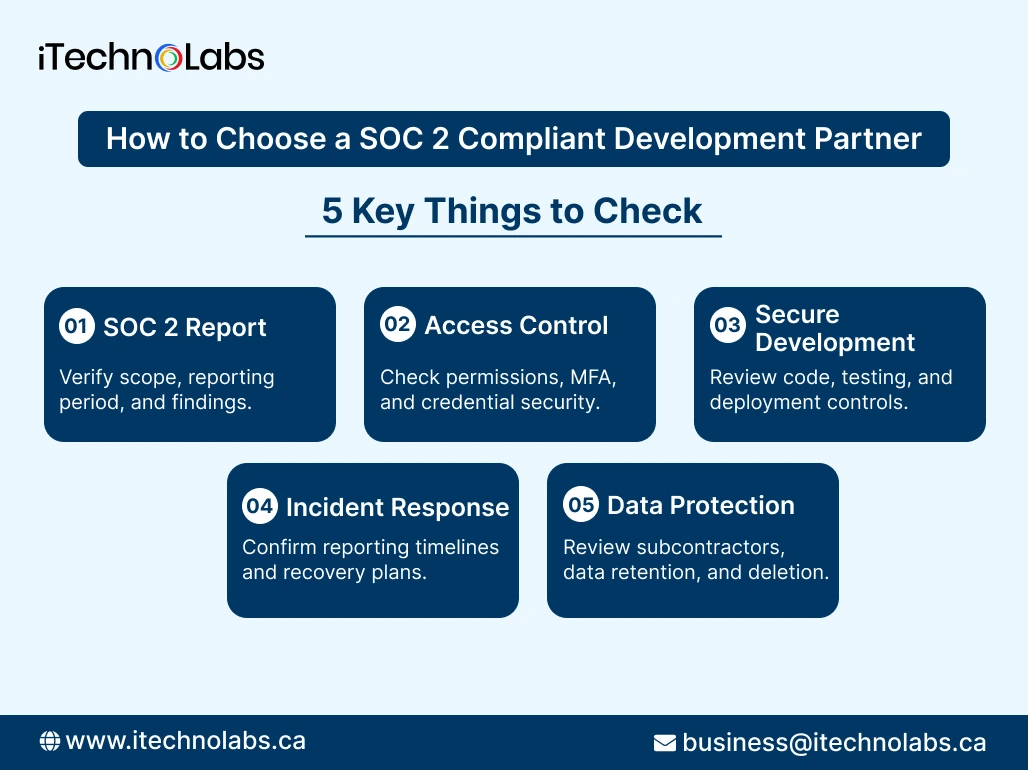
What Should a SOC 2 Compliant Development Company Provide?
Ask prospective partners for evidence that their security practices are documented, implemented, and appropriate to the services they will deliver.
1. A relevant SOC 2 report
SOC 2 is an examination and reporting framework, not a general certification that automatically makes every service or activity compliant. The scope of the report matters because a report may cover specific systems, locations, services, and control activities rather than an entire organization.
Request the report under appropriate confidentiality arrangements. Check the service organization’s name, the systems covered, the relevant Trust Services Criteria, the reporting period, and any exceptions described by the auditor. Ask whether the report covers the actual development team and delivery environment assigned to your project.
2. Clear access management
Access controls are particularly important when external developers work inside an enterprise’s technology environment. A partner may follow good internal practices while still receiving excessive permissions in your systems.
Verify that the partner uses individual accounts, least privilege, multifactor authentication where appropriate, timely access removal, and controlled handling of privileged credentials. Confirm who approves production access and how access is reviewed when team members change roles or leave the engagement.
3. Secure development and change management
Ask how the partner protects the software development lifecycle. Review its approach to peer code reviews, dependency management, vulnerability remediation, automated testing, release approvals, and separation between development and production environments.
A written policy alone does not demonstrate that a control operates effectively. Ask for evidence such as redacted workflow records, sample change approvals, or a walkthrough of the deployment process. Evidence should be shared through an appropriate secure channel.
4. Incident response and business continuity
Establish how the partner identifies, reports, investigates, and resolves security incidents. Confirm the escalation contacts, notification timelines, evidence preservation procedures, and responsibilities for supporting your incident response team.
Also review backup practices, recovery arrangements, service dependencies, and continuity planning where these affect the engagement. Contractual commitments should define responsibilities clearly instead of assuming that the development partner and customer share identical recovery obligations.
5. Subcontractor and data handling controls
Outsourced engineering can create additional risk when project work, infrastructure, or support activities involve other service providers. Your direct development partner may not be the only organization with access to project information.
Request disclosure of relevant subcontractors and understand which parties can access source code, customer data, credentials, and production systems. Review data location, retention, deletion, confidentiality obligations, and approval requirements for introducing new subcontractors.
SOC 2 Type 1 vs. Type 2: What should enterprise buyers check?
A SOC 2 Type 1 report evaluates the description of a service organization’s system and the suitability of control design at a specified point in time. A Type 2 report also evaluates the operating effectiveness of controls over a specified period.
Type 1 can provide useful information about control design, but it does not establish that those controls operated effectively throughout a period. Type 2 provides evidence about operation over its stated examination period, although it does not guarantee that every future activity or project will be free of risk.
For a high access or high impact engagement, ask whether a Type 2 report is available and whether its period and scope match your risk requirements. If the partner has only a Type 1 report, evaluate the gap and request additional evidence of how controls operate in practice.
In either case, review any qualifications, exceptions, complementary user entity controls, and subservice organization arrangements. Determine which controls your own organization must operate to achieve the intended security outcomes.
A Practical Checklist For Evaluating A Development Partner
Use the following checklist during procurement, security review, and technical discovery.
- The SOC 2 report is available for review under appropriate confidentiality terms.
- The report covers relevant systems, services, and delivery activities.
- The reporting period and any exceptions have been reviewed.
- Identity management, privileged access, and account removal processes are documented.
- Code review, vulnerability management, and deployment controls can be demonstrated.
- Incident response contacts and notification responsibilities are defined.
- Subcontractors and material third-party dependencies are disclosed.
- Data retention, deletion, and access requirements are documented.
- Contract terms address confidentiality, security responsibilities, and incident cooperation.
- Evidence gaps have named owners and agreed remediation dates.
A partner that answers detailed questions clearly and provides relevant evidence gives your security team a stronger basis for assessment than a partner that relies on broad assurances.
How To Compare Security Evidence Across Development Partners
Score each candidate against the same requirements so the evaluation is consistent. A simple internal scorecard can use three outcomes: verified, partially verified, and not verified.
| Evaluation area | Evidence to request |
| SOC 2 scope | Report, covered systems, services, and examination period |
| Access security | Access policy, approval workflow, account review evidence |
| Secure development | Code review and release process walkthrough |
| Incident management | Response plan, escalation contacts, contractual notification terms |
| Third-party risk | Subcontractor inventory and access responsibilities |
| Data lifecycle | Retention, deletion, location, and transfer requirements |
| Contractual accountability | Security addendum, confidentiality terms, remediation commitments |
This scorecard is an evaluation aid, not a substitute for a formal audit or legal review. A missing report or unresolved control gap should trigger further assessment rather than an automatic assumption that the partner is unsafe. Your organization’s risk tolerance and the sensitivity of the project determine what evidence is sufficient.
What This Means When Evaluating iTechnolabs
The supplied iTechnolabs company information lists ISO 27001:2013 and ISO 9001:2015 certifications, alongside software development, AI development, and cloud and DevOps services. These credentials are distinct from a SOC 2 report.
Enterprise buyers should evaluate those credentials in the context of the specific project, delivery team, architecture, and contractual requirements. An ISO certification should not be presented as proof that a company holds a SOC 2 report, and neither credential should replace a review of relevant controls.
Before making any SOC 2-related claim about iTechnolabs, the team should confirm whether a current SOC 2 report exists and whether it covers the proposed services. If it does not, the content should describe only verified security credentials and explain that customers can discuss their specific security requirements during technical discovery.
Conclusion
Choosing a SOC 2 compliant development company requires more than checking a compliance claim. Enterprise CTOs and IT directors need to verify the scope of available audit reports, assess security controls across the software development lifecycle, and understand how the partner manages access, subcontractors, incidents, and sensitive data.
The right development partner should be able to explain its security practices clearly, provide relevant evidence, and define responsibilities before work begins. Remember that SOC 2 reporting, ISO certification, and project-specific security controls serve different purposes. Evaluate each against your organization’s risk requirements rather than treating any single credential as a guarantee of security.
Before committing to a development engagement, identify your mandatory security requirements, document any evidence gaps, and agree on how those gaps will be addressed.
FAQs
1. What is a SOC 2-compliant development company?
A SOC 2-compliant development company is generally understood to be a software development provider whose relevant systems and controls have been examined under the SOC 2 framework. Buyers should verify the report, its scope, and its findings rather than relying on the phrase alone. SOC 2 is a reporting framework, not a blanket certification.
2. Is SOC 2 mandatory for software development companies?
SOC 2 is not a universal legal requirement for every software development company. However, an enterprise customer may require a report through procurement policies, contractual terms, or internal risk controls. Whether it is necessary depends on the services involved, the information accessed, applicable obligations, and the customer’s vendor assurance requirements.
3. What is the difference between SOC 2 Type 1 and Type 2?
Type 1 examines control design and the service organization’s system description at a specified point in time. Type 2 also evaluates whether controls operated effectively over a defined period. Neither report guarantees that a supplier will never experience an incident, so buyers should review scope, exceptions, and continuing security practices.
4. What should I check in a SOC 2 report?
Review the service organization’s identity, covered systems, relevant Trust Services Criteria, reporting period, auditor’s opinion, and any exceptions. Also identify complementary user entity controls and subcontractor arrangements. Confirm that the report applies to the team and services involved in your project, and arrange secure access to the report where confidentiality restrictions apply.
5. What if a development partner does not have a SOC 2 report?
Determine whether the report is a mandatory procurement condition or whether alternative evidence can be considered. Request documented security policies, control walkthroughs, relevant independent assessments, and contractual commitments. Escalate any gaps to your security and procurement teams, document the residual risk, and approve the engagement only through your organization’s established risk process.
6. How can I verify that a development partner’s controls cover my project?
Compare the report’s system description with the planned engagement, including the assigned team, repositories, infrastructure, data flows, and subcontractors. Ask the partner to identify any services or activities outside the report’s scope. Where gaps remain, request additional evidence and agree on project-specific safeguards before granting access.
7. What security questions should I ask during a technical discovery call?
Ask who can access your systems, how credentials are protected, how code changes are reviewed, how vulnerabilities are handled, and how incidents are reported. Discuss subcontractors, data retention, production access, and termination procedures as well. Request evidence for material claims and record any outstanding requirements, owners, and target dates.











